Your ecosystem crossed chains. Your experience should too.
Build an asset bridge that feels like part of your product. Passage Bridge gives technical teams a connected starting point for route quotes, approvals, execution and transfer tracking—with direct access to the engineer behind it.
Tech stack
Solidity
EVM
Foundry
React / Vue
TypeScript
Solidity bridge contracts connect Ethereum Virtual Machine (EVM) transfer workflows with independent message approval, relayer execution and TypeScript backend services, supported by Foundry tests.
Architecture and delivery, directly with the builder
Your direct engineering partner
What comes with your head start
Source, validation and setup, assembled around your selected modules.
React bridge DApp and Vue operator source
Solidity bridge contracts and shared interfaces
NestJS API, independent Indexer and Relayer
Deployment definitions, configuration and recovery guides
A DELIVERY SCENARIO
Protocol teams & cross-chain infrastructure builders
From a bridge backlog to a connected transfer journey.
A technical team wants a branded bridge for selected EVM routes. Start with quotes, independent approval, execution and transfer tracking, then shape liquidity and operations for those routes.
Focus specialist engineering on the networks and operating model.
CLIENT FEEDBACK
“Working directly with the engineer made bridge development a completely different experience. Clear responsibilities for approvals, the relayer and transfer tracking let our team focus on making liquidity and the user experience on our target networks the best they could be.”
— Technical lead at a Web3 infrastructure team
Your brand. Your source package.
Choose the product modules, branding and integrations around your launch.
A handover your team can use.
Walk through setup, the codebase and release checks directly with Fone.
A partner for the next chapter.
Add ongoing maintenance and iteration support as your product grows.
An independent approver authorizes the transfer message.
03
Execute the route
The Relayer executes an approved destination payment.
04
Reconcile operations
Track messages, receipts, inventory and recovery tasks.
LESS REBUILDING. MORE BUSINESS.
Your next move starts further ahead.
THE OLD WAY
The build before the business.
Users leave your product to move their assets. Your team starts another build: quotes, signatures, approvals, destination execution and the inevitable “where is my transfer?” screen.
THE FONE WAY
Start with a working foundation.
Start with Passage Bridge’s connected transfer journey. Build around your routes and brand, then work directly with Fone on the approval and operational model.
YOUR RETURN
Put your time where it pays.
Spend your engineering capacity on the networks, liquidity and operations that define your bridge. Keep the transfer journey inside your own ecosystem.
FROM FIRST CLICK TO BUSINESS OUTCOME
See the business take shape.
Explore the real product, one customer moment at a time. Screens show a demo workspace with sample data.
THE BUSINESS IN ACTION / 01
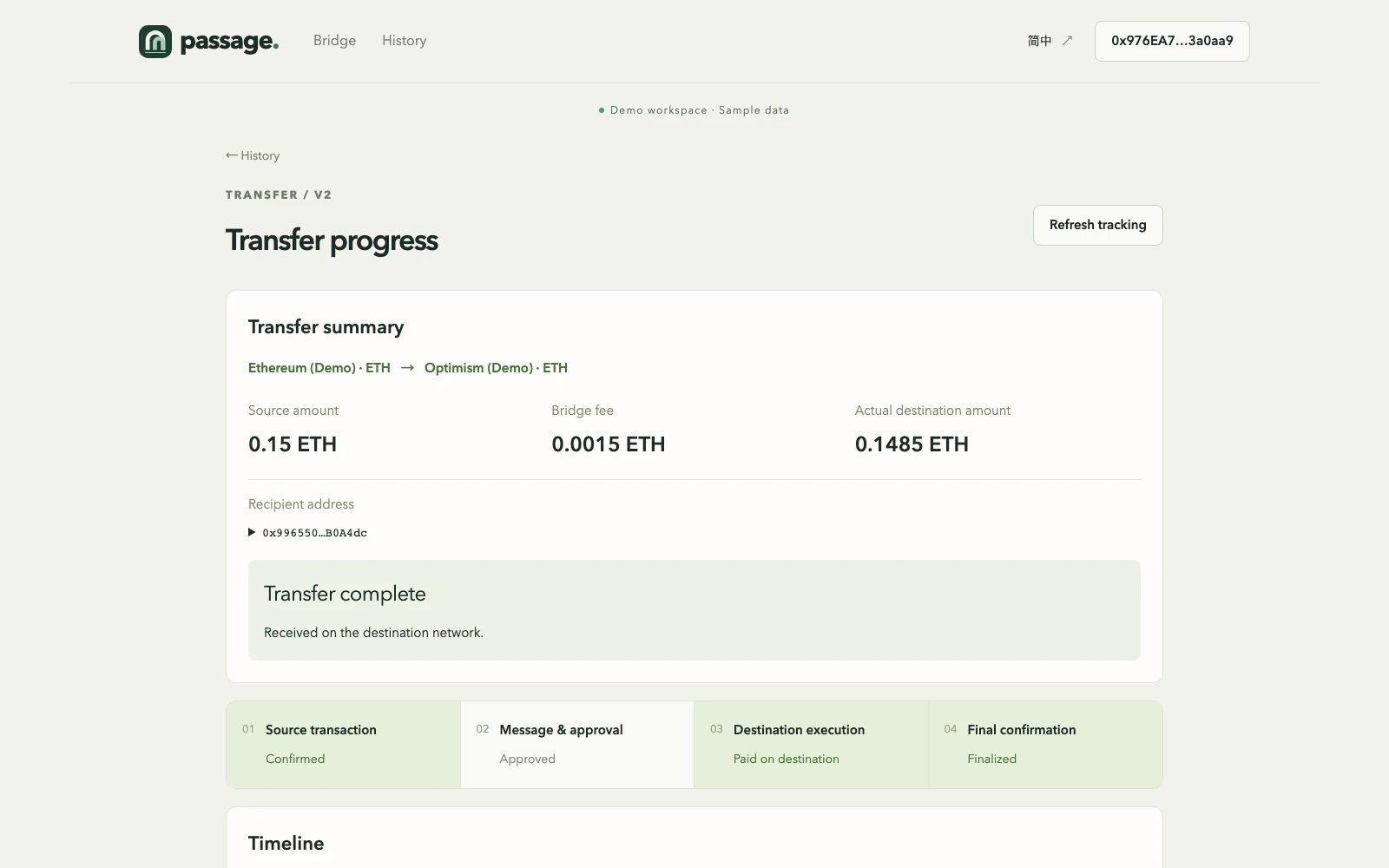
Make the destination feel within reach.
Give the user a clear completed-transfer outcome under your brand. Keep the destination and received amount easy to find.
Make the destination feel within reach. View the full interface
THE BUSINESS IN ACTION / 02
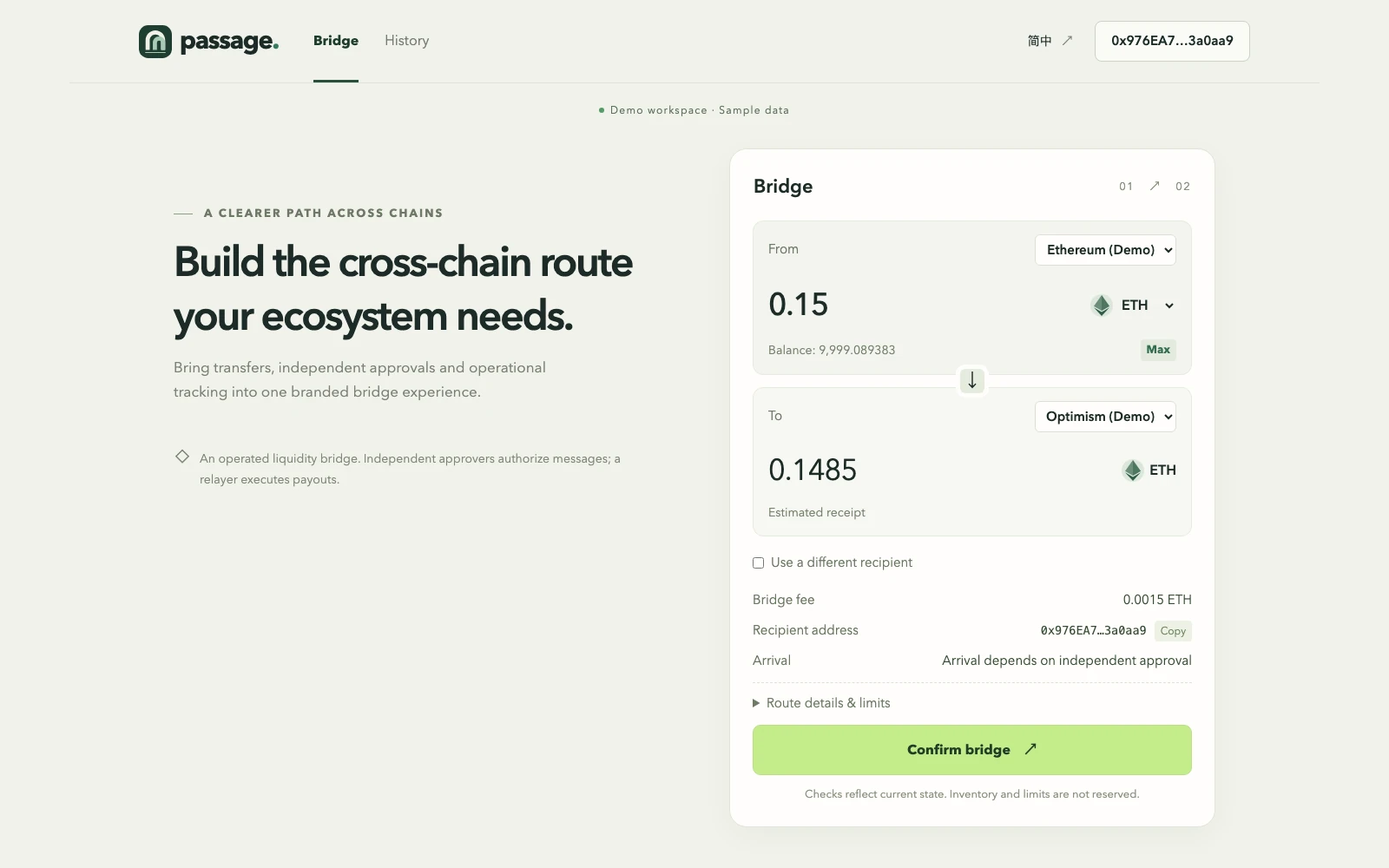
Help users decide before they sign.
Bring route, amount and fees into the quote. Let users review the journey before committing their assets.
Help users decide before they sign. View the full interface
THE BUSINESS IN ACTION / 03
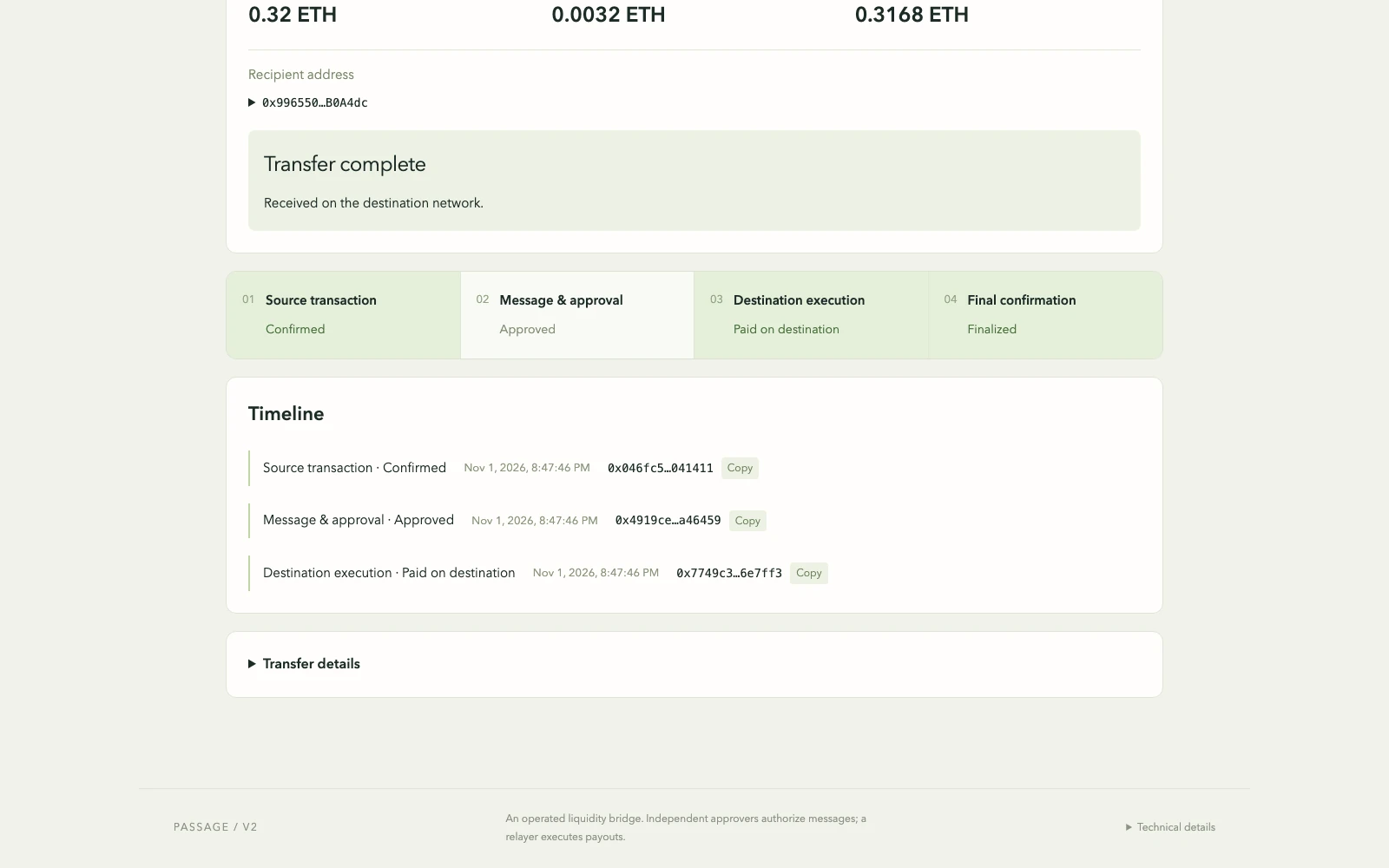
Answer “where is my transfer?” in the product.
Follow initiation, approval, execution and finality as distinct steps. Make waiting understandable instead of sending users looking for answers.
Answer “where is my transfer?” in the product. View the full interface
THE BUSINESS IN ACTION / 04
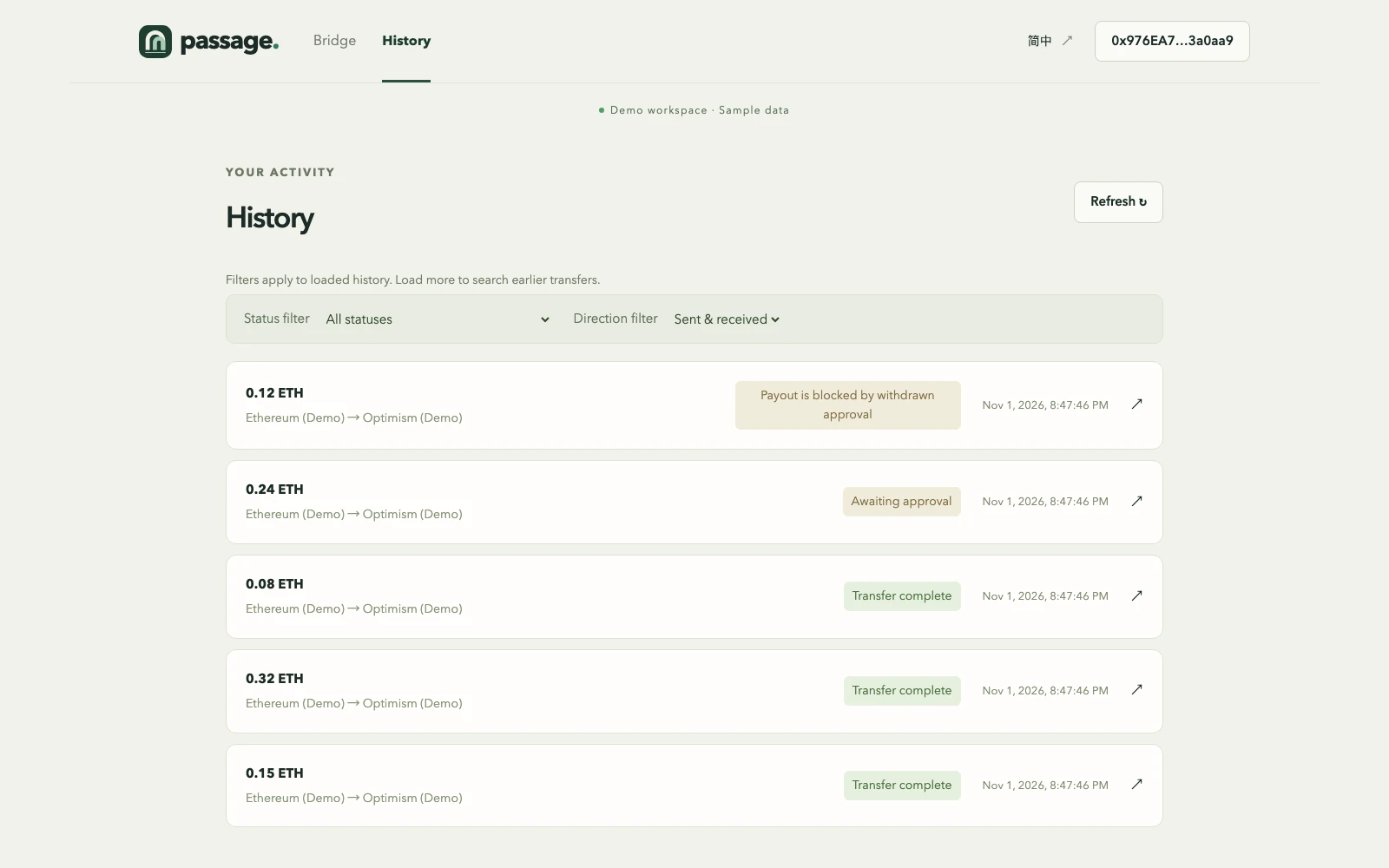
Keep every journey easy to find again.
Bring completed and in-progress transfers into one history. Give returning users and support a shared starting point.
Keep every journey easy to find again. View the full interface
BUSINESS MODEL
Operate an asset route your team understands
01
Price the transfer service
Design route fees around destination liquidity, rebalancing, network execution and support. Give users a clear quote and the team a defined operating model.
02
Deliver dedicated infrastructure
Build a branded route for your ecosystem or an integration for a business partner. Scope the source, signing infrastructure and operating procedures around that use case.
03
Expand route by route
Add networks and operational automation as your requirements grow. Evaluate each new route’s asset behavior, liquidity and execution needs before launch.
Start with source delivery and brand customization. Add maintenance when you need it, and shape your own customer pricing and operating model.
BUILT BY FONE / 0xF1
Know who’s building your advantage.
0xF1
Built by 0xF1. Delivered with you.
Work directly with Fone, the independent engineer behind this product. Discuss the business, review the code and shape the release with the same person.
The supplied two-chain walkthrough follows source initiation, independent approval and destination execution. Solidity and Foundry provide the contract development foundation.
Solidity · Foundry · EVM
SEE IT BEFORE YOU BUILD
Follow a workflow. Ask the hard questions.
Use these product screens as the start of a live walkthrough. Review source, business flows and verification records with the person who built them.
Adapt branding, language, transfer entry points, recipient history and support flows to your product.
02
Your networks and operating model
Assess named networks and assets, fees, liquidity budgets, approval responsibilities and monitoring.
03
Your production execution plan
Scope production signing, multisig operation, RPC infrastructure and external review separately, with target-network acceptance before release.
SEE THE PRODUCT IN ACTION
See the workflow. Talk to the builder.
The refreshed DApp captures follow a transfer across the quote, approval, execution and final-confirmation stages. Open the timeline and history to see how the product communicates progress.
Walk through the product with Fone, then map the brand, modules and integrations your business needs.
Demo environment & implementation details
Passage is an operated liquidity bridge. These captures use an isolated two-chain environment; the existing operations console is outside this capture set. The current signing runner is local-only. Production signing, liquidity operations, source licensing and network acceptance are implementation work.
Screens captured on 30 October 2026. Source snapshots, reproduction steps and product verification records are available for the technical walkthrough.
Go deeper with the engineering notes
Explore the decisions behind these workflows before planning your own integration.
React DApp and Vue operations console modules for transfer tracking and role-based operational work.
02
The cross-chain engineering stack
Solidity contracts, Nest API, separate Indexer and Relayer services, MySQL / Redis and shared API / deployment definitions. Source licensing must be confirmed before handover.
03
A scoped implementation package
Agree configuration, deployment and recovery instructions, role responsibilities, historical evidence and acceptance criteria for the selected environment.
Choose the modules for your first release. We’ll put source access, licenses, setup, handover and optional support into one clear proposal.
Planning your Passage Bridge business
Who is this product for?
Technical teams with signing and liquidity operations. Build an asset-transfer service for your multichain product. Reuse the transfer interface, independent approvals and operations workflow while defining your networks and liquidity model.
No. It relies on independent message approval and destination liquidity. Approver responsibilities, signer control and operating procedures are part of the service design.
Can we enable production by changing a setting?
No. The current signing runner is restricted to the local environment. Production execution, key management, network behavior and external security review need a separately agreed implementation and acceptance scope.
Can any network or token be connected?
The historical local routes model Ethereum, Optimism and Base with ETH, WETH and a standard ERC-20. New networks, token behavior and real external bridge services require individual integration and validation.
Can I launch under my own brand with the source code?
Yes. Build your branded version around the agreed modules: React bridge DApp and Vue operator source; Solidity bridge contracts and shared interfaces; NestJS API, independent Indexer and Relayer. The proposal specifies repository access, commercial-use licensing, setup documentation, available tests and deployment materials, plus the handover with Fone. Third-party components retain their own licenses; exclusive IP transfer, if needed, is agreed separately.
What determines launch timing and ongoing costs?
Start with your source and destination networks, asset routes, approval roles, signing and liquidity operations. Fone maps the reusable modules and integrations into a first-release plan with milestones, workflow tests and deployment checks. The launch date follows that scope and any separately arranged security review. Budget for relayer hosting, RPC, monitoring and transaction fees; destination liquidity needs its own operating budget. Maintenance and further development are optional, with their scope and price agreed separately.
Passage Bridge / FONE
Start with the route. Build for the operation.
Share your networks, assets and operational setup. Work directly with Fone on the bridge architecture, approval model and deployment path.