In the day-to-day operation of Web3 memberships, SaaS NFT passes, and paid creator communities, technical teams often face an almost inevitable crisis of community trust.
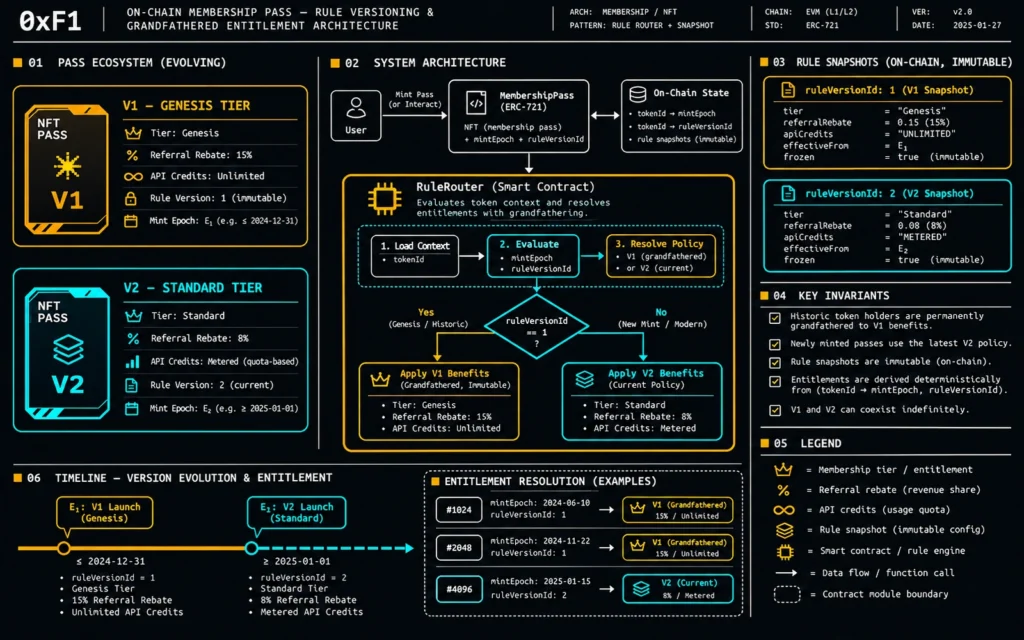
At launch, the team offers a “V1 Genesis Pass” to attract its first 500 users. Holders are promised permanent free access to every feature and lifetime referral commissions of up to 15%. Six months later, the product has grown, and the team changes its monetization strategy: new users receive a “V2 Standard Pass” with an 8% referral rate and monthly limits on advanced API calls.
But the developers originally hardcoded entitlements—rebate rates and usage limits—in a single global contract variable, or made the centralized backend read one unversioned database configuration. When operations changes the referral rate to 8%, users who paid a substantial price for V1 Genesis cards discover that their referral rate has also fallen to 8%, erasing the promised lifetime benefits in one update.
The community erupts. Early supporters accuse the project of unilaterally breaking its agreement and defrauding them. Long-term brand credibility disappears overnight.
For on-chain digital entitlements, “code is law” is an engineering constraint, not a slogan. Teams need to adapt business rules to the market without breaking commitments to early users. Using production practices from NOVA Membership, this article explains an entitlement-grandfathering architecture based on Rule Versioning and irreversible snapshots.
1. The Traditional NFT Pass Dead End: Coupling Ownership to Rule Interpretation
Most Web3 membership implementations exhibit one of two antipatterns:
+----------------------------------------------------------------------------------------------------+
|                             Two Vulnerable Membership Antipatterns                                 |
+----------------------------------------------------------------------------------------------------+

   [ Antipattern A: Global Off-Chain Database Resolution ]
   User holds NFT (TokenId: #12) ──> Backend authorization ──> SELECT referral_bps FROM membership_configs
   [Critical flaw]: One global configuration means every rule change downgrades historical holders too.

   --------------------------------------------------------------------------------------------------

   [ Antipattern B: Entitlements Hardcoded in NFT Storage ]
   TokenId #12: { holder: 0xAlice, discountBps: 1500, maxCredits: 999999 }
   [Critical flaw]: If the platform adds "priority AI voice inference," old cards have a fixed storage layout
   that cannot accommodate the new field; upgrading requires burning and reminting thousands of cards at enormous gas cost.
+----------------------------------------------------------------------------------------------------+
To escape the choice between “change everyone at once” and “no extensibility,” modern membership systems must structurally separate Ownership from the Rule Engine:
- NFT asset layer (ERC-721): Records only TokenId ownership, the
mintTimestamp, and the boundruleVersionId; - Rule Registry: Maintains an immutable state machine with multiple policy versions. New versions can be published, while historical versions remain permanently immutable and auditable on-chain for early holders.
2. NOVA Membership’s Three-Layer Versioning Architecture
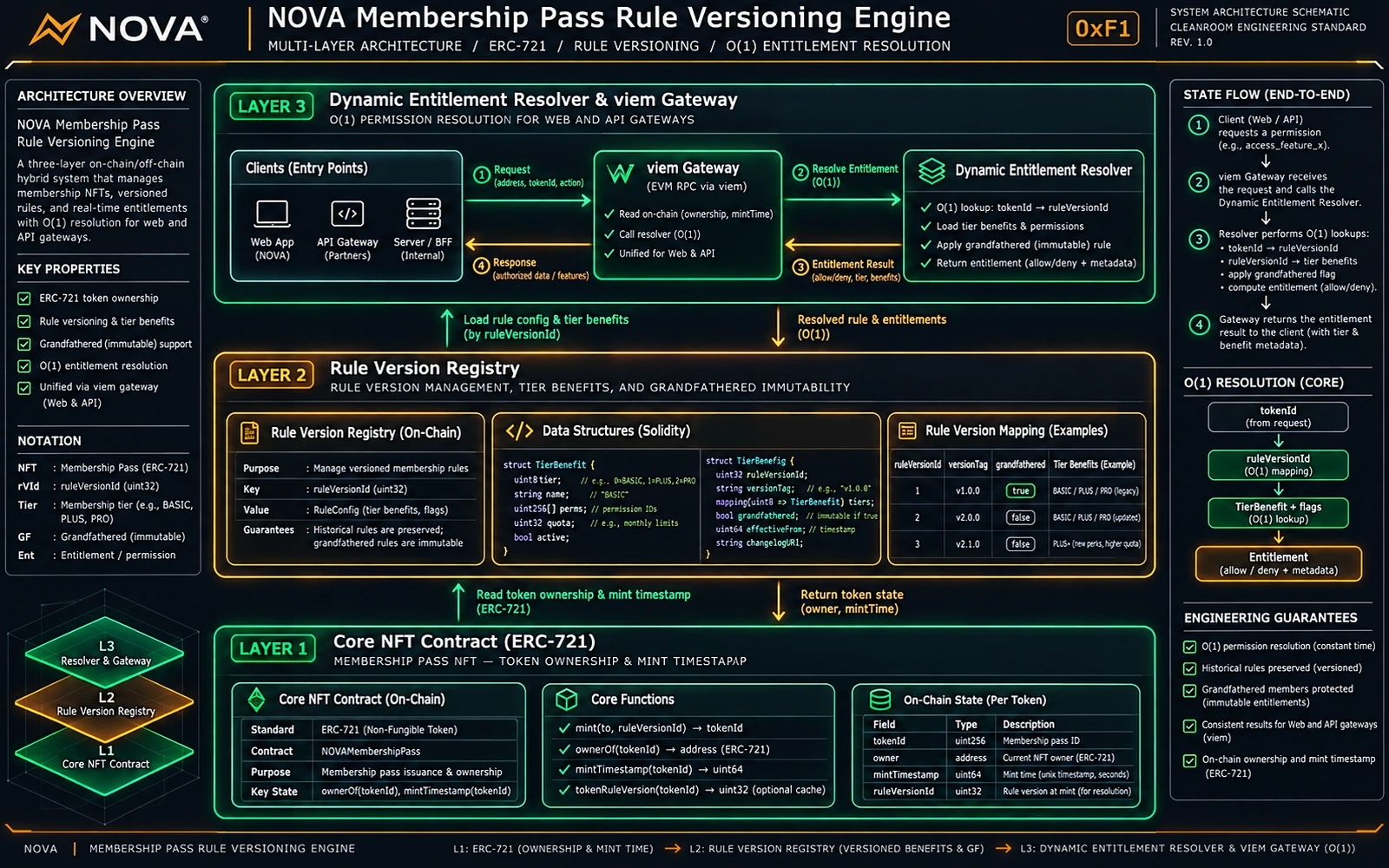
NOVA Membership uses rule snapshots to enforce protection of historical benefits:
+----------------------------------------------------------------------------------------------------+
|                                 NOVA Membership Rule Versioning                                    |
+----------------------------------------------------------------------------------------------------+

   [ Layer 1: NFT Pass Core Contract (NovaPassNFT.sol) ]
   TokenId #1 (V1 Genesis) ─── snapshot binding ──> ruleVersionId = 1 (minted 2026-01)
   TokenId #888 (V2 Standard) ── snapshot binding ──> ruleVersionId = 2 (minted 2026-06)
                                   │
                                   ▼
   [ Layer 2: Rule Version Registry (PassRuleRegistry.sol) ]
   ├── Version 1 (V1 Genesis Rules - sealed, immutable):
   │     ├── referralRebateBps: 1500 (15%)
   │     ├── isUnlimitedCredits: true
   │     └── tierLabel: "Genesis Founder"
   │
   └── Version 2 (V2 Standard Rules - currently active):
         ├── referralRebateBps: 800 (8%)
         ├── isUnlimitedCredits: false (monthly quota: 5,000 calls)
         └── tierLabel: "Standard Member"
                                   │
                                   ▼
   [ Layer 3: Dynamic Entitlement Resolver (EntitlementResolver.sol / viem Gateway) ]
   Gateway input: (tokenId: #1)
   Resolution:
     1. Read tokenId #1's ruleVersionId -> 1
     2. Query the sealed Version 1 configuration directly
     3. Output: Lifetime 15% referrals + unlimited quota (Grandfathered Invariant enforced!)
+----------------------------------------------------------------------------------------------------+
3. Core Solidity Implementation: PassRuleRegistry.sol
The following production contract implementation shows rule registration, irreversible sealing, version binding at mint time, and entitlement resolution:
// nova-membership/contracts/src/PassRuleRegistry.sol
// SPDX-License-Identifier: MIT
pragma solidity ^0.8.20;

import "@openzeppelin/contracts/access/Ownable2Step.sol";

error RuleVersionNotFound(uint256 versionId);
error RuleVersionSealed(uint256 versionId);
error InvalidRebateBps(uint256 bps);

contract PassRuleRegistry is Ownable2Step {
    struct MembershipRule {
        uint256 referralRebateBps;  // Referral rebate basis points (1500 = 15%)
        uint256 monthlyQuota;       // Monthly quota (0 means unlimited usage)
        bool isUnlimited;           // Whether usage is unlimited
        bool isSealed;              // Whether permanently sealed (strict grandfathering guarantee)
        string tierLabel;           // Entitlement tier label
        uint64 publishedAt;         // Publication timestamp
    }

    // versionId => Rule configuration
    mapping(uint256 => MembershipRule) public rules;
    uint256 public activeRuleVersion;
    uint256 public totalRuleVersions;

    event RulePublished(uint256 indexed versionId, uint256 rebateBps, bool isUnlimited, string tierLabel);
    event RuleSealedPermanently(uint256 indexed versionId);
    event ActiveRuleSwitched(uint256 indexed previousVersion, uint256 indexed newVersion);

    constructor(address initialOwner) Ownable(initialOwner) {}

    /**
     * @notice Publish a new entitlement rule version (must pass sandbox simulation first)
     */
    function publishNewRuleVersion(
        uint256 referralRebateBps,
        uint256 monthlyQuota,
        bool isUnlimited,
        string calldata tierLabel
    ) external onlyOwner returns (uint256 versionId) {
        if (referralRebateBps > 5000) revert InvalidRebateBps(referralRebateBps); // 50% maximum

        totalRuleVersions++;
        versionId = totalRuleVersions;

        rules[versionId] = MembershipRule({
            referralRebateBps: referralRebateBps,
            monthlyQuota: monthlyQuota,
            isUnlimited: isUnlimited,
            isSealed: false,
            tierLabel: tierLabel,
            publishedAt: uint64(block.timestamp)
        });

        emit RulePublished(versionId, referralRebateBps, isUnlimited, tierLabel);
    }

    /**
     * @notice Core protection: permanently seal a rule version to prevent later administrative changes
     */
    function sealRuleVersionPermanently(uint256 versionId) external onlyOwner {
        MembershipRule storage rule = rules[versionId];
        if (rule.publishedAt == 0) revert RuleVersionNotFound(versionId);
        if (rule.isSealed) revert RuleVersionSealed(versionId);

        rule.isSealed = true;
        emit RuleSealedPermanently(versionId);
    }

    /**
     * @notice Make a published version the global default for new mints
     */
    function setActiveVersion(uint256 versionId) external onlyOwner {
        if (rules[versionId].publishedAt == 0) revert RuleVersionNotFound(versionId);
        uint256 oldVersion = activeRuleVersion;
        activeRuleVersion = versionId;

        emit ActiveRuleSwitched(oldVersion, versionId);
    }

    /**
     * @notice External query: resolve the values of any rule version
     */
    function getRuleDetails(uint256 versionId) external view returns (MembershipRule memory) {
        MembershipRule memory rule = rules[versionId];
        if (rule.publishedAt == 0) revert RuleVersionNotFound(versionId);
        return rule;
    }
}
// nova-membership/contracts/src/NovaPassNFT.sol (excerpt)
// SPDX-License-Identifier: MIT
pragma solidity ^0.8.20;
import "@openzeppelin/contracts/token/ERC721/ERC721.sol";
import "./PassRuleRegistry.sol";
contract NovaPassNFT is ERC721 {
PassRuleRegistry public immutable ruleRegistry;
// tokenId => Historical rule version bound at mint time
mapping(uint256 => uint256) public tokenRuleVersions;
uint256 public nextTokenId;
event PassMintedWithVersion(uint256 indexed tokenId, address indexed recipient, uint256 indexed ruleVersionId);
constructor(address _registry) ERC721("Nova Membership Pass", "NOVAPASS") {
ruleRegistry = PassRuleRegistry(_registry);
}
/**
* @notice Mint a pass: atomically bind the currently active rule version
*/
function mintPass(address to) external returns (uint256 tokenId) {
uint256 currentActiveVersion = ruleRegistry.activeRuleVersion();
require(currentActiveVersion > 0, "NO_ACTIVE_RULE");
tokenId = ++nextTokenId;
_mint(to, tokenId);
// Core invariant: immutably bind tokenId to the current ruleVersionId
tokenRuleVersions[tokenId] = currentActiveVersion;
emit PassMintedWithVersion(tokenId, to, currentActiveVersion);
}
/**
* @notice Resolve a holder's effective entitlements in O(1) time
*/
function resolvePassEntitlements(uint256 tokenId) external view returns (
address currentHolder,
uint256 boundVersionId,
PassRuleRegistry.MembershipRule memory rule
) {
currentHolder = ownerOf(tokenId);
boundVersionId = tokenRuleVersions[tokenId];
rule = ruleRegistry.getRuleDetails(boundVersionId);
}
}4. Paid Opt-in Upgrades and State Migration
Existing users may welcome new rules. For example, V3 might lower referral commissions from 15% to 12% while adding free access to a physical incubator space.
NOVA Membership uses Opt-in Upgrades, with no forced migration:
- Default Grandfathered: Without any on-chain interaction, an existing holder’s card stays on V1 permanently, with no entitlement downgrade;
- Explicit Opt-in: A holder who wants the new privileges can call
upgradePassRuleVersion(tokenId, targetVersionId). After paying the price difference or burning the required points, the boundtokenRuleVersions[tokenId]advances to the new version.
+----------------------------------------------------------------------------------------------------+
|                              Voluntary Upgrades and Entitlement Migration                          |
+----------------------------------------------------------------------------------------------------+

   [ Existing holder Alice (TokenId #10, bound to Rule V1) ]
                  │
                  ├── Scenario A: No action ──> Keep V1 Genesis benefits forever (15% referrals + unlimited quota)
                  │
                  └── Scenario B: Wants V3's new physical-space benefits
                            │
                            ▼
                  Call upgradePassRuleVersion(10, 3)
                            │
                            ├── Check targetVersion > currentVersion
                            ├── Pay the upgrade difference or burn points
                            │
                            ▼
                  tokenRuleVersions[10] transitions to 3
                  (The user controls the upgrade, with zero contract-fraud risk)
+----------------------------------------------------------------------------------------------------+
5. Comparison: Global Configuration, Static Attributes, and Versioned Rules
The three entitlement-management approaches differ in flexibility, contractual protection, and extensibility:
| Dimension | A: Centralized / Single Global Variable | B: Attributes Fixed in NFT Storage at Mint | C: NOVA Rule Version Registry |
|---|---|---|---|
| Historical commitments | Very poor (global edits downgrade everyone and provoke disputes) | Good (immutable on-chain values) | Excellent (independently sealed versions protect historical benefits in code) |
| Adding future benefits | Easily creates confusion; cannot segment by issuance cohort | Unsupported (fixed storage layout cannot add fields) | Excellent (publish a new RuleVersion structure for smooth forward compatibility) |
| Gas for version changes | Low | Very high (every upgrade requires burning and reminting all old cards) | Very low (publish one lightweight version structure, with no per-card migration) |
| Upgrade choice | Users must accept the team’s changes | No upgrades possible | User-selected paid or conditional Opt-in upgrades |
| On-chain authorization performance | Requires centralized API assembly | Multiple cold storage-slot reads | One read-only RPC resolves the complete entitlement structure |
6. Connecting Prepublication Simulation and Anti-Sybil Referrals
Rule versioning supports the wider Web3 growth system:
- Integration with the prepublication simulation sandbox: Before calling
publishNewRuleVersionon-chain, operations and actuarial teams must run the new rules against tens of thousands of historical user profiles in the Rule Simulation architecture, ensuring that new commissions and quotas cannot cause a treasury run or negative returns; - Integration with anti-Sybil referral incentives: When the Sybil-resistant on-chain referral architecture calculates multi-level commissions, it reads the referrer’s card-bound
ruleVersionIdin real time and awards the exact rebate for that tier, turning early-user loyalty into sustained referral growth.
Architecture Consulting and Source-Code Delivery
If you are planning a Web3 paid membership pass, NFT access-control system, or multi-tier creator incentive community with strong retention and long-term value, and want to avoid the technical pitfalls that make later rule changes trigger disputes with existing holders:
- Visit Fone client deliveries and system demos for NOVA Membership card minting, version-publication console, and dynamic entitlement-gate demos;
- Read our 12-Point Engineering and Security Audit for Production Web3 Launches;
- Book a one-to-one technical discussion through the Fone architecture consulting channel for custom support including Foundry contract source, Next.js frontend integration, and rule-version migration plans.