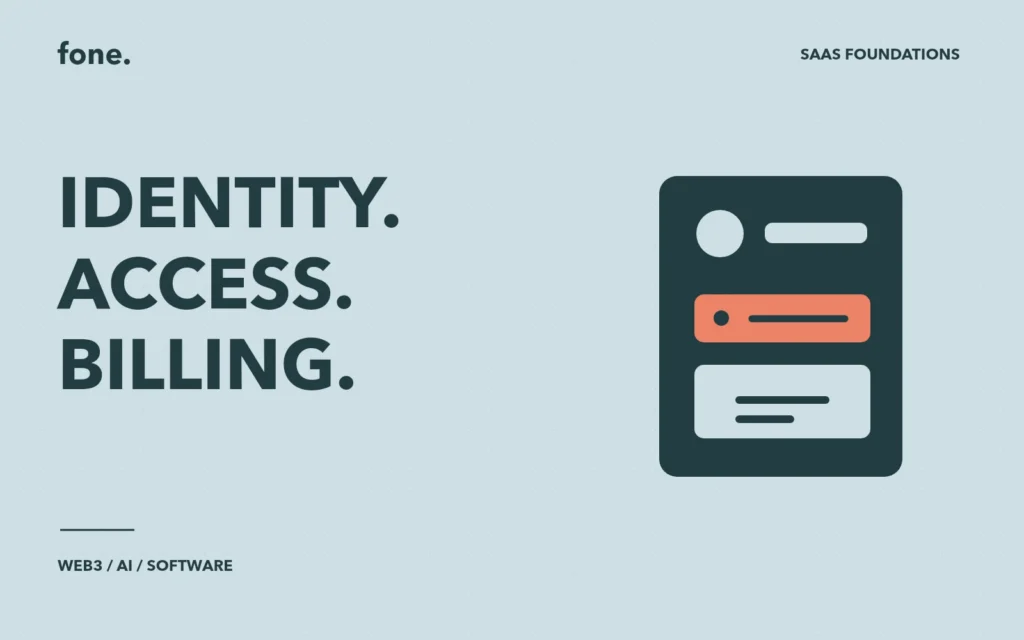
A SaaS product usually needs three separate answers: who is making the request, whether that person may perform the action, and whether the workspace has access to the feature. Keeping these responsibilities explicit makes failures easier to understand and changes easier to test.
Start with a concrete action
Consider exporting a customer report. The user signs in, selects a workspace and clicks Export. Before generating the file, the server should check workspace membership, the permission to export, the workspace’s plan and any usage limit. A hidden button is useful interface feedback, but it cannot be the access check.
| Boundary | Question | Example decision |
|---|---|---|
| Identity | Who is this? | A session maps to an internal user record. |
| Authorization | May they do this here? | This workspace member may export reports. |
| Entitlement | Does this workspace have the feature? | The current plan allows exports. |
| Usage | Is capacity available? | The workspace has exports remaining. |
Write the membership rules before building screens
Define who can invite people, change roles, remove members and transfer ownership. Include what happens when a person belongs to two workspaces. Model the workspace identifier explicitly on protected records. OWASP recommends denying access by default and validating permissions on every request. A useful negative test asks whether a member of workspace A can retrieve a known record from workspace B.
Let billing events update application state
A checkout return page is not a reliable source of payment truth. For Stripe integrations, verify webhook signatures, handle duplicate events and avoid depending on event delivery order. Store enough processing state to retry safely. The application should expose a clear pending state while a payment-related change is being confirmed.
Product decisions still need an owner: how long is a grace period, what happens after cancellation, and can a customer still export their own data? Write these rules down before implementing the event handlers.
Review the unhappy paths
- A removed member still has an open browser tab.
- A subscription update arrives twice.
- A payment succeeds but the customer’s network drops.
- An owner leaves a workspace without a replacement.
- A plan changes while a background export is running.
For each scenario, specify the server decision, the message shown to the user and the recovery action. This small table is often more useful for estimating delivery than a long feature list.
References and next step
See the OWASP authorization guidance and Stripe webhook documentation for implementation requirements. This article is an architecture planning guide, not a complete authentication implementation.
Use the free project brief to capture your workspace and billing rules, or explore full-stack delivery.