In traditional Web2 architecture, login is a simple, closed, nearly linear HTTP exchange: users submit credentials, and the server verifies them and issues a Session Cookie or JWT.
In modern Web3 systems using Sign-In with Ethereum (SIWE / EIP-4361), login becomes an asynchronous distributed state machine spanning the browser DOM, injected extensions such as MetaMask and Rabby, hardware wallets, on-chain RPC nodes, and backend authentication servers.
Most open-source tutorials and scaffolds demonstrate only the Happy Path, which represents less than 10% of wallet-connection behavior:
// Textbook happy-path antipattern: fails as soon as an exception occurs
const { data: signature } = await signMessageAsync({ message: siweMessage });
await api.post('/auth/verify', { signature });
Ignoring the uncontrollable, heterogeneous nature of external wallet extensions leaves more than 90% of DApps with fragile real-world experiences:
- While the signing prompt is open, a user switches MetaMask from Account 1 to Account 2. The private key now belongs to Account 2, but the message still hardcodes Account 1’s address. Server verification fails, and the frontend stays on a loading spinner forever;
- A user selects Reject on a mobile or hardware wallet. The frontend mishandles MetaMask’s
4001/ACTION_REJECTEDcode, deadlocking the UI until a forced refresh; - A user starts login in tab A, then logs out in tab B while waiting to sign. Seconds later, A’s callback writes an expired authentication Token, creating conflicting ghost identities across tabs;
- The signature message’s
nonceexpires, for example after 5 minutes. The server returns a context-free401 Unauthorized, and the frontend has no recovery path to fetch a fresh Nonce automatically.
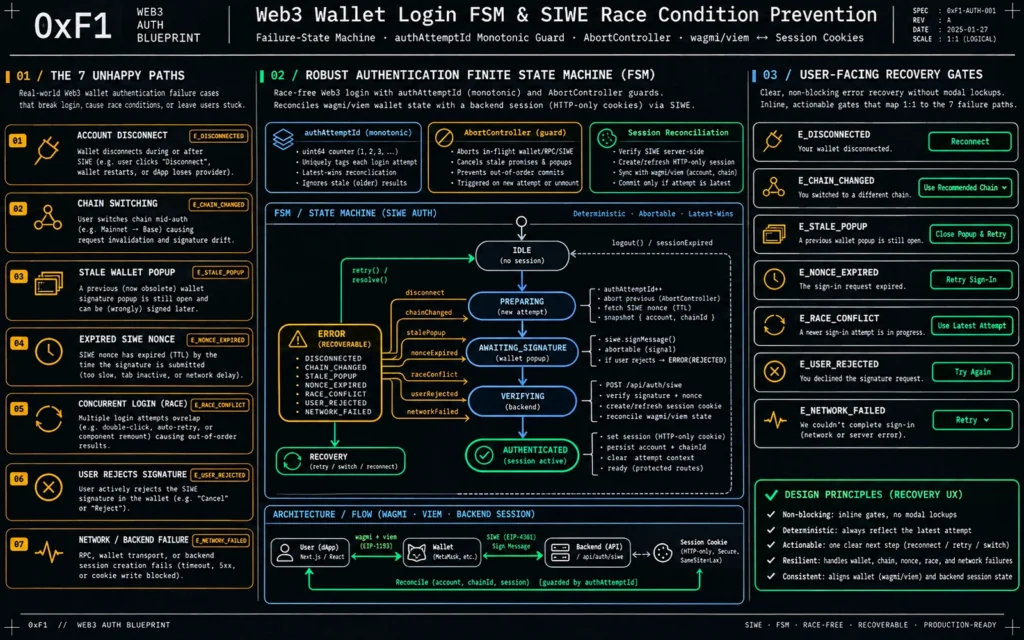
In our early infrastructure article Wallet login: design the failure states first, we established a core rule: design wallet interactions by defining their Failure States first. Drawing on production work in NOVA Membership, this article examines 7 unhappy paths and provides a production solution using TypeScript, wagmi/viem, an authAttemptId generation counter, and a finite state machine (FSM).
Wallet Authentication: Seven Unhappy Paths
A robust SIWE login flow must handle these 7 common production exceptions:
+-----------------------------------------------------------------------------------+
|                         Seven Web3 Wallet Login Unhappy Paths                      |
+-----------------------------------------------------------------------------------+
|  [State 1: IDLE / Initially disconnected]                                           |
|     |                                                                             |
|     +--> [Path 1: Extension missing / Provider lost] -> Offer another wallet or WalletConnect |
|     |                                                                             |
|  [State 2: ACQUIRING_NONCE / Fetching server Nonce]                                  |
|     |                                                                             |
|     +--> [Path 2: Server RPC instability / gateway timeout] -> Exponential backoff, 3 retries maximum |
|     |                                                                             |
|  [State 3: AWAITING_SIGNATURE / Wallet prompt open]                                 |
|     |                                                                             |
|     +--> [Path 3: User cancels / rejects (Error 4001)] -> Clean reset and restore retry |
|     +--> [Path 4: Account changes (accountsChanged race)] -> Abort, invalidate generation |
|     +--> [Path 5: Chain changes (chainChanged race)] -> Abort and request target chain |
|     +--> [Path 6: Nonce expires while prompt remains open] -> Refresh Nonce and request signature again |
|     |                                                                             |
|  [State 4: VERIFYING / Server cryptographic verification]                           |
|     |                                                                             |
|     +--> [Path 7: Concurrent tab login / cross-tab logout conflict] -> BroadcastChannel logout sync |
|     |                                                                             |
|  [State 5: AUTHENTICATED / Final authenticated state]                               |
+-----------------------------------------------------------------------------------+
Comparing Three Wallet Authentication Architectures
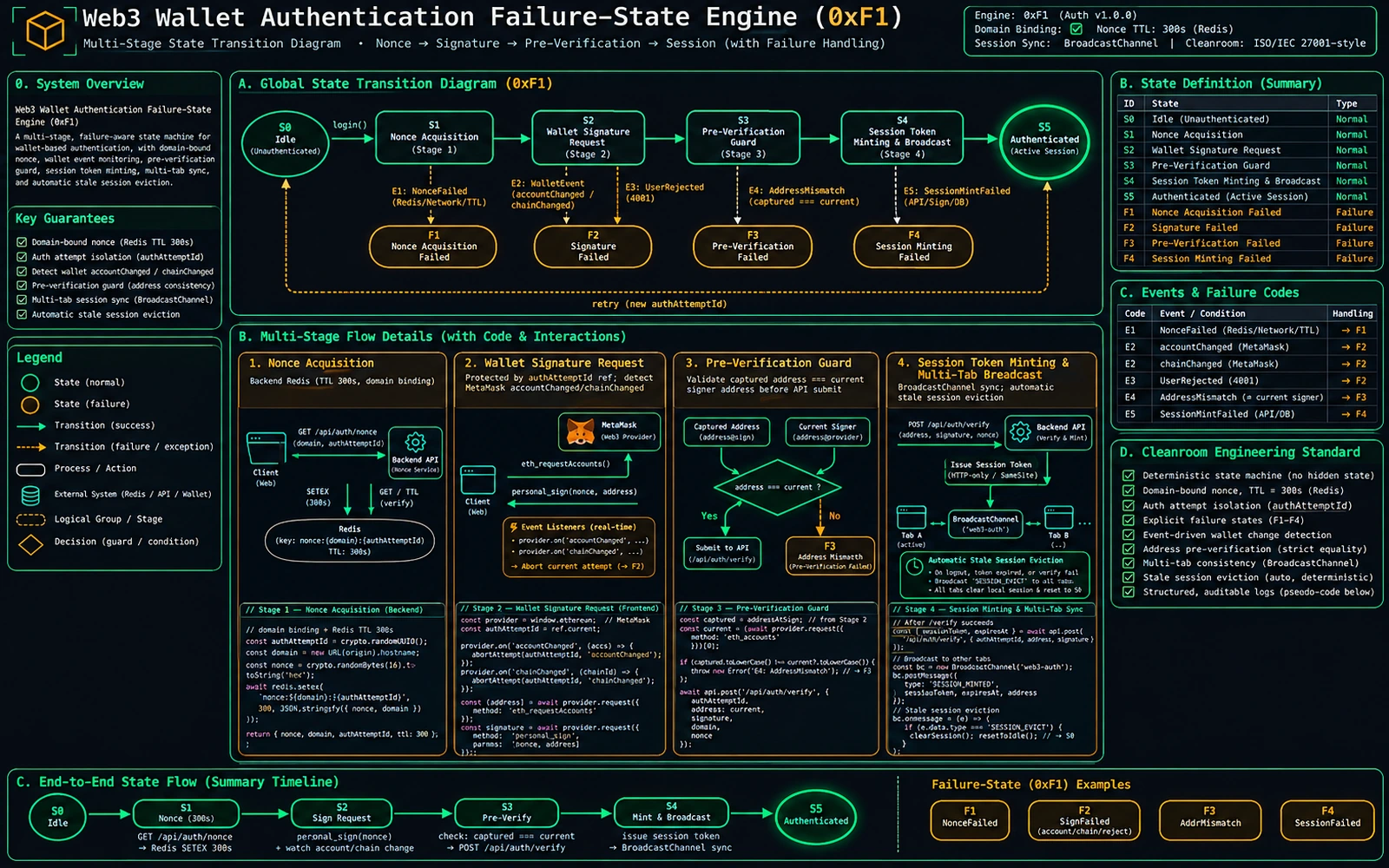
| Dimension | Basic useSignMessage Scaffold |
Common Default RainbowKit/ConnectKit Integration | Fone Failure-State Machine (NOVA) |
|---|---|---|---|
| Account/chain switch defense | 0% (signature/address mismatch) | Weak (may disconnect but cannot neutralize in-flight work) | 100% immunity (authAttemptId generation lock + two physical-state checks) |
| Rejection/cancellation | Can stick at isConnecting: true |
Toast appears, but internal state may lag | Precisely catches ACTION_REJECTED, returns to IDLE with 0 delay |
| Stale-prompt replacement | Multiple overlapping signing prompts | Relies on browser replacement; unexpected errors possible | Make-Before-Break actively cancels pending Promises |
| Cross-tab sessions | Unsupported (A logged in, B still guest) | LocalStorage polling introduces delay | Bidirectional BroadcastChannel sync in milliseconds |
| Clock-skew tolerance | Unclear boundaries; frequent Expired errors | Server-only configuration | Shared 300-second tolerance band and automatic renewal |
Implementation: A Wallet State Machine with Generation Locks
The following excerpts are sanitized from our production membership and permission system (nova-membership/src/hooks/useWalletAuth.ts).
1. Neutralizing Async Races with authAttemptId
After a user clicks “connect and sign,” fetching the Nonce and opening the wallet occur at different times. Rapid double-clicks or an account change while the prompt is open can create two concurrent asynchronous contexts.
The production solution is a monotonically increasing Generation Counter:
// Excerpt from nova-membership/src/hooks/useWalletAuth.ts
import { useRef, useState, useCallback, useEffect } from 'react';
import { useWalletClient, usePublicClient } from 'wagmi';
import { SiweMessage } from 'siwe';

export type AuthState =
  | 'IDLE'
  | 'PREPARING_NONCE'
  | 'AWAITING_SIGNATURE'
  | 'VERIFYING'
  | 'AUTHENTICATED'
  | 'REJECTED'
  | 'SESSION_CONFLICT'
  | 'ERROR';

export function useGuardedWalletAuth() {
  const [state, setState] = useState<AuthState>('IDLE');
  const [errorMessage, setErrorMessage] = useState<string | null>(null);

  const { data: walletClient } = useWalletClient();
  const publicClient = usePublicClient();

  // Core defense: a monotonically increasing generation counter
  const authAttemptId = useRef(0);
  const activeAbortController = useRef<AbortController | null>(null);

  // Destroy in-flight tasks on component unmount or reset
  useEffect(() => {
    return () => {
      authAttemptId.current++;
      activeAbortController.current?.abort();
    };
  }, []);
2. Preflight Checks and Wallet-State Snapshots
Before sending personal_sign to the wallet, capture the current address, chain ID, and Genesis Hash, and start a new generation context:
// Excerpt from nova-membership/src/hooks/useWalletAuth.ts
  const login = useCallback(async () => {
    // 1. Invalidate old in-flight work and create a new generation ID
    authAttemptId.current++;
    const currentGeneration = authAttemptId.current;

    // 2. Abort previous HTTP requests
    activeAbortController.current?.abort();
    activeAbortController.current = new AbortController();
    const signal = activeAbortController.current.signal;

    if (!walletClient || !publicClient) {
      setState('ERROR');
      setErrorMessage('WALLET_NOT_CONNECTED');
      return;
    }

    try {
      setState('PREPARING_NONCE');
      setErrorMessage(null);

      // 3. Capture the initial physical wallet state
      const [initialAddress] = await walletClient.getAddresses();
      const initialChainId = await walletClient.getChainId();

      // Fetch a high-entropy server Nonce, protected by AbortSignal
      const nonceRes = await fetch('/api/auth/nonce', { signal });
      if (!nonceRes.ok) throw new Error('NONCE_ACQUISITION_FAILED');
      const { nonce } = await nonceRes.json();

      // Checkpoint 1: after the network response, check whether this generation was abandoned
      if (currentGeneration !== authAttemptId.current) return;

      // Build the standard EIP-4361 SIWE payload
      const domain = window.location.host;
      const origin = window.location.origin;
      const siwe = new SiweMessage({
        domain,
        address: initialAddress,
        statement: 'Sign in to access Web3 Membership & Portal features.',
        uri: origin,
        version: '1',
        chainId: initialChainId,
        nonce,
        issuedAt: new Date().toISOString(),
        expirationTime: new Date(Date.now() + 5 * 60 * 1000).toISOString(), // Hard 5-minute timeout
      });
      const preparedMessage = siwe.prepareMessage();

      // Enter the awaiting-signature state
      setState('AWAITING_SIGNATURE');

      // Checkpoint 2: before opening the prompt, recheck for account or chain changes
      const [currentAddress] = await walletClient.getAddresses();
      const currentChainId = await walletClient.getChainId();
      if (
        currentAddress.toLowerCase() !== initialAddress.toLowerCase() ||
        currentChainId !== initialChainId
      ) {
        throw new Error('ACCOUNT_OR_CHAIN_CHANGED');
      }

      // Open the external wallet signing prompt
      const signature = await walletClient.signMessage({
        account: initialAddress,
        message: preparedMessage,
      });

      // Checkpoint 3: after signing, recheck the generation and active address
      if (currentGeneration !== authAttemptId.current) return;
      const [postSignAddress] = await walletClient.getAddresses();
      if (postSignAddress.toLowerCase() !== initialAddress.toLowerCase()) {
        throw new Error('ACCOUNT_SWITCHED_DURING_SIGNATURE');
      }

      // Enter server-side credential verification
      setState('VERIFYING');
      const verifyRes = await fetch('/api/auth/verify', {
        method: 'POST',
        headers: { 'Content-Type': 'application/json' },
        body: JSON.stringify({ message: preparedMessage, signature }),
        signal,
      });

      if (!verifyRes.ok) {
        throw new Error('SIGNATURE_VERIFICATION_FAILED');
      }

      // Authentication succeeded; broadcast session state across tabs
      syncChannel.postMessage({ type: 'LOGIN_SUCCESS', address: initialAddress });
      setState('AUTHENTICATED');

    } catch (err: any) {
      // Prevent stale generations from overwriting current UI state
      if (currentGeneration !== authAttemptId.current) return;

      // Identify explicit rejection errors from the wallet prompt
      if (
        err?.code === 4001 ||
        err?.code === 'ACTION_REJECTED' ||
        err?.name === 'UserRejectedRequestError'
      ) {
        setState('REJECTED');
        setErrorMessage('User rejected the signature request.');
        return;
      }

      if (err.message === 'ACCOUNT_SWITCHED_DURING_SIGNATURE' || err.message === 'ACCOUNT_OR_CHAIN_CHANGED') {
        setState('SESSION_CONFLICT');
        setErrorMessage('Wallet account or chain changed during login. Please retry.');
        return;
      }

      setState('ERROR');
      setErrorMessage(err.message || 'AUTHENTICATION_FAILED');
    }
  }, [walletClient, publicClient]);
For a more detailed examination of stale-prompt cancellation during asynchronous generation, see Cancel Stale Wallet Prompts with Async Generation Checks.
3. Real-Time Cross-Tab Session Synchronization (BroadcastChannel)
If login in tab 1 leaves tab 2 showing a guest view, or disconnecting in tab 2 leaves tab 1 authenticated, business state becomes seriously inconsistent.
The browser-native BroadcastChannel enables cross-tab broadcasts within seconds, without server polling:
// Excerpt from nova-membership/src/domain/wallet-state-machine.ts
const syncChannel = new BroadcastChannel('nova_wallet_auth_channel');

export function initMultiTabSessionSync(
  onLogin: (address: string) => void,
  onLogout: () => void
) {
  syncChannel.onmessage = (event) => {
    switch (event.data?.type) {
      case 'LOGIN_SUCCESS':
        onLogin(event.data.address);
        break;
      case 'LOGOUT_SUCCESS':
        onLogout();
        break;
      case 'ACCOUNT_CHANGED':
        // Another tab changed accounts; trigger global revalidation
        onLogout();
        break;
      default:
        break;
    }
  };
}

export function broadcastLogout() {
  syncChannel.postMessage({ type: 'LOGOUT_SUCCESS' });
}
Four Production Rules for Wallet Authentication
Before releasing a login flow for a Web3 business application, membership system, or DApp, verify these requirements:
- Never request a wallet signature without locking the generation: Record the interaction with
authAttemptIdand check its validity at everyawaitboundary so old requests cannot overwrite new state; - Check physical account and network state before and after signing: At prompt invocation and after the signature returns, compare
walletClient.getAddresses()against the message address to prevent account substitution; - Treat rejection properly (Error 4001 / ACTION_REJECTED): A normal cancellation is not a system-wide network failure. Reset to
REJECTEDorIDLEwithin 0 milliseconds and preserve one-click retry; - Use BroadcastChannel for consistent site-wide login state: Broadcast credential changes to all open tabs within milliseconds to prevent conflicts.
Enterprise Web3 Architecture Consulting and Full-Stack Delivery
Fone specializes in Web3 frontends, ERC-4337 smart accounts, high-concurrency membership points, and decentralized business platforms. Alongside code-level security, we use a thoroughly tested production standard for handling interaction failures:
- Explore our full-stack membership, referral, and entitlement platform: NOVA Membership
- Read the original failure-state design approach: Wallet login: design the failure states first
- Review the production-readiness audit: From AI and Web3 Prototype to Production: 12 Engineering and Financial-Security Checks
- Book a system availability and code assessment with a senior Web3 architect: Discuss Custom Requirements with Fone