In traditional Stripe or PayPal card payments, transactions are largely synchronous: the customer clicks Pay, the issuer approves or declines online, and the amount is exact. There is no unusual state where a customer pays $1 too little or the bank charges them 10 minutes after the payment window closes.
In blockchain checkout using multichain stablecoins such as USDC and USDT, however, exceptions and edge cases are routine production conditions:
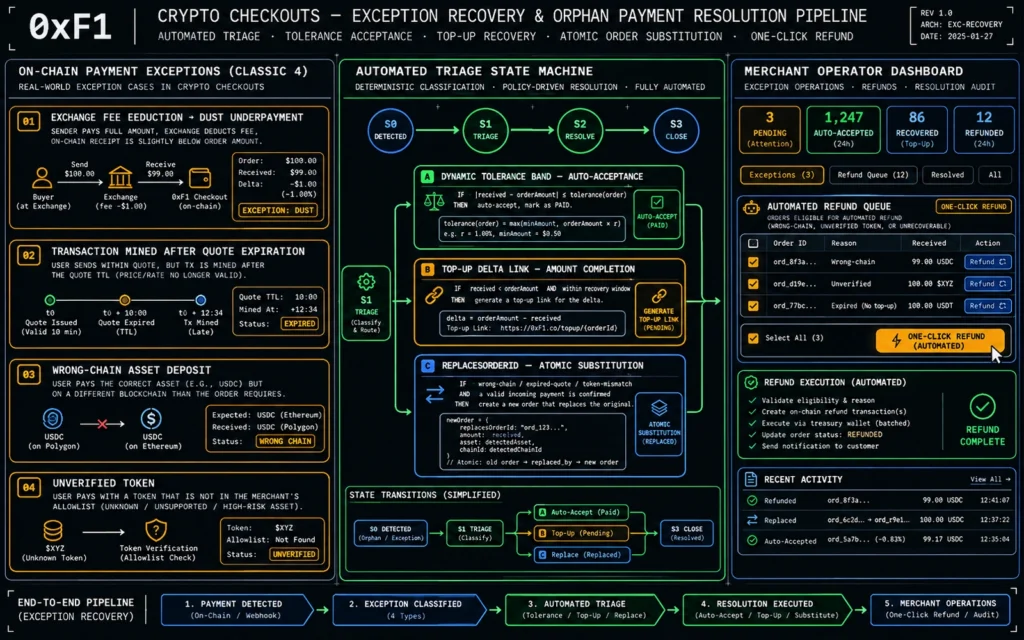
- The 1-USDT underpayment: a product costs 100 USDT. The customer withdraws directly from Binance or OKX to the checkout deposit address. The exchange deducts a 1 USDT withdrawal network fee, leaving the contract with
99.000000USDT. The payment state machine requires full payment, marks the $99 orderUNDERPAID, and refuses fulfillment. The customer asks support: “My money was deducted. Why haven’t I received my activation code?” - Late payment on an expired quote: a checkout exchange-rate quote typically lasts 15 minutes. With 10 seconds remaining, the customer sends a wallet transfer, but a low gas fee leaves it in Ethereum’s mempool for 20 minutes before inclusion. The order has already become
EXPIRED. When the event scanner detects the late transfer, the original order lifecycle has ended, leaving an unclaimed orphan payment. - Wrong-chain or wrong-asset transfers: a customer should send USDC on Base but sends the identically named token on Arbitrum instead. Worse, someone may send a worthless token named “USDT” from an unofficial contract in an attempt to obtain goods fraudulently.
Without automated triage and self-healing workflows for these four failure states, merchant support teams face overwhelming manual reconciliation work and may mistakenly approve fraud.
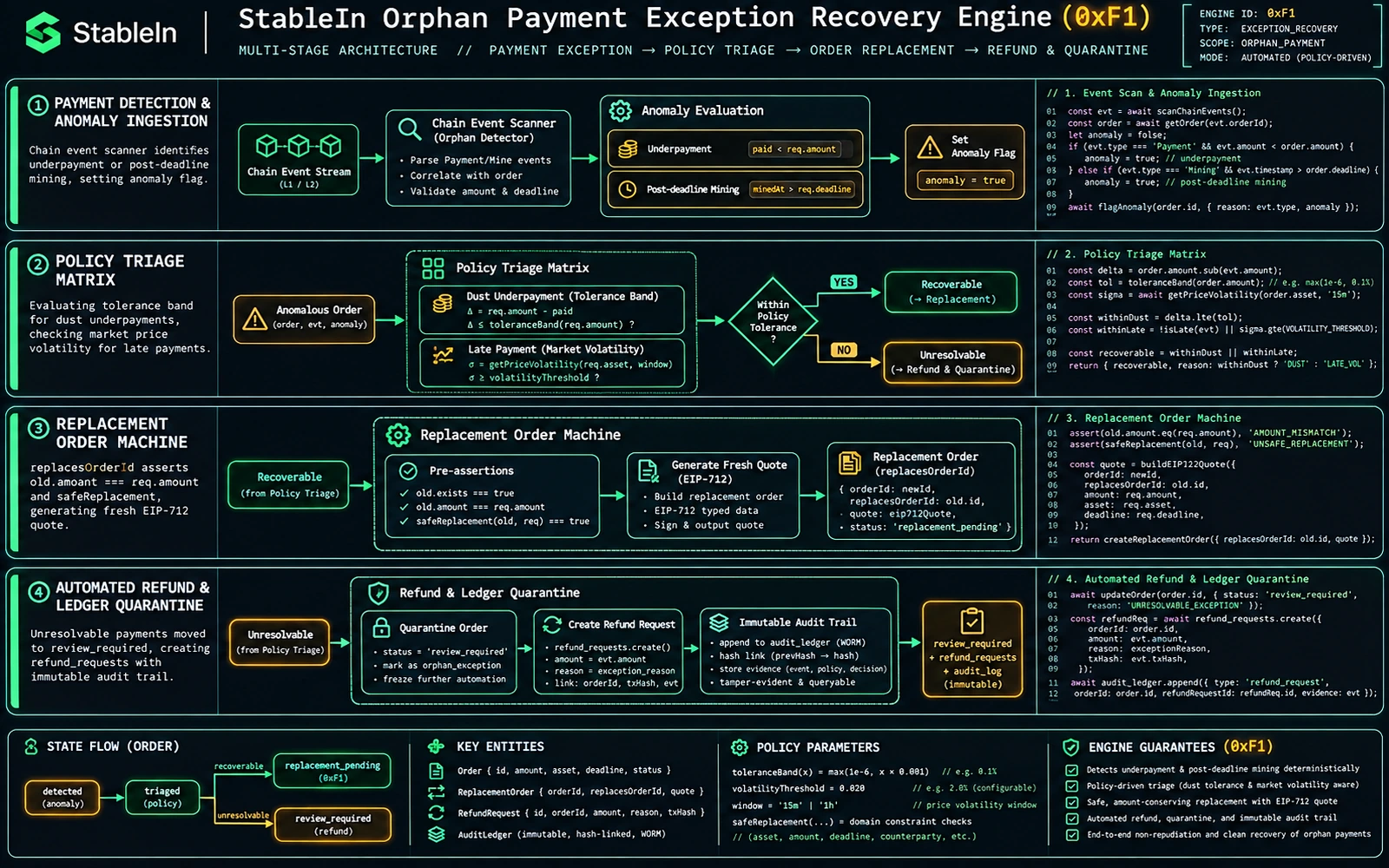
In production, enterprise multichain stablecoin infrastructure StableIn uses a resilient exception-recovery engine. This article examines configurable tolerance bands, lossless atomic order replacement through replacesOrderId, and automatically queued on-chain refunds.
Orphan Payment Triage and State Transitions
StableIn classifies on-chain deposits that have not completed fulfillment into four exception categories and drives deterministic state transitions:
+-----------------------------------------------------------------------------------+
|                         StableIn Automated On-Chain Payment Triage                  |
+-----------------------------------------------------------------------------------+
|  [Scenario 1: Dust Underpayment]                                                    |
|  Received amount falls within tolerance (for example, >= 99% due or shortfall <= 1 USDT) |
|  -> Policy A: merchant enables tolerance acceptance; absorb small loss, mark PAID, fulfill |
|  -> Policy B: create Top-Up Delta Link; fulfill jointly once the customer pays the balance |
|  -------------------------------------------------------------------------------- |
|  [Scenario 2: Late Payment on Expired Quote]                                         |
|  Order is EXPIRED, but full payment arrives on-chain                                 |
|  -> Policy engine checks price changes and inventory:                                |
|     * No FX loss and stock available: atomic replacesOrderId replacement restores fulfillment |
|     * Major asset-price change or no stock: queue merchant refund and issue refund link |
|  -------------------------------------------------------------------------------- |
|  [Scenario 3: Overpayment]                                                          |
|  Customer accidentally sends 150 USDC (100 USDC due)                                |
|  -> Fulfill 100 USDC normally; record extra 50 USDC as Refundable Liability          |
|  -> Automatically issue one Partial Refund for the excess to the original wallet    |
|  -------------------------------------------------------------------------------- |
|  [Scenario 4: Wrong-Chain / Phishing Token]                                          |
|  Unapproved asset or wrong network used for gateway deposit                         |
|  -> Scanner marks anomaly: UNRECOGNIZED_ASSET; order becomes review_required         |
|  -> Block fulfillment; isolate in exception audit console to stop fake-deposit fraud |
+-----------------------------------------------------------------------------------+
Comparing Three Exception-Handling Architectures
| Architecture | Manual support tickets | Simple reject-on-timeout model | StableIn automated recovery and replacement |
|---|---|---|---|
| Small underpayments | Customer stuck; support reconciles manually (1–2 days) | No delivery or refund; heavy complaints | Configurable tolerance acceptance or one-click balance-payment link |
| Late payments | Finance manually checks explorer and adds records | Merchant silently retains funds; compliance scrutiny | Native atomic replacesOrderId replacement and seamless EIP-712 requoting |
| Overpayment automation | Manual bank refund with high fees | Cannot identify the excess | Separate fulfillment/refund; one-click on-chain return of excess |
| Fake-token defense | Humans can be fooled by matching names | Frontend-only filtering leaves backend exposed | pay_scan_cursors strictly checks token bytecode and allowlists |
| Reconciliation consistency | Manual Excel records often disagree with reality | Broken financial history | TypeORM transaction consistency across orders, refunds, and chain events |
Core Implementation 1: Atomic Order Replacement (replacesOrderId)
When an order closes as EXPIRED but the customer later pays in full, asking them to place and pay for another order is the worst response: they would pay twice.
In stablein-platform/src/modules/payment/orders/orders.service.ts, atomic order replacement lets a client include replacesOrderId in a new order, binding the old unresolved order to the new one through consistent on-chain parameters:
// From stablein-platform/src/modules/payment/orders/orders.service.ts
    return transactionRetry(this.db, async (m) => {
      // 1. Acquire merchant row-level exclusive lock as a concurrency barrier
      await m.query('SELECT id FROM pay_merchants WHERE id=? FOR UPDATE', [tenant.tenantId]);

      // 2. Core replacement validation
      if (input.replacesOrderId) {
        // Fetch the old order to replace
        const [old] = await m.query(
          'SELECT * FROM pay_orders WHERE id=? AND tenant_id=? AND environment=? FOR UPDATE',
          [input.replacesOrderId, tenant.tenantId, tenant.environment]
        );
        if (!old) throw new PaymentError(404, 'NOT_FOUND');

        // Assert each old order can be replaced only once to prevent repeated replacement exploits
        const [replacement] = await m.query(
          'SELECT id FROM pay_orders WHERE replaces_order_id=?',
          [old.id]
        );
        if (replacement) {
          throw new PaymentError(409, 'ORDER_REFERENCE_EXISTS', { id: replacement.id });
        }

        // Core security constraint: chainId, token, and amount must match exactly!
        if (
          old.chain_id !== req.chainId ||
          old.amount !== req.amount ||
          readAddress(old.token) !== req.token ||
          !(await this.risk.safeReplacement(old, m))
        ) {
          throw new PaymentError(409, 'PAYMENT_ATTEMPT_UNRESOLVED');
        }
      }

      // 3. Create the new order with immutable replaces_order_id audit linkage
      const id = randomUUID();
      const orderId = bytes32(`0x${randomBytes(32).toString('hex')}`);
      const paymentId = getPaymentId(req.chainId, manifest.gateway, merchant.merchant_id, orderId);
      const deadline = (BigInt(Math.floor(Date.now() / 1000)) + BigInt(req.expiresInSeconds)).toString();

      // Insert pay_orders with replaces_order_id binding
      await m.query(
        `INSERT INTO pay_orders (..., replaces_order_id) VALUES (..., ?)`,
        [..., input.replacesOrderId ?? null]
      );

      // ... Insert signing task and idempotency record
    });
With this replacement pipeline:
- The customer does not pay again. After verifying receipt of the original late on-chain transaction, the system binds fulfillment entitlements to the newly created replacement order.
- Financial records retain a complete, auditable
replaces_order_idchain.
Core Implementation 2: Dynamic Underpayment Tolerance and Top-Ups
Exchange withdrawal fees, such as sending 100 USDT but receiving 99 USDT, are a common industry problem. StableIn supports two handling modes:
1. Automatically Absorb Small Shortfalls Within a Tolerance Band
Merchants can configure automatic tolerance for long-tail retail orders, such as tolerancePercentage = 1.0% or maxToleranceAbsoluteMinor = 1_000_000, equal to 1 USDC.
When the event projector (projector.ts) detects an on-chain receipt and calculates: amountexpected − amountactual ≤ Tolerance The system automatically records a promotional allowance (Merchant Subsidy), moves the order directly to terminal paid state, and triggers fulfillment, eliminating support disputes over a $1 fee.
2. Generate a Dedicated Top-Up Delta Link
If the shortfall exceeds the merchant’s tolerance, such as receiving only 60 USDC against 100 USDC due, the system does not fulfill. It marks the order UNDERPAID and atomically creates a dedicated balance-payment order:
- The new order charges the unpaid difference: Δ = 100 − 60 = 40 USDC.
- Checkout shows a clear yellow notice: “60 USDC received. Pay another 40 USDC to complete fulfillment.”
- Once the second 40 USDC arrives, the system combines both payment records and marks the order fully paid.
Core Implementation 3: Exception Isolation and Automated Refund Queues (rwa_refund)
Orphan payments that cannot be fulfilled, because stock is exhausted, an unauthorized token arrived on the wrong chain, or the token price crashed during the delay, must not remain stranded in the gateway contract.
In stablein-platform/src/modules/payment/refunds/refunds.service.ts, these exceptions receive an anomaly label, enter the review_required audit console, and automatically produce a preliminary refund request (pay_refund_requests):
-- From stablein-platform/src/migrations/1792108803000-PaymentRefunds.ts
CREATE TABLE pay_refund_requests (
  id CHAR(36) CHARACTER SET ascii COLLATE ascii_bin PRIMARY KEY,
  order_id CHAR(36) CHARACTER SET ascii COLLATE ascii_bin NOT NULL,
  merchant_refund_id VARBINARY(512) NOT NULL,
  refund_id BINARY(32) NOT NULL,
  amount VARCHAR(78) NOT NULL,
  status VARCHAR(20) NOT NULL DEFAULT 'requires_action',
  abandoned BOOLEAN NOT NULL DEFAULT FALSE,
  created_at DATETIME(6) NOT NULL DEFAULT CURRENT_TIMESTAMP(6),
  updated_at DATETIME(6) NOT NULL DEFAULT CURRENT_TIMESTAMP(6) ON UPDATE CURRENT_TIMESTAMP(6),
  UNIQUE KEY refund_reference(order_id, merchant_refund_id),
  UNIQUE KEY protocol_refund(order_id, refund_id),
  FOREIGN KEY(order_id) REFERENCES pay_orders(id)
) ENGINE=InnoDB;
An operator or automated refund bot can batch-approve requests from the console. The gateway then returns tokens to the payer’s original on-chain address through refund(), reconciling the PaymentRefunded fact with the original order both on-chain and off-chain.
Four Production Rules for Eliminating Orphan Payments
When integrating stablecoin payments into international commerce, SaaS, or Web3 platforms, establish these four requirements during architecture review:
- Never rely on frontend wallet transfers without timeout warnings: checkout must explicitly warn, “Do not withdraw directly from a centralized exchange. If you do, add the network fee yourself.” Warn about expiry 30 seconds before the countdown ends.
- Implement lossless atomic order replacement (
replacesOrderId) in the business layer: do not send customers straight to refunds after expiry. Verify safe receipt and matching amounts, then prioritize one-click replacement. - Set reasonable tolerance bands for frequent long-tail retail orders: treat a missing $1 fee as a controlled operating expense. A discount below 1% can recover at least 90% of high-value customers otherwise lost to payment friction.
- Isolate exceptions and provide a complete return-to-source refund flow: record any funds not fulfilled within the required window clearly as refundable liabilities. Never leave an on-chain payment as an unowned orphan.
Enterprise Multichain Payment Infrastructure and Consulting
Fone provides low-friction, highly available multichain stablecoin acceptance and automated exception recovery for cross-border commerce, international digital products, and Web3 businesses. Our StableIn infrastructure has been tested in tens of thousands of complex real production payment scenarios:
- Explore the full multichain payment solution: StableIn Solutions
- Understand exact integer accounting: Precision-Safe Stablecoin Accounting: Why Floating Point Breaks Checkout
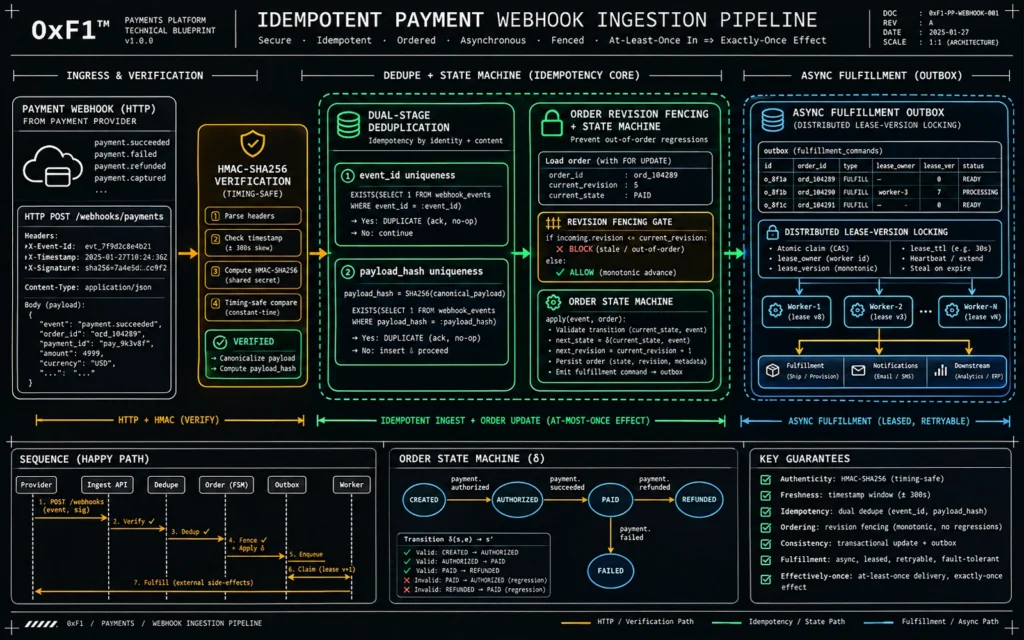
- Explore idempotent, order-independent webhook processing: High-Concurrency Payment Webhook Ingestion
- Arrange a business-process audit and technical assessment with a senior payment architect: Discuss Custom Requirements with Fone