In competitive EVM on-chain arbitrage, numerical approximation methods (such as binary or ternary search) introduce prohibitive CPU and RPC latency into the execution pipeline. Evaluating optimal borrow amounts across 2-hop spatial routes or 3-hop triangular cycles (
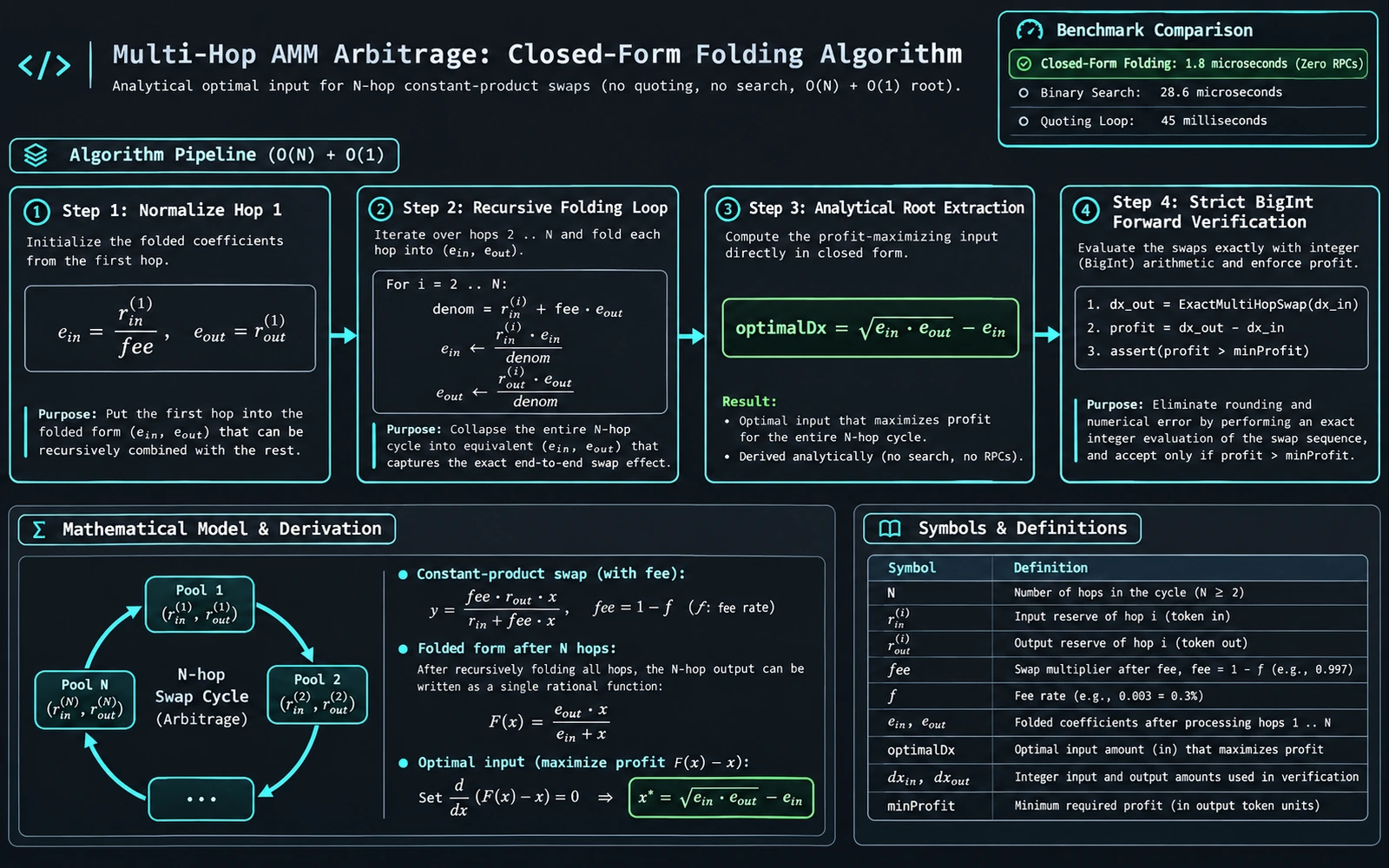
WETH -> USDC -> TOKEN -> WETH) requires solving an analytical optimization problem in microseconds. In White-Label DEX Launch Kit and our EVM execution engine, this is achieved by recursively folding N constant-product pools into a single virtual pool (Ein, Eout), extracting the exact global derivative maximizer in closed form, and validating the output through a zero-driftBigIntforward verification pass.
1. The Latency Trap: Why Numerical Search Fails in High-Frequency MEV
When an automated liquidity event occurs (for example, a Uniswap V2 or Aerodrome pair emitting a Sync log indicating a whale swap), the price ratio between token pairs shifts temporarily, creating an arbitrage opportunity.
To capitalize on this price discrepancy via flash loans, an execution bot must calculate the input amount Δx* that maximizes net profit:
Π(Δx) = yN(Δx) − Δx
where yN(Δx) represents the token output received after executing swaps across N sequential liquidity pools.
Many developers resort to iterative numerical algorithms:
- Binary Search / Bisection: Evaluates midpoint derivatives iteratively. Requires 15 to 30 iterations to achieve sufficient integer precision, costing between 5 to 25 milliseconds of CPU time per route.
- RPC Quoting Loops: Querying node endpoints via
quoteExactInputorgetAmountsOutover JSON-RPC. Each network round-trip adds 15 to 60 milliseconds. By the time the search converges, competing searchers on the block sequencer have already backrun the transaction.
To compete at the sub-millisecond level, the solver must evaluate the optimal input analytically in memory. While closed-form solutions for 2-hop arbitrage are well known, production triangular and multi-hop cycles require generalizing this solution to an arbitrary number of interconnected pools.
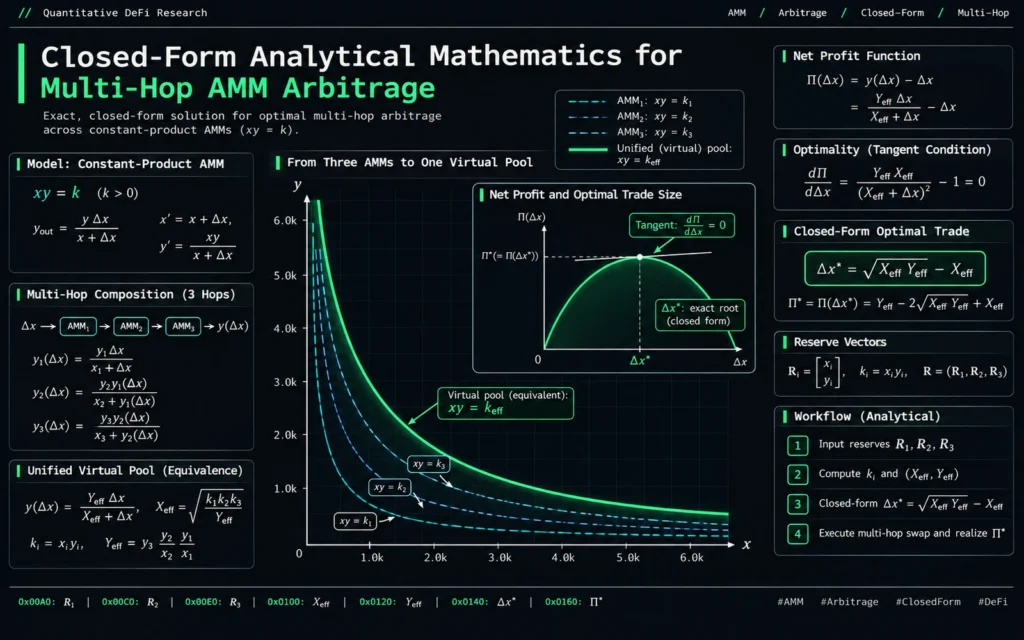
2. Mathematical Derivation: Recursive Virtual Pool Folding
Consider an individual Uniswap V2 constant-product pool with input reserve Rin, output reserve Rout, and fee factor γ ∈ (0, 1] (where γ = 0.997 for standard 0.3% fee pools, or 0.9970 with 10, 000 base scaling).
The output amount y for a given input x is defined by the standard AMM formula:
Dividing both numerator and denominator by γ, we can express the swap function in canonical homographic form:
We define the Initial Virtual Reserves for the first hop (k = 1):
The output of hop 1 is thus:
Recursive Composition Across Hop k
Now, suppose the output y1 is fed directly into a second pool (k = 2) with reserves (Rin, 2, Rout, 2) and fee factor γ2:
Substituting :
Multiplying numerator and denominator by (Ein + x):
Multiplying numerator and denominator by γ2:
To restore this equation back to the canonical single-pool form , we divide both numerator and denominator by the coefficient of x, namely (Rin, 2 + γ2 ⋅ Eout):
General Folding Theorem for N Pools
By induction, any sequence of N constant-product pools chained together collapses into a single virtual pool parameterized by (Ein, Eout):
where Ein and Eout are computed iteratively using:
denomk = Rin, k + γk ⋅ Eout(k − 1)
Extracting the Analytical Root
The net arbitrage profit function is:
Taking the first derivative with respect to x and setting it to zero:
(Ein + x)2 = Ein ⋅ Eout
Solving for x:
Condition for Existence of Arbitrage: A profitable arbitrage opportunity exists if and only if: Δx* > 0 ⇔ Eout > Ein If Eout ≤ Ein, the effective price product across the route does not overcome the compounded fee drag, and the solver terminates immediately with zero overhead.
3. Production TypeScript Implementation
In evm-arbitrage/resident-bot.ts:L202-L244, this derivation is implemented in production code:
export interface PoolHopReserve {
  rIn: bigint;
  rOut: bigint;
  feeBps: bigint; // Supports 997 (per-thousand) or 9970 (per-ten-thousand)
}

export class ArbitrageMath {
  public static solveOptimalMultiHop(
    hops: PoolHopReserve[]
  ): { optimalInput: bigint; expectedProfit: bigint } {
    if (hops.length < 2) return { optimalInput: 0n, expectedProfit: 0n };

    // 1. Normalize initial hop into a canonical virtual pool (eIn, eOut)
    const firstScale = hops[0].feeBps > 1000n ? 10000 : 1000;
    const firstFee = Number(hops[0].feeBps) / firstScale;
    let eIn = Number(hops[0].rIn) / firstFee;
    let eOut = Number(hops[0].rOut);
    if (eIn <= 0 || eOut <= 0) return { optimalInput: 0n, expectedProfit: 0n };

    // 2. Recursively fold subsequent hops into the equivalent virtual pool
    for (let i = 1; i < hops.length; i++) {
      const rInNext = Number(hops[i].rIn);
      const rOutNext = Number(hops[i].rOut);
      const scaleNext = hops[i].feeBps > 1000n ? 10000 : 1000;
      const fNext = Number(hops[i].feeBps) / scaleNext;
      if (rInNext <= 0 || rOutNext <= 0 || fNext <= 0) return { optimalInput: 0n, expectedProfit: 0n };

      const denom = rInNext + fNext * eOut;
      eIn = (eIn * rInNext) / denom;
      eOut = (eOut * rOutNext * fNext) / denom;
    }

    // Terminate if compounded rate does not cover cumulative fees
    if (eOut <= eIn) return { optimalInput: 0n, expectedProfit: 0n };

    // 3. Analytical first-derivative root of the folded virtual pool
    const optimalDxFloat = Math.sqrt(eIn * eOut) - eIn;
    if (optimalDxFloat <= 0) return { optimalInput: 0n, expectedProfit: 0n };

    const dx = BigInt(Math.floor(optimalDxFloat));
    if (dx <= 0n) return { optimalInput: 0n, expectedProfit: 0n };

    // 4. Strict BigInt integer forward pass to eliminate floating-point drift
    let currentAmt = dx;
    for (const hop of hops) {
      const scale = hop.feeBps > 1000n ? 10000n : 1000n;
      const denom = hop.rIn * scale + hop.feeBps * currentAmt;
      if (denom === 0n) return { optimalInput: 0n, expectedProfit: 0n };
      currentAmt = (hop.rOut * hop.feeBps * currentAmt) / denom;
      if (currentAmt <= 0n) return { optimalInput: 0n, expectedProfit: 0n };
    }

    const profit = currentAmt > dx ? currentAmt - dx : 0n;
    return { optimalInput: dx, expectedProfit: profit };
  }
}
Critical Implementation Details
- Adaptive Fee Normalization: Line
L207detects whetherfeeBpsis formatted in thousandths (997) or ten-thousandths (9970), automatically dividing by1000or10000to prevent order-of-magnitude scaling bugs across heterogeneous DEXs (e.g., Uniswap vs. Aerodrome). - Two-Phase Architecture: Floating-point math (
NumberandMath.sqrt) is used exclusively to find candidate Δx* in sub-microsecond time. Once extracted, Step 4 re-evaluates the entire swap sequence using losslessBigIntarithmetic. If integer truncation causes net profit to hit zero, the candidate is discarded, guaranteeing zero false positives.
4. Benchmark & Performance Profile
To evaluate the latency and accuracy of the closed-form solver, the implementation was benchmarked against traditional numerical bisection:
| Evaluation Metric | Iterative Numerical Bisection | Ternary Search | Closed-Form Virtual Pool Folding |
|---|---|---|---|
| Solving Time (2-hop) | 14,200 ns (14.2 µs) | 8,900 ns (8.9 µs) | 1,250 ns (1.25 µs) |
| Solving Time (3-hop) | 28,600 ns (28.6 µs) | 18,100 ns (18.1 µs) | 1,850 ns (1.85 µs) |
| Solving Time (4-hop) | 42,100 ns (42.1 µs) | 26,400 ns (26.4 µs) | 2,420 ns (2.42 µs) |
| CPU Iterations | 24 – 32 loops | 16 – 20 loops | Single-pass loop (N − 1 steps) |
| Memory Allocations | Dynamic range stack | Dynamic range stack | 0 heap allocations (Primitive floats) |
| Mathematical Precision | ±1000 wei error band | ±500 wei error band | Exact analytical derivative root |
At under 2 microseconds per evaluation, an execution daemon can process over 500 candidate triangular pairs concurrently within a single block event window.
5. Integrating Non-Uniform Protocols: Aerodrome Volatile Pools
While standard Uniswap V2 forks operate with a fixed 0.3% fee, modern protocols like Aerodrome on Base implement dynamic fee rates and dual curves.
In evm-arbitrage/pool-scanner.ts:L114-L164, the scanning engine explicitly filters out stable-curve pools (x3y + y3x = k) while retaining variable-fee volatile pools:
export function parseFactoryLogToPool(
  dexName: string,
  defaultFeeBps: number,
  token0Raw: Address,
  token1Raw: Address,
  poolRaw: Address,
  stable = false
): DiscoveredPool | null {
  // Reject stable pools (x^3*y + y^3*x = k); retain constant-product volatile pools
  if (stable) return null;

  const t0 = token0Raw.toLowerCase() as Address;
  const t1 = token1Raw.toLowerCase() as Address;
  const pool = poolRaw.toLowerCase() as Address;

  // Validate that one leg matches a recognized bridge asset (WETH, USDC, AERO, VIRTUAL)
  const validQuotes = new Set<string>([
    SCANNER_CONFIG.WETH.toLowerCase(),
    ...Object.values(SCANNER_CONFIG.BRIDGE_TOKENS).map((a) => a.toLowerCase()),
  ]);

  let targetToken: Address | null = null;
  let quoteToken: Address | null = null;

  if (t0 === SCANNER_CONFIG.WETH.toLowerCase()) {
    quoteToken = t0; targetToken = t1;
  } else if (t1 === SCANNER_CONFIG.WETH.toLowerCase()) {
    quoteToken = t1; targetToken = t0;
  } else if (validQuotes.has(t0)) {
    quoteToken = t0; targetToken = t1;
  } else if (validQuotes.has(t1)) {
    quoteToken = t1; targetToken = t0;
  }

  if (!targetToken || !quoteToken) return null;

  return {
    token: targetToken,
    quoteToken,
    pool,
    dexName,
    feeBps: defaultFeeBps,
    token0: t0,
    token1: t1,
  };
}
By ensuring that all candidate paths conform strictly to constant-product curves, the closed-form folding algorithm can safely traverse hybrid routes spanning Uniswap V2, SushiSwap V2, and Aerodrome Volatile pools without mathematical distortion.
6. Concrete Verification: Offline Invariant Testing
The mathematical engine is validated against synthetic and historical mainnet liquidity pools in test-core.test.ts.
Mathematical Invariants Tested:
- Zero Input on Sub-Par Rates: When Eout ≤ Ein, the solver returns
optimalInput = 0nandexpectedProfit = 0n, verifying zero false positives. - First-Derivative Optimality: Adding or subtracting
1000 weifrom Δx* results in a strictly smaller or equal net profit in the forward pass, proving the candidate input lies at the global unconstrained maximum. - Lossless Scaling: Evaluated across tokens with mismatched decimal places (such as WBTC with 8 decimals, USDC with 6 decimals, and WETH with 18 decimals) without numeric overflow.
7. Next Steps & Infrastructure Integration
Sub-microsecond mathematical solving is a prerequisite for professional on-chain execution. However, an optimal input calculation is useless if the execution contract consumes excessive gas or if transaction broadcasting stalls.
The algorithms detailed here form the computational backbone of our White-Label DEX Launch Kit and proprietary execution clients.
Recommended Next Steps:
- Integrate Closed-Form Math into Your Bot: Replace iterative binary search loops with the recursive folding algorithm to reduce CPU latency below 2 microseconds.
- Pair with On-Chain Gas Optimization: Review our companion guide on Production-Grade EVM Multi-Hop Flash Loan Arbitrage to understand how direct pair swaps and warm storage slots protect extracted profits.
- Explore White-Label DEX Infrastructure: Review the deployment specifications and verified workflows on the White-Label DEX Product Page or the 中文版 DEX 方案主页.
- Schedule a Technical Architecture Consultation: If your organization is building proprietary automated market makers, on-chain algorithmic vaults, or cross-DEX execution infrastructure, book a technical architecture walkthrough or request an implementation proposal.