Teams building end-to-end encryption (E2EE) often spend months on cryptography: standard 256-bit AES-GCM, careful PBKDF2 derivation, and on-chain deliverable hashes. Yet a contradictory security incident repeatedly appears in real deployments:
A security team spends two weeks producing a confidential vulnerability report worth US$50,000. WebCrypto successfully decrypts it in the client’s browser. To spare users from reentering their password after a refresh, a junior frontend engineer places the complete decrypted Markdown in Redux and lets redux-persist serialize it automatically to localStorage.
Later that afternoon, a minor rendering-style error triggers the global React error boundary. The integrated Sentry SDK captures the current Redux snapshot and sends the complete plaintext audit report, including 14 undisclosed zero-day vulnerabilities, in an HTTPS POST payload without application-level encryption to a third-party logging server.
Poor frontend memory hygiene has undone every end-to-end zero-knowledge encryption promise.
For sensitive consulting, vulnerability reports, and confidential asset agreements, successful decryption is only the beginning of frontend security. Using the production client design in Fone ProofDesk, this article examines memory hygiene engineering and end-to-end leakage prevention in Next.js and React.
1. Five Frontend Plaintext Leakage Paths
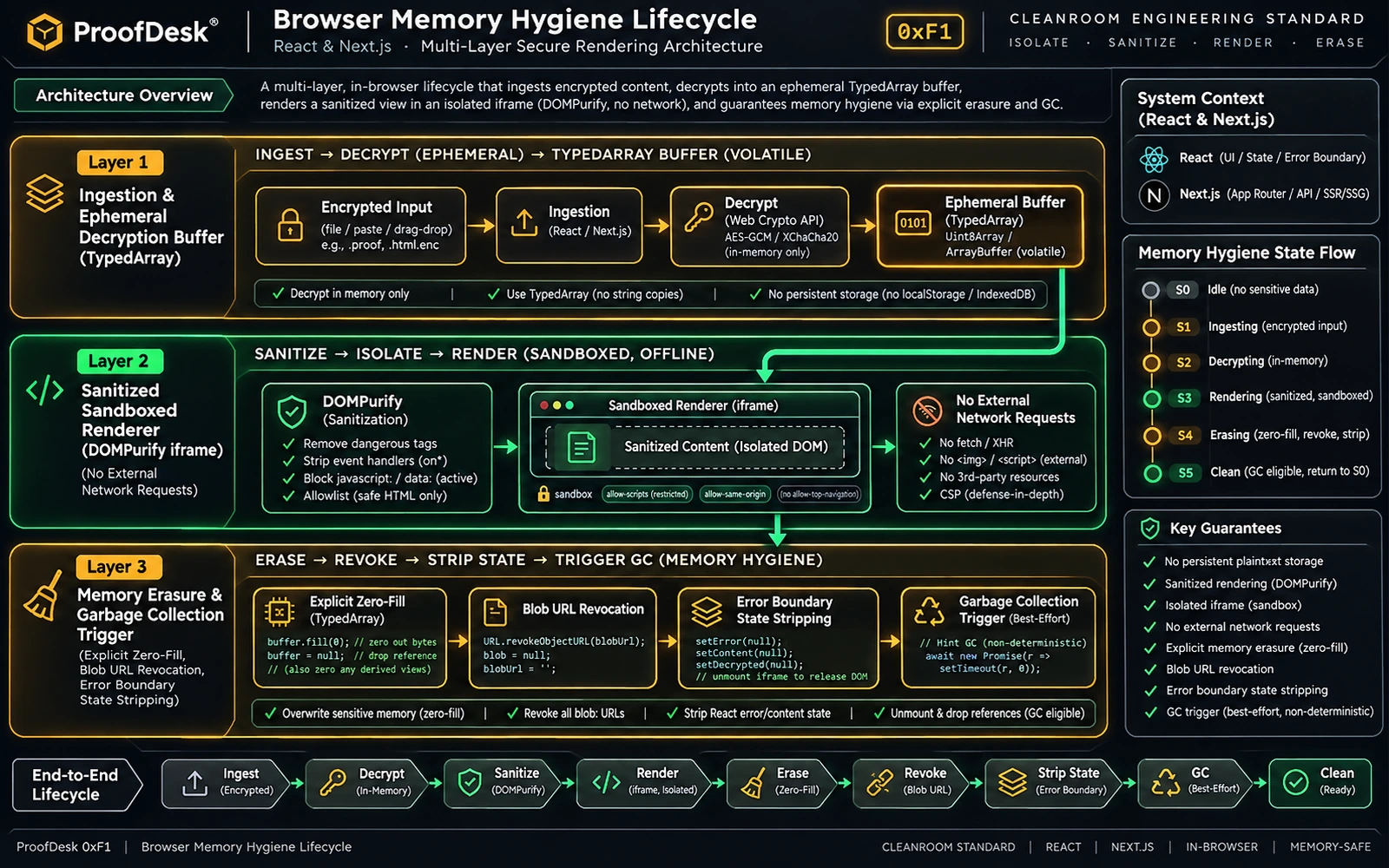
Once ciphertext becomes a plaintext string or byte array (Uint8Array) on the browser’s main thread, it faces five subtle, widespread leakage paths:
+----------------------------------------------------------------------------------------------------+
|                           Five Potential Leakage Paths for Decrypted Plaintext                     |
+----------------------------------------------------------------------------------------------------+

   [ WebCrypto decryption completes: confidential plaintext ArrayBuffer created ]
               │
               ├── Path 1: storage misuse ──> localStorage / sessionStorage / IndexedDB (unencrypted persistence)
               │
               ├── Path 2: monitoring leakage ──> Sentry / Datadog / LogRocket global state snapshots
               │
               ├── Path 3: dangling objects ──> globals, closures, and `blob:` URLs left uncollected by GC
               │
               ├── Path 4: DOM exposure ──> malicious Chrome extensions directly read innerText
               │
               └── Path 5: XSS injection ──> Markdown renderer fails to escape malicious image URLs / JavaScript schemes
+----------------------------------------------------------------------------------------------------+- Unchecked persistence: Developers commonly use Redux, Zustand, or Pinia with default persistence plugins, silently writing decrypted text to disk in plaintext.
- Telemetry data leaks: APM tools such as Sentry and Datadog automatically capture
console.error, Redux actions, and request bodies. Plaintext objects in error-stack closures or props can leak directly to third-party cloud services. - Dangling resources and GC lag: Temporary links created through
URL.createObjectURL(blob)remain in the browser’s core memory pool unlessURL.revokeObjectURLis explicitly called, even after their React component has been destroyed. - Browser-extension sniffing: Third-party extensions can have privileges to inspect the current tab’s DOM. Plaintext displayed without isolation in a normal
<div>is easy for malicious or highly privileged extensions to scrape silently.
2. ProofDesk’s Four Memory-Hygiene Rules
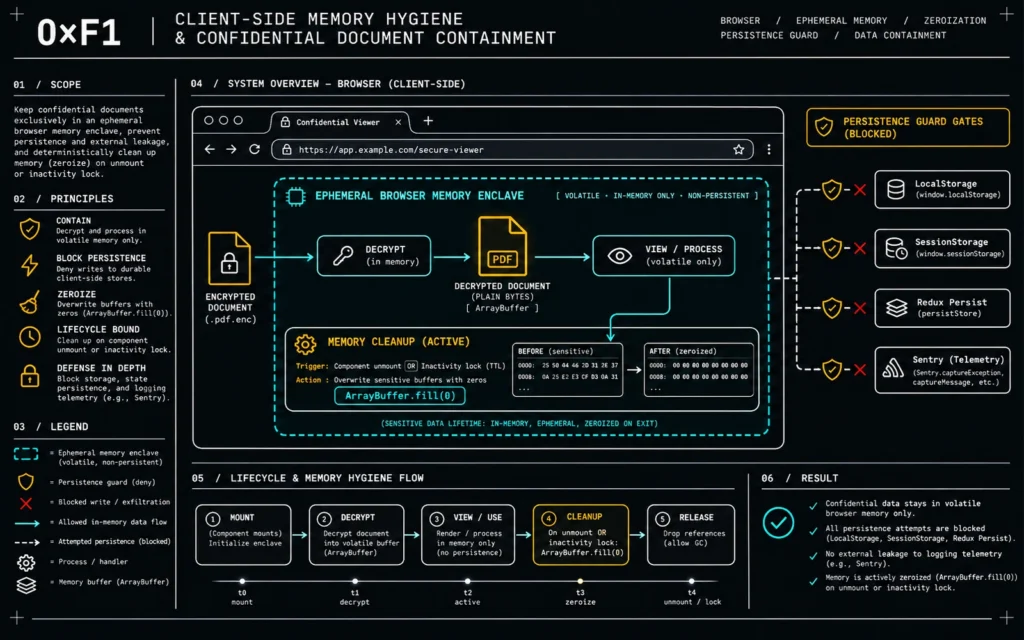
To prevent plaintext escape at the engineering level, Fone ProofDesk imposes four non-negotiable coding rules:
+----------------------------------------------------------------------------------------------------+
|                              ProofDesk Client Memory Protection Pipeline                           |
+----------------------------------------------------------------------------------------------------+

   [ Rule 1: Zero Disk Persistence ]
   Plaintext may live only in transient React component-local closures or WeakRef; no persistence middleware.
            │
            ▼
   [ Rule 2: Explicit Zero-Fill ]
   On leaving the reader or unmounting, overwrite the underlying `Uint8Array` with `.fill(0)` without waiting for V8 GC.
            │
            ▼
   [ Rule 3: Sanitized Error Boundary ]
   Configure strong beforeSend scrubbers in Sentry / global error listeners to suppress report fields globally.
            │
            ▼
   [ Rule 4: Sandboxed Viewer & Immediate Revocation ]
   Render PDF/Markdown inside a restricted `<iframe>`; revoke temporary Blob URLs within 2 seconds of mounting.
+----------------------------------------------------------------------------------------------------+
3. Transient Memory Management and Explicit Byte Erasure
JavaScript strings are immutable. Once created, V8’s garbage collector determines when to destroy them. Repeatedly concatenating long strings can leave residual data visible in heap dumps for extended periods.
For highly sensitive data, prefer mutable typed arrays (Uint8Array / ArrayBuffer) and explicitly overwrite them after use:
// proofdesk/src/security/ephemeral-memory-buffer.ts
export class EphemeralSecretBuffer {
  private buffer: Uint8Array | null;
  private isWiped = false;

  constructor(size: number) {
    this.buffer = new Uint8Array(size);
  }

  public getRawBuffer(): Uint8Array {
    if (this.isWiped || !this.buffer) {
      throw new Error('Memory buffer has already been sanitized and wiped.');
    }
    return this.buffer;
  }

  /**
   * @notice Explicit zeroing: overwrite bytes with 0x00 to prevent heap-dump inspection
   */
  public wipe(): void {
    if (this.buffer && !this.isWiped) {
      this.buffer.fill(0); // Explicitly erase underlying memory
      this.buffer = null;
      this.isWiped = true;
    }
  }
}
In React, we bind the buffer’s lifecycle atomically to component unmounting:
// proofdesk/src/components/SecureDocumentViewer.tsx
import React, { useEffect, useState, useRef } from 'react';
import { EphemeralSecretBuffer } from '../security/ephemeral-memory-buffer';

interface SecureDocumentViewerProps {
  encryptedBlob: ArrayBuffer;
  decryptionKey: CryptoKey;
  iv: Uint8Array;
}

export const SecureDocumentViewer: React.FC<SecureDocumentViewerProps> = ({
  encryptedBlob,
  decryptionKey,
  iv,
}) => {
  const [renderedContent, setRenderedContent] = useState<string | null>(null);
  const secretBufferRef = useRef<EphemeralSecretBuffer | null>(null);

  useEffect(() => {
    let isCancelled = false;

    async function decryptAndContain() {
      try {
        // 1. Use WebCrypto to decrypt into a transient ArrayBuffer
        const decryptedRaw = await window.crypto.subtle.decrypt(
          { name: 'AES-GCM', iv },
          decryptionKey,
          encryptedBlob
        );

        if (isCancelled) return;

        // 2. Copy into the controlled memory wrapper
        const secret = new EphemeralSecretBuffer(decryptedRaw.byteLength);
        secret.getRawBuffer().set(new Uint8Array(decryptedRaw));
        secretBufferRef.current = secret;

        // 3. Decode to plaintext for rendering; immediately mark for sanitization after rendering
        const decoder = new TextDecoder('utf-8');
        const text = decoder.decode(secret.getRawBuffer());
        setRenderedContent(text);
      } catch (err) {
        console.error('Decryption failed. Memory cleared.');
      }
    }

    decryptAndContain();

    // 4. On component unmount or navigation away, enforce zeroing
    return () => {
      isCancelled = true;
      if (secretBufferRef.current) {
        secretBufferRef.current.wipe();
        secretBufferRef.current = null;
      }
      setRenderedContent(null); // Clear the React state reference
    };
  }, [encryptedBlob, decryptionKey, iv]);

  if (!renderedContent) {
    return <div className="text-zinc-500 font-mono text-sm">Decrypting in secure enclave...</div>;
  }

  return (
    <div className="secure-view-container select-none">
      {/* Render the secure isolated view */}
      <SafeMarkdownContainer rawContent={renderedContent} />
    </div>
  );
};
4. Preventing Telemetry Leakage: Sentry and Log Scrubbers
To prevent decrypted documents from reaching Sentry during production troubleshooting, register a global scrubber for confidential fields and payloads at application startup (_app.tsx or instrumentation.ts):
// proofdesk/src/monitoring/telemetry-scrubber.ts
import * as Sentry from '@sentry/nextjs';

export function configureStrictTelemetryScrubber() {
  Sentry.init({
    dsn: process.env.NEXT_PUBLIC_SENTRY_DSN,
    beforeSend(event) {
      // 1. Traverse exception context and remove any fields that may contain confidential plaintext
      if (event.extra) {
        delete event.extra.decryptedPayload;
        delete event.extra.rawReport;
        delete event.extra.secretKey;
      }

      // 2. Inspect breadcrumbs and suppress data containing sensitive paths or text
      if (event.breadcrumbs) {
        event.breadcrumbs = event.breadcrumbs.filter(breadcrumb => {
          const message = breadcrumb.message?.toLowerCase() || '';
          if (
            message.includes('report') ||
            message.includes('audit') ||
            message.includes('vulnerability') ||
            message.includes('secret')
          ) {
            return false; // Drop potentially sensitive traces
          }
          return true;
        });
      }

      // 3. Remove attached Redux/Zustand state snapshots
      if (event.contexts && event.contexts.state) {
        delete event.contexts.state;
      }

      return event;
    },
  });
}
5. Comparing Ordinary Web Frontends with ProofDesk’s Memory-Hygiene Standard
The following table compares memory protection in ordinary web development and institutional confidential-reading portals:
| Protection dimension | Ordinary web frontend | This approach: ProofDesk memory hygiene |
|---|---|---|
| State persistence | localStorage or sessionStorage caching enabled by default |
Zero persistence; refresh clears state; no writes to any Web Storage |
| Memory destruction | Relies on delayed JavaScript garbage collection | Explicit buffer.fill(0) on unmount for active byte zeroing |
| Temporary files and Blob URLs | Long-lived blob:http://... links without manual release |
Immediately call URL.revokeObjectURL after rendering |
| APM and crash logs | Uploads complete Redux state and props, risking widespread leaks | Strict scrubbers remove all report fields and context snapshots |
| DOM and copy protection | Unrestricted selection and copying; exposed to extensions | Sandboxed iframe isolation + CSS selection prevention (select-none) |
| Navigation and screen lock | Long-lived background state leaves plaintext exposed while locked | Listen for visibilitychange; automatically lock and erase after more than 30 seconds without focus |
6. Integrating the Client-Side Encrypted Delivery Lifecycle
Memory hygiene is the final stage of E2EE protection and complements the preceding architecture:
- Integrate with the client-side WebCrypto engine: When decrypting under the Zero-Trust Confidential Report Delivery Architecture, keep derived symmetric keys and plaintext in the same protected execution context, preventing escape to global scope.
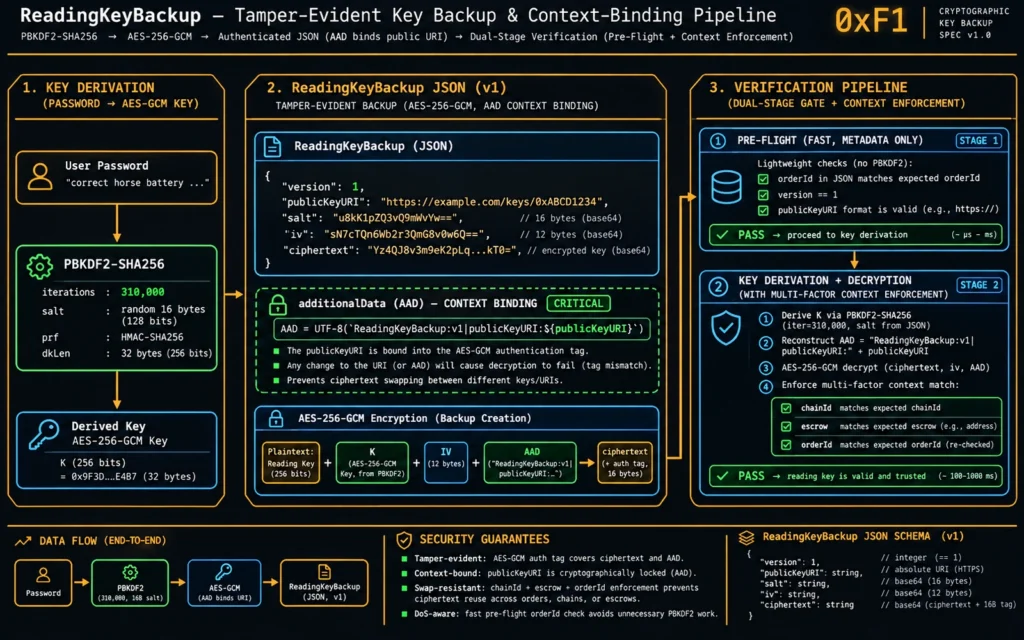
- Combine with tamper-resistant key backups: With the Tamper-Evident Key Backup Schema, recovery compares passwords and backup files transiently in local memory. Immediately clear derived credentials after verification so the workflow leaves no local digital traces.
Consulting and Source-Code Delivery
If you are building a Web3 platform for confidential intellectual-property delivery, decentralized audit consoles, or high-value legal and financial reports, and need bank-grade frontend memory protection:
- Visit Fone’s Client Deliveries and System Demos to explore Fone ProofDesk client-side zero-knowledge decryption and transient memory erasure;
- Read our On-Chain Escrow and Encrypted Delivery Solution for Consulting Payment Disputes;
- Book a one-to-one discussion through Fone Architecture Consulting for a WebCrypto frontend library, security-review rules, and a white-label interface.