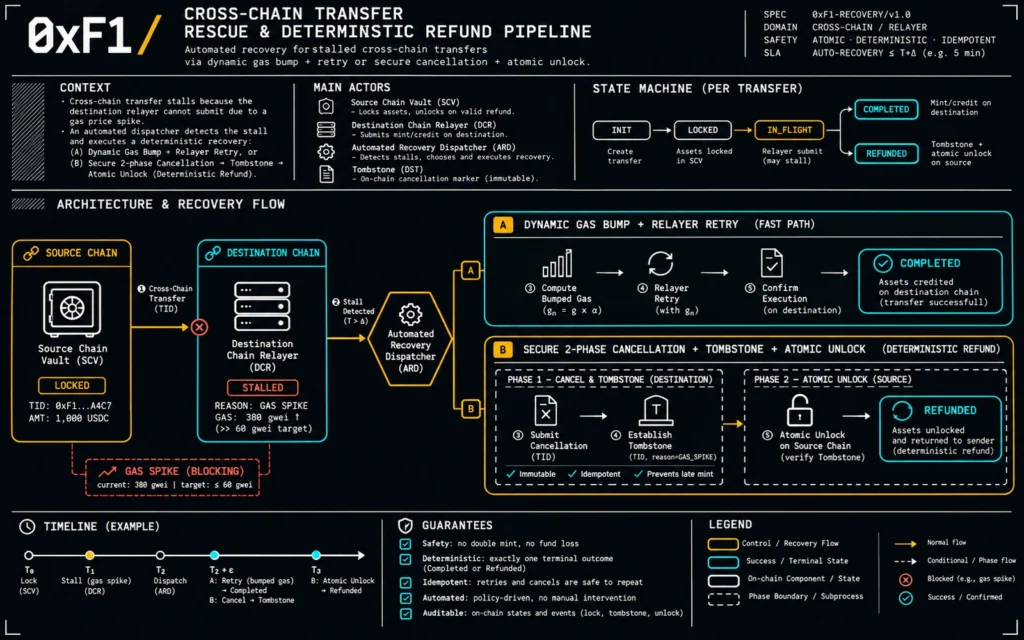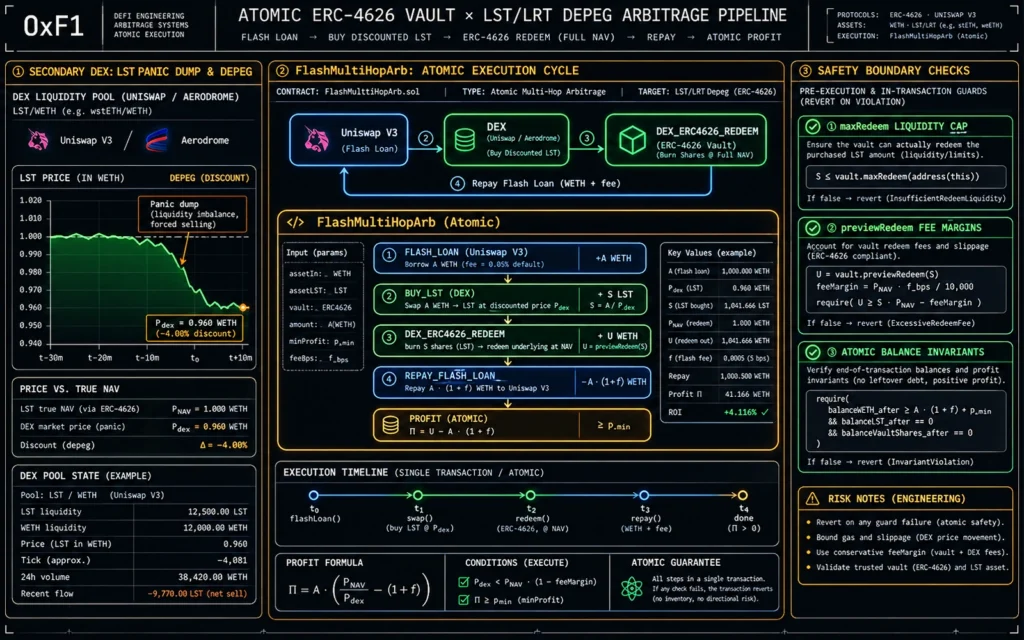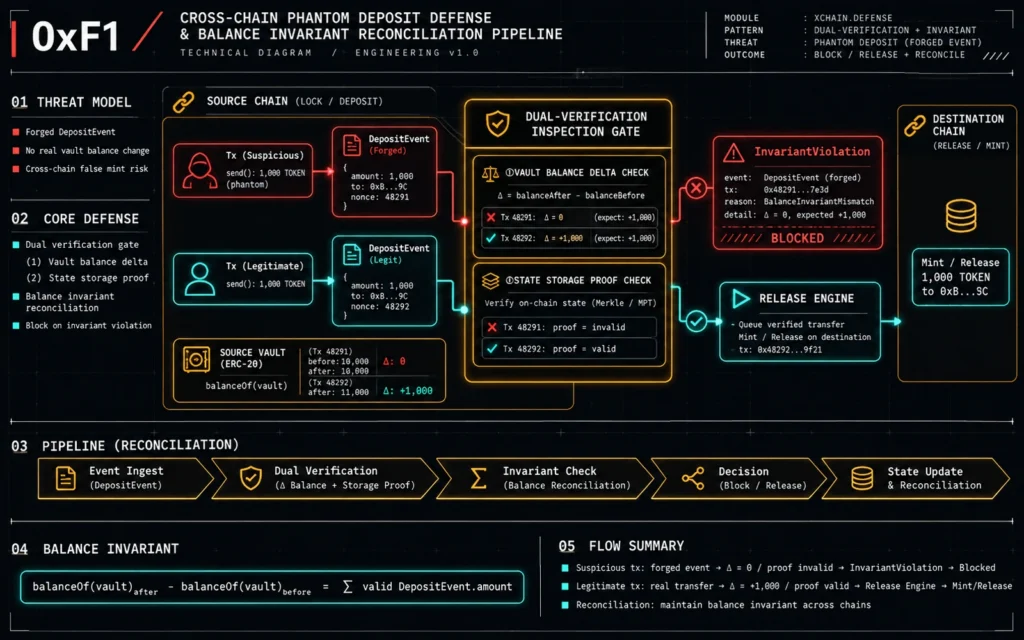
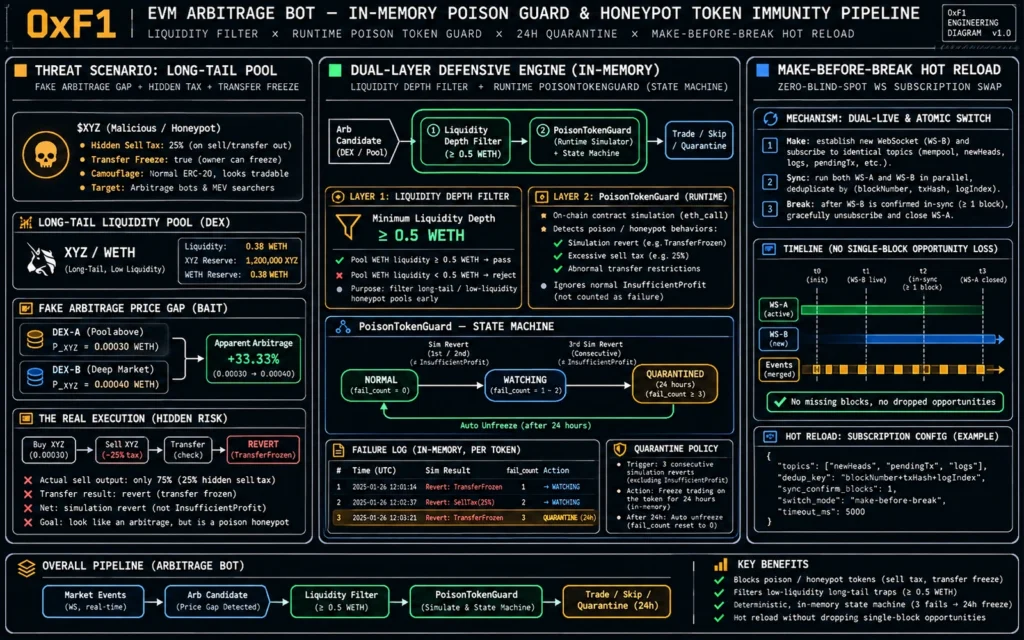
On low-gas Layer-2 networks such as Base, BSC, and Arbitrum, the growth of long-tail tokens and meme coins creates apparently lucrative high-frequency spreads for arbitrage and market-making bots. Liquidity is fragmented across small pools on Uniswap, Aerodrome, Sushi, and other DEXs. During retail trading surges, prices across those pools often diverge by 5%–20%.
Yet almost every team entering long-tail arbitrage encounters honeypots and dynamic-tax token traps within its first 48 hours of live operation.
New pools may contain tokens with malicious logic: allowlisted addresses can trade, but other sellers revert; buys have 0% tax while sells dynamically lose 99%; or transfers succeed only through a particular official router. Because users can buy but cannot sell, one-way demand pushes prices artificially high, leaving persistently attractive fake price gaps across DEXs.
Without automatic defenses, an arbitrage bot faces several failures:
- RPC simulation quotas and compute are exhausted: every new block reveals the same apparently exceptional spreads, triggering repeated
eth_callsimulations. Expensive commercial RPC quotas disappear within hours, while genuine opportunities wait behind meaningless failures. - Restarts lose opportunities: many teams remove poisoned pairs by periodically rescanning every pool and restarting the bot. During the tens of seconds needed to stop and reconnect WebSockets, several valuable arbitrage blocks may pass.
- Idle compute and RPC costs exceed returns: during quiet overnight sideways markets, bots still poll Ethereum nodes several times per second, accumulating substantial idle costs.
To operate autonomously among malicious long-tail contracts, our production resident engine (evm-arbitrage) uses two defensive stages: discovery-time liquidity gates and a runtime PoisonTokenGuard with an in-memory circuit breaker. These work alongside make-before-break hot reload and a Binance candlestick-amplitude wake-up sentinel. This article examines the complete implementation.
Poison-Token Defense and Hot-Reload Architecture
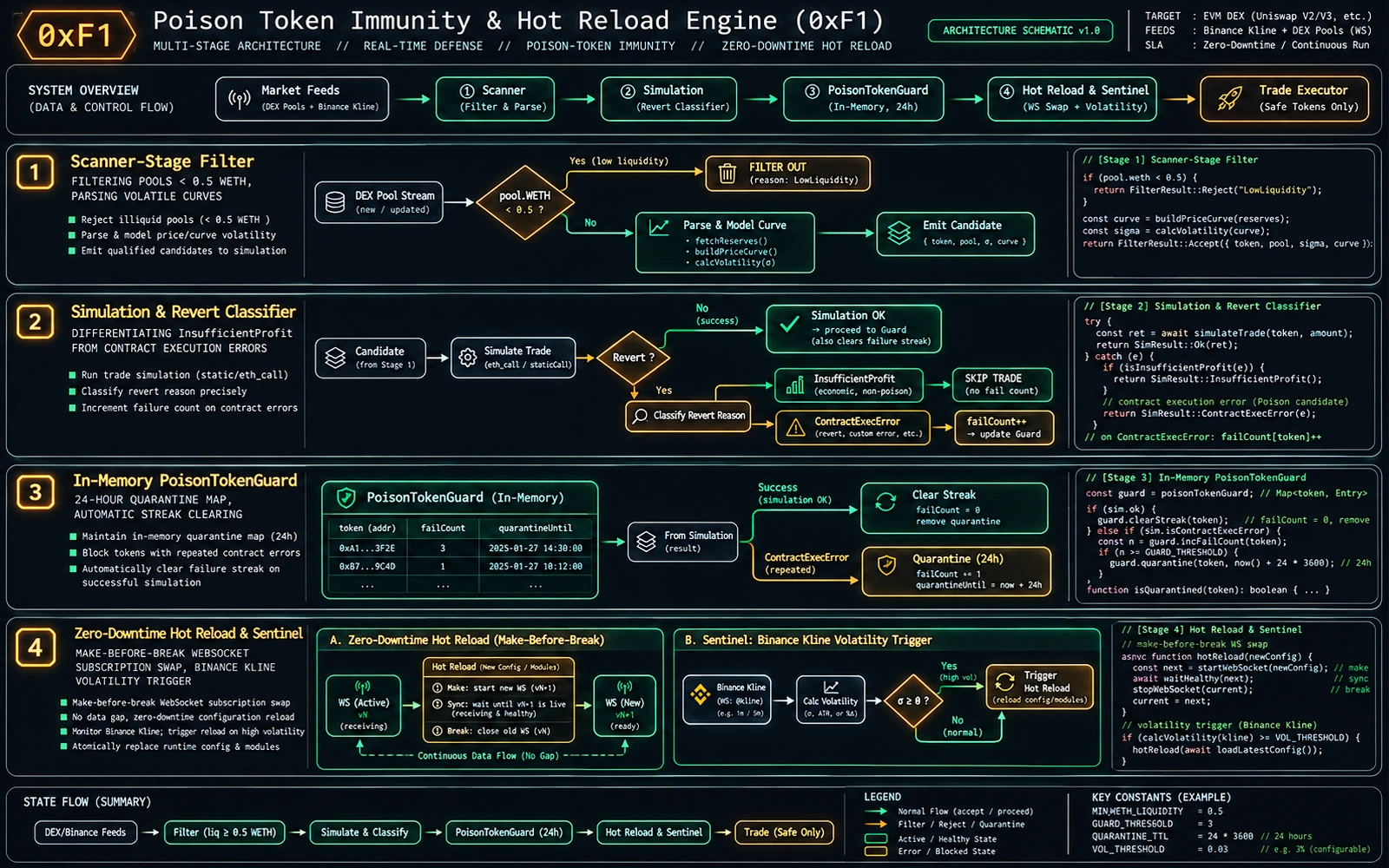
The engine divides malicious-token defenses and resource management into four cooperating layers:
+-----------------------------------------------------------------------------------+
|                     Long-Tail Arbitrage Defense and Hot-Reload Pipeline              |
+-----------------------------------------------------------------------------------+
|  1. Scanner-Stage Filter: pool-scanner.ts                                            |
|     - Both-side liquidity: reserves must equal >= 0.5 WETH / stablecoin equivalent   |
|     - Exclude stable == true curves and pools without a core quote-token pair        |
+-----------------------------------------------------------------------------------+
                                       |
                                       v
+-----------------------------------------------------------------------------------+
|  2. Simulation & Failure Classifier with PoisonTokenGuard                           |
|     - Normal slippage (revertName == 'InsufficientProfit'): expected; no penalty      |
|     - Execution failure (blocked transfer/honeypot/tax): record 1 consecutive failure |
|     - 3 unexpected consecutive reverts: in-memory blacklist for 24 hours (0 RPC use) |
|     - Any successful simulation: clear failures and remove suspicion immediately     |
+-----------------------------------------------------------------------------------+
                                       |
                                       v
+-----------------------------------------------------------------------------------+
|  3. Make-Before-Break Hot Reload                                                     |
|     - Timer/event updates watch_pairs.json (atomically persisted by pool-scanner)    |
|     - Connect/subscribe new WebSocket -> verify stream stability -> release old one  |
|     - 0 milliseconds of service downtime; no missed block arrival                     |
+-----------------------------------------------------------------------------------+
                                       |
                                       v
+-----------------------------------------------------------------------------------+
|  4. Binance Kline Sentinel: arb-sentinel.ts                                          |
|     - Monitor ethusdt@aggTrade live 1-minute candles: amplitude = (High - Low) / Low |
|     - Amplitude >= 1.2%: wake resident engine in milliseconds; extend active window 15 minutes |
|     - Sleep during quiet sideways markets; save 90% of idle RPC and node compute     |
+-----------------------------------------------------------------------------------+
Comparing Long-Tail Token Defense Strategies
| Dimension | Manual static blacklist | Catch every error without circuit breaking | Fone dynamic PoisonTokenGuard + sentinel |
|---|---|---|---|
| New honeypot detection | Hours late; manual investigation | None; repeats the same failure every block | Self-isolates within seconds after 3 failures per token |
| Normal slippage | May wrongly block healthy competitive pools | Cannot distinguish low profit from malicious code | Exempts InsufficientProfit; penalizes only code-level errors |
| Automatic unblocking | Permanent bans miss recovered liquidity | No unblocking mechanism | 24-hour rolling quarantine, then automatic retry |
| Configuration downtime | Process restart, 30s+ downtime | Crashes can stop the whole system | Make-before-break, 0 seconds downtime |
| Quiet-market RPC cost | Expensive 24-hour high-frequency polling | Fake pools consume compute | CEX-price-triggered wake-up saves 90% of idle RPC |
Core Implementation 1: The In-Memory PoisonTokenGuard
In evm-arbitrage/resident-bot.ts, the lightweight PoisonTokenGuard monitors every tracked long-tail token.
1. Why InsufficientProfit Must Be Exempt
MEV prices move in milliseconds. A simulation returning InsufficientProfit, meaning profit below the minimum or a loss, is normal market behavior: another trader closed the spread first, or liquidity was insufficient. It does not mean the token is malicious.
Simulation errors such as TransferFailed, Pausable: paused, or unknown EVM execution failures instead indicate honeypot mechanics, malicious dynamic taxes, or transfer blacklists.
2. Three Consecutive Failures and a 24-Hour Quarantine
// From evm-arbitrage/resident-bot.ts
export class PoisonTokenGuard {
  // Track each token's current consecutive failure count
  private failureCounts = new Map<string, number>();
  // Track quarantine expiration timestamps
  private quarantinedUntil = new Map<string, number>();

  // Trip after 3 consecutive failures
  private readonly MAX_CONSECUTIVE_FAILURES = 3;
  // Quarantine duration: 24 hours
  private readonly QUARANTINE_MS = 24 * 60 * 60 * 1000;

  /**
   * Check whether the token is currently quarantined
   */
  public isQuarantined(token: Address): boolean {
    const key = token.toLowerCase();
    const until = this.quarantinedUntil.get(key);
    if (!until) return false;

    if (Date.now() >= until) {
      // Quarantine expired: remove ban and reset counter
      this.quarantinedUntil.delete(key);
      this.failureCounts.delete(key);
      return false;
    }
    return true;
  }

  /**
   * Record an unexpected failure (call only for errors other than InsufficientProfit)
   * @returns Whether a new quarantine was triggered
   */
  public recordFailure(token: Address): boolean {
    const key = token.toLowerCase();
    const current = (this.failureCounts.get(key) || 0) + 1;
    this.failureCounts.set(key, current);

    if (current >= this.MAX_CONSECUTIVE_FAILURES) {
      this.quarantinedUntil.set(key, Date.now() + this.QUARANTINE_MS);
      return true; // Start 24-hour quarantine
    }
    return false;
  }

  /**
   * Clear failure history immediately after successful simulation or execution
   */
  public recordSuccess(token: Address): void {
    const key = token.toLowerCase();
    this.failureCounts.delete(key);
    this.quarantinedUntil.delete(key);
  }
}
3. Error Classification in the Resident Executor
During simulation, the system recursively walks viem‘s error chain to identify the underlying contract revert:
// From evm-arbitrage/resident-bot.ts
    } catch (err) {
      if (broadcastAttempted) {
        this.executionPaused = true;
        console.error('[交易暂停] 广播后的结果无法确认;请核对钱包交易后重启,避免重复发送。');
      } else {
        // Recursively locate the underlying contract revert
        const reverted = err instanceof BaseError
          ? err.walk((e) => e instanceof ContractFunctionRevertedError)
          : undefined;

        // Penalize only underlying contract errors other than InsufficientProfit
        if (
          initialSimulation &&
          reverted instanceof ContractFunctionRevertedError &&
          reverted.data?.errorName !== 'InsufficientProfit'
        ) {
          if (this.poisonGuard.recordFailure(targetToken)) {
            console.warn(`[PoisonGuard] ⚠️ ${targetToken} 连续 3 次异常合约回滚,已拉入黑名单暂停 24 小时!`);
          }
        }
        console.warn('[跳过机会]', err instanceof BaseError ? err.shortMessage : String(err));
      }
    } finally {
      this.executionInFlight = false;
    }
After failed simulations in the first 3 blocks following discovery, a honeypot is silently isolated for 24 hours. Later blocks skip it in O(1) time without wasting even half a word of RPC compute.
Core Implementation 2: Make-Before-Break Hot Reload
Long-tail pools change constantly: dozens appear daily while older pools are drained. The background scanner (pool-scanner.ts) writes an updated watch_pairs.json every hour.
Restarting the resident engine after every configuration update loses context for queued in-flight transactions and can miss profitable opportunities during the restart window.
1. Make-Before-Break Design
We use the make-before-break pattern from highly available telecom systems:
- Make: parse the new configuration in memory and create WebSocket
Syncfilters or log subscriptions for new pools. - Verify: confirm the new streams continuously receive reserve updates from the latest blocks, warming the shadow pool in memory.
- Cut over: atomically replace the active-pool reference with
this.activeWatchPairs = newPairs. - Break: gracefully remove subscriptions and close handles for obsolete pools.
// Core zero-downtime hot-reload pseudocode
export async function hotReloadWatchPairs(engine: ArbitrageEngine, newPairsConfigPath: string) {
  console.log('[HotReload] 收到新长尾交易对配置,启动先建后拆热切换...');

  // 1. Read and parse the new configuration atomically written by pool-scanner
  const rawData = fs.readFileSync(newPairsConfigPath, 'utf8');
  const newPairs: ArbPairConfig[] = JSON.parse(rawData);

  // 2. Identify newly added liquidity pool addresses
  const currentPoolAddresses = new Set(engine.getAllTrackedPools());
  const incomingPools = newPairs.flatMap(p => [p.poolA, p.poolB]);
  const newPoolsToSubscribe = incomingPools.filter(addr => !currentPoolAddresses.has(addr));

  // 3. Incrementally subscribe to new pools without downtime
  if (newPoolsToSubscribe.length > 0) {
    await engine.subscribeIncrementalPools(newPoolsToSubscribe);
  }

  // 4. Atomically replace the route-matrix reference (microsecond memory assignment)
  engine.updateRouteMatrix(newPairs);

  // 5. Clean up subscriptions for pools no longer monitored
  const activePoolAddresses = new Set(incomingPools);
  const obsoletePools = Array.from(currentPoolAddresses).filter(addr => !activePoolAddresses.has(addr));
  if (obsoletePools.length > 0) {
    engine.unsubscribeObsoletePools(obsoletePools);
  }

  console.log(`[HotReload] ✨ 热重载完成!无缝切换至 ${newPairs.length} 组交易对,全程 0 停机。`);
}
Core Implementation 3: A Binance-Driven Wake-Up Sentinel (arb-sentinel.ts)
On-chain DEX opportunities commonly follow sharp price breakouts on centralized exchanges such as Binance, prompting external arbitrageurs to sell into on-chain pools or making those pools follow prices downward.
During quiet sideways markets, Ethereum mainnet and Base may offer almost no arbitrage. Full-power scanning around the clock can cost hundreds of dollars per day in node calls.
In evm-arbitrage/arb-sentinel.ts, we implement a lightweight off-chain amplitude-based wake-up sentinel:
// From evm-arbitrage/arb-sentinel.ts
  private handleKlineTick(kline: { h: string; l: string; c: string; v: string }): void {
    const high = parseFloat(kline.h);
    const low = parseFloat(kline.l);
    const close = parseFloat(kline.c);

    if (low <= 0) return;

    // Compute live amplitude of the current 1-minute candle: (high - low) / low
    const amplitude = (high - low) / low;

    // Treat amplitude above the threshold (e.g. >= 1.2%) as a major market move
    if (amplitude >= CONFIG.VOLATILITY_THRESHOLD) {
      console.log(
        `⚡ [Sentinel] 检测到中心化市场剧烈波动!当前 ETH 1m 振幅: ${(amplitude * 100).toFixed(2)}% (现价: $${close})`
      );
      this.triggerOrExtendActiveMode();
    }
  }

  private triggerOrExtendActiveMode(): void {
    // Wake resident on-chain engine in milliseconds (skip internally if already running)
    this.arbEngine.wakeup();

    // Debounce: ongoing volatility continually extends the 15-minute active window
    if (this.cooldownTimer) {
      clearTimeout(this.cooldownTimer);
    }

    this.cooldownTimer = setTimeout(() => {
      console.log('[Sentinel] 市场波动平息超过 15 分钟,套利引擎平滑进入节能休眠态...');
      this.arbEngine.hibernate();
      this.cooldownTimer = null;
    }, CONFIG.COOLDOWN_MS); // Default 15-minute cooldown
  }
With this sentinel:
- During quiet sideways periods, the bot sleeps while the sentinel maintains only a lightweight Binance WebSocket, saving at least 90% of unnecessary RPC spending.
- When volatility begins, the first price tick wakes the resident engine in under 10 milliseconds, capturing the first major opportunities from sharp CEX/DEX price divergence.
Four Production Rules for Long-Tail Arbitrage Defense
When building long-tail liquidity arbitrage bots for Base, Arbitrum, or other high-frequency chains, follow these four rules:
- Exclude shallow dead pools during discovery: enforce strict two-sided liquidity thresholds in
pool-scanner, such as at least 0.5 WETH on both sides and pairing with approved core assets. This filters out 95% of low-cost worthless-token pools. - Do not classify normal slippage as a malicious token: distinguish underlying error codes in the circuit breaker. Exempt
InsufficientProfitto avoid blocking legitimate competitive pairs. - Avoid configuration reloads that restart the process: use make-before-break, warming subscriptions on new connections before atomically swapping memory references, preserving every consecutive block opportunity.
- Use inexpensive off-chain market signals to activate the engine: do not consume commercial RPC quotas in inactive markets. Use free high-frequency CEX amplitude data to reserve resources for real volatility.
Enterprise DeFi Trading and Arbitrage Architecture Consulting
Fone provides production EVM multihop arbitrage, MEV protection, liquidity monitoring gateways, and white-label DEX infrastructure for market makers, quantitative trading teams, and Web3 investment firms. Our White-Label DEX Launch Kit and arbitrage engine have been verified through mainnet forks and high-concurrency live operation:
- Explore the complete flash-loan arbitrage stack: Production EVM Multihop Flash-Loan Arbitrage Architecture
- Read about contract gas optimization: EVM Arbitrage Gas Optimization with 1-Wei Storage Prewarming
- Learn about heterogeneous pool discovery: Base Arbitrage Scanning: Aerodrome V2 Events and Dual-Curve Pitfalls
- Arrange a strategy audit and performance assessment with a senior MEV architect: Discuss Custom Requirements with Fone