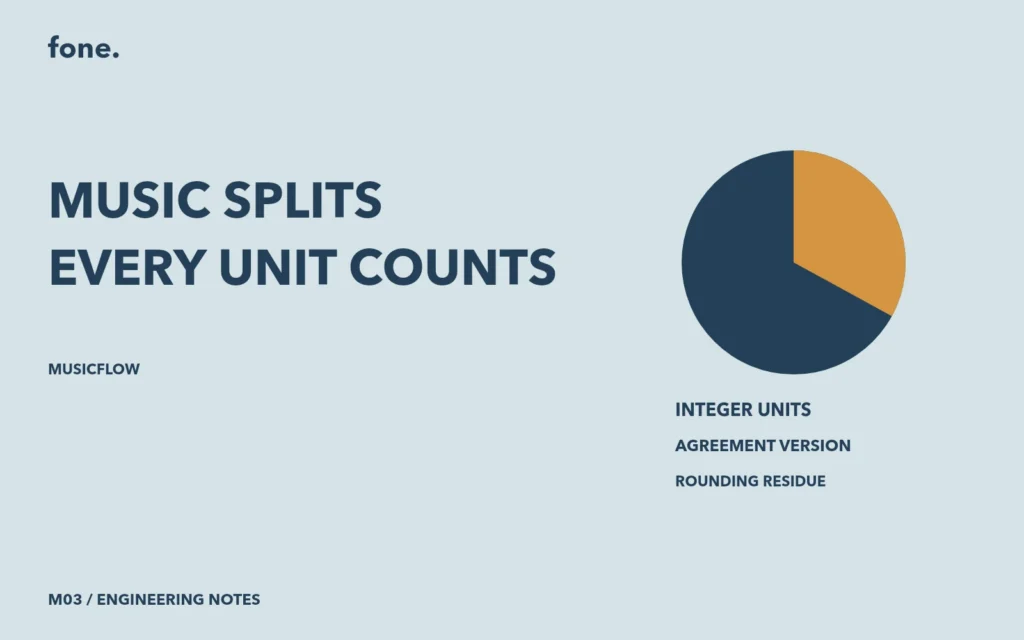
A licensing split can add up on a percentage sheet and still leave a remainder when money is represented in indivisible units. The allocation record needs to preserve that remainder. Otherwise a later payment review has to explain a difference that the original calculation never recorded.
The Fone MusicFlow demonstration describes a 10 test USDC license with a 15 percent platform share. The remaining 85 percent is divided 70/30 between two collaborators. Those particular values produce 1.50, 5.95 and 2.55 test USDC without a remainder. Smaller unit amounts reveal the rounding policy more clearly.
Calculate in the asset's smallest unit
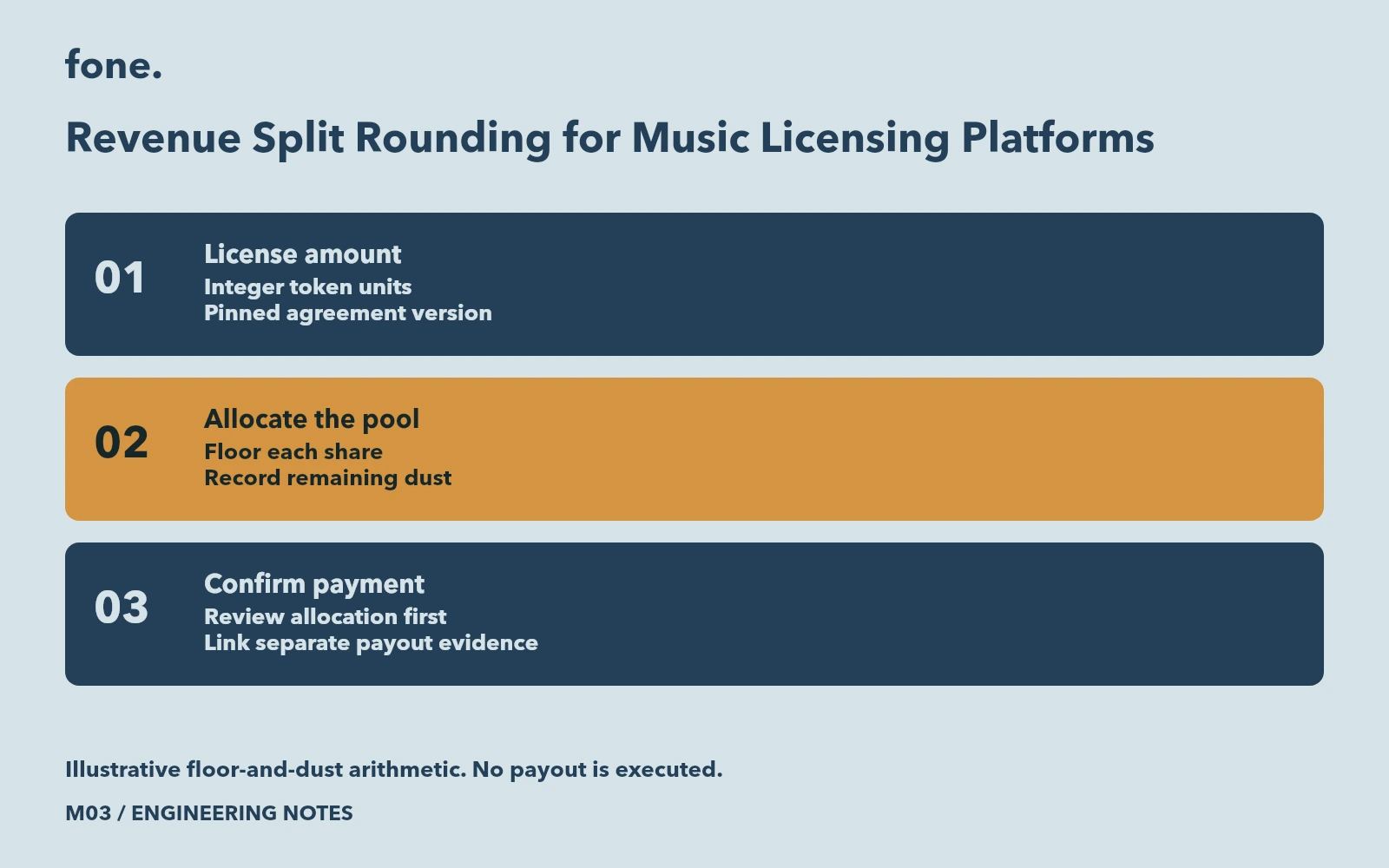
The inspected allocation function reads the order amount as an integer and uses a scale of 10,000 for basis points. It first calculates the platform amount using integer division. It subtracts that amount from the order total, calculates each collaborator's share from the remaining pool and stores the unallocated difference as dust.
This order of operations matters. A collaborator's 70 percent is applied to the collaborator pool after the platform share, so it is not 70 percent of the whole license amount. Store both the basis and the rate in a reviewable snapshot. A percentage without its base leaves room for different interpretations of the same agreement.
For an illustrative amount of 101 smallest units, a 15 percent platform share floors to 15 units. The pool becomes 86 units. Applying the 70/30 collaborator split floors the two allocations to 60 and 25 units. One unit remains. The conservation check is therefore 15 plus 60 plus 25 plus 1 equals 101.
| Component | Whole license example | Small-unit example |
|---|---|---|
| Gross amount | 10.00 test USDC | 101 units |
| Platform at 15 percent | 1.50 test USDC | 15 units |
| Collaborator pool | 8.50 test USDC | 86 units |
| First collaborator at 70 percent | 5.95 test USDC | 60 units |
| Second collaborator at 30 percent | 2.55 test USDC | 25 units |
| Explicit remainder | 0 | 1 unit |
These are worked arithmetic examples, not reports of tests run for this article. The downloadable worksheet includes additional inputs so an implementer can check the chosen policy independently.
Make the remainder policy explicit
MusicFlow's inspected function records dust separately. It does not redistribute that dust to the largest fractional share or automatically give it to the last collaborator. The event-accounting path also recognizes a distinct dust liability when allocation is recorded. An article or proposal should preserve that distinction instead of replacing the source behavior with a familiar rounding algorithm.
A project may choose a different policy. If so, name the recipient of every residual unit and define a deterministic tie rule before implementing it. Changing that rule changes who receives the smallest amounts. Keep the policy version with each allocation so a recalculation months later uses the rule that applied to that order.
The same review should cover totals that are too small to pay every beneficiary, a platform rate of zero and contributor shares that fail to sum to the permitted total. These checks belong before an allocation can be approved. A display that rounds to two decimal places can conceal a valid residual amount in a token with finer precision.
Keep allocation and payment evidence separate
The product materials state that a license order fixes its agreement version and that administrators sign allocation and settlement actions after review. The inspected server also evaluates settlement eligibility against finalized payment state, fulfillment, an observation period and open disputes. An arithmetic result alone does not authorize a payment.
The payment record needs its own destination and transaction evidence. A credited amount may remain unpaid while a destination is being checked or an authorization expires. Keeping those stages separate lets the interface say what has actually happened without implying that an allocation is already in the recipient's possession.
For reconciliation, begin with the order's integer amount and pinned agreement. Reproduce platform, collaborator and dust amounts, then match the approved allocation to the subsequent payment record. Do not recalculate an old order using today's collaborator list. A new collaborator agreement should affect the orders that explicitly reference it.
The split rounding worksheet supplies review vectors and a place to record actual results, with every case initially marked Not run. Fone MusicFlow shows the licensing workflow and implementation scope. Its current demonstration uses test assets and fixed music samples; real model operation and commercial media rights require project-specific agreement.