A Web3 startup that has raised an angel round pays an external engineering team $80,000 to build a decentralized trading and staking system. On the contract’s final day, the vendor posts a GitHub link and archive in Slack: “All code submitted, tests passing, delivery complete. Great working with you!”
Three weeks later, problems arrive one after another:
- A newly hired senior full-stack engineer runs
npm run buildlocally and gets 14 dependency conflicts. The vendor used loose^versions inpackage.jsonand committed neitherpackage-lock.jsonnor a Dockerfile; - Mainnet contract administration still belongs to the personal MetaMask EOA of a vendor developer who has already left. With one-step
transferOwnership, one mistyped character could permanently destroy all upgrade and administration rights; - A database connection-pool deadlock occurs overnight. The new team searches the repository and finds no architecture diagram, environment-variable dictionary, or Runbook explaining safe rollback and pending-lock cleanup.
The startup must return to the vendor and buy operational support at $200 per hour.
Sending a source-code archive is not an engineering handover; it is passing responsibility along under the cover of delivery.
For customers buying white-label foundations or commissioning development, the goal is complete control and independent operation of the system—Zero-Vendor-Lock-In. This article shares fone.cc‘s 5-Pillar Handover Standard and its acceptance checklist for independent operations.
1. Why a Code-Only Delivery Creates Long-Term Risk
Failed outsourced and white-label projects repeatedly show four gaps behind lasting dependence on the original developers:
+----------------------------------------------------------------------------------------------------+
|                                   Four Gaps in Traditional Code Delivery                            |
+----------------------------------------------------------------------------------------------------+

   [ Gap 1: Build Reproducibility ]
   "It works on my machine" — no version-pinned Docker / DevContainer orchestration.
   An OS or base-image upgrade can cost a new engineer 2 weeks of environment debugging.

   --------------------------------------------------------------------------------------------------

   [ Gap 2: Key & Governance Ambiguity ]
   Deployer, Owner, and FeeTo addresses are mixed into temporary personal seed phrases held by
   the vendor. The client cannot know whether its vault still has a backdoor.

   --------------------------------------------------------------------------------------------------

   [ Gap 3: Secret Rotation Blindness ]
   Development/test API Tokens (Infura, Stripe, AWS, KMS) are copied directly into production.
   After handover, the client does not know how to rotate them without downtime.

   --------------------------------------------------------------------------------------------------

   [ Gap 4: No Incident Runbook ]
   Deadlocks, RPC 429 limits, and chain reorgs have no step-by-step response guide.
   Panicked operators restart servers blindly and risk secondary data corruption.
+----------------------------------------------------------------------------------------------------+
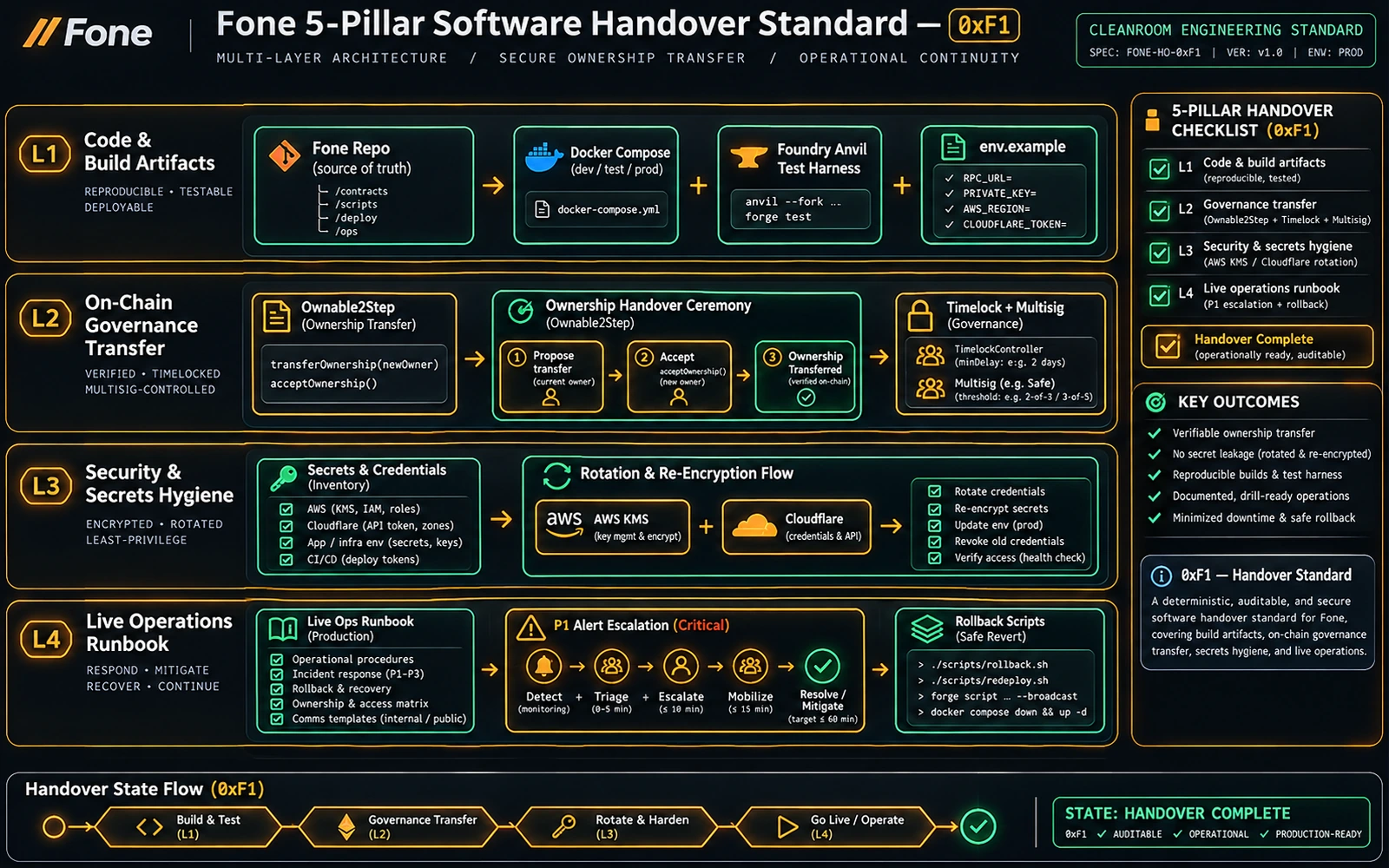
2. Fone’s Five Production Handover Pillars
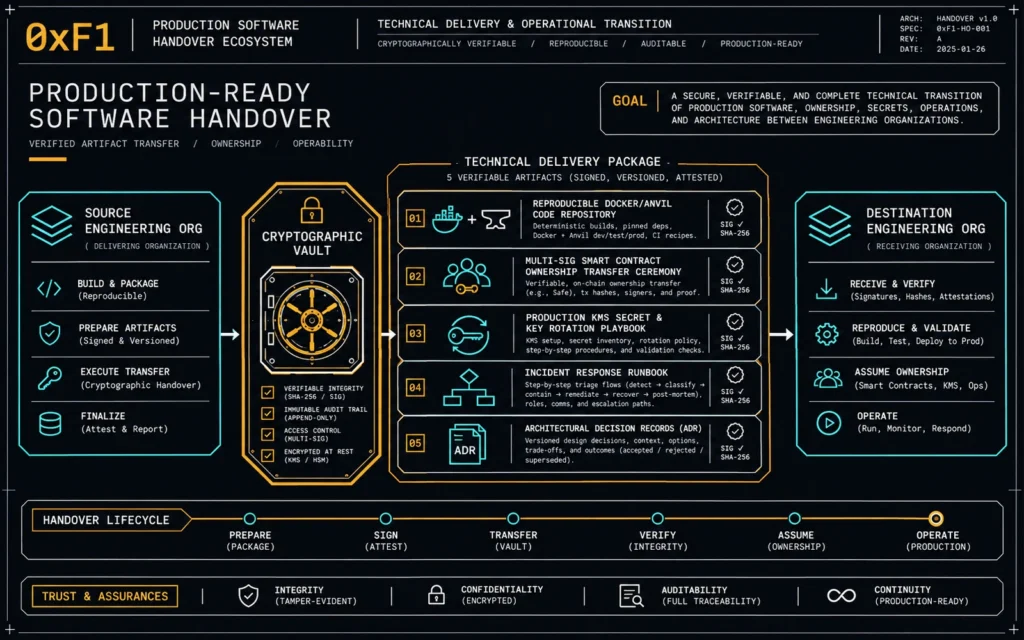
A complete Handover Package covers five distinct dimensions:
+----------------------------------------------------------------------------------------------------+
|                                    Fone Five-Pillar Production Handover                             |
+----------------------------------------------------------------------------------------------------+

   [ Pillar 1: Deterministic One-Command Build Environment ]
   ├── Complete Docker Compose (App + Redis + MySQL 8.0 + Local Foundry Anvil Fork)
   └── Self-explanatory .env.example: purpose, security level, and provisioning URL for each variable
                 │
                 ▼
   [ Pillar 2: On-Chain Ownership Transfer Ceremony ]
   ├── Mandatory Ownable2Step confirmation (prevent mistyped addresses from destroying control)
   └── On-chain governance assignment for Safe Multisig vaults and TimelockController
                 │
                 ▼
   [ Pillar 3: Zero-Vendor-Lock-In Secret Rotation ]
   ├── Zero-downtime rotation Playbook for AWS KMS / Cloudflare R2 / database master credentials
   └── Revoke all former developer SSH Keys, cloud IAM subaccounts, and GitHub collaborator access
                 │
                 ▼
   [ Pillar 4: Operations Runbook & Incident Triage ]
   ├── P1/P2 recovery SOPs (stuck Mempool transactions, database lock timeouts)
   └── Hot/cold backup and Disaster Recovery verification drill scripts
                 │
                 ▼
   [ Pillar 5: Architecture Decision Records (ADR) and Evolution Roadmap ]
   ├── Record technology choices, rejected alternatives, and intended extension points
   └── Expose technical-debt risks so the incoming team can extend the system independently
+----------------------------------------------------------------------------------------------------+
3. Performing the Smart-Contract Ownership Transfer Ceremony
In Web3 systems holding funds, contract-permission handover is the riskiest part of delivery. Poor-quality implementations use one-step OpenZeppelin Ownable.transferOwnership(newOwner): a mistyped address or clipboard malware can immediately destroy administration rights.
The fone.cc delivery standard requires Ownable2Step, with engineers from both parties completing the ceremony on-chain:
// whitelabel-platform/contracts/src/security/SafeOwnershipCeremony.sol
// SPDX-License-Identifier: MIT
pragma solidity ^0.8.20;

import "@openzeppelin/contracts/access/Ownable2Step.sol";

contract SafeOwnershipCeremony is Ownable2Step {
    event OwnershipTransferInitiated(address indexed previousOwner, address indexed newPendingOwner);
    event OwnershipTransferCompleted(address indexed previousOwner, address indexed newOwner);

    constructor(address initialDeployer) Ownable(initialDeployer) {}

    /**
     * @notice Step 1 (vendor): nominate the client multisig as pending Owner
     * The vendor retains control until the client multisig accepts
     */
    function initiateHandoverToClient(address clientSafeMultisig) external onlyOwner {
        require(clientSafeMultisig != address(0), "INVALID_MULTISIG_ADDRESS");
        transferOwnership(clientSafeMultisig); // Set pendingOwner through Ownable2Step
        emit OwnershipTransferInitiated(msg.sender, clientSafeMultisig);
    }

    /**
     * @notice Step 2 (must be submitted by the client multisig): accept control
     * Permissions change atomically only when the client multisig calls acceptOwnership()
     * This proves the client controls signing for the new address
     */
    function finalizeHandover() external {
        address previous = owner();
        acceptOwnership(); // OpenZeppelin asserts msg.sender == pendingOwner internally
        emit OwnershipTransferCompleted(previous, msg.sender);
    }
}
The handover package must also include a Foundry-verified deployment and ownership-transfer script:
# Client takeover verification drill (included in handover)
# 1. Vendor nominates the client
cast send $CONTRACT_ADDRESS "initiateHandoverToClient(address)" $CLIENT_MULTISIG --private-key $DEVELOPER_KEY

# 2. Client multisig accepts
cast send $CONTRACT_ADDRESS "acceptOwnership()" --from $CLIENT_MULTISIG --ledger

# 3. Assert final on-chain ownership
cast call $CONTRACT_ADDRESS "owner()(address)" # Output must exactly equal $CLIENT_MULTISIG
4. Rotating Production Credentials Without Downtime
To demonstrate that developers retain no hidden access to client servers, the handover checklist must include a zero-downtime Key Rotation Playbook:
+----------------------------------------------------------------------------------------------------+
|                                  Zero-Downtime Production Credential Rotation                      |
+----------------------------------------------------------------------------------------------------+

   [ Step 1: Create New Production Credentials (Dual-Key Ingestion) ]
   The client creates new production API Keys and IAM roles in its own AWS / Cloudflare console.
   Both old and new Keys remain valid at this point.
            │
            ▼
   [ Step 2: Rolling Environment Update (Rolling Restart) ]
   Update container environment variables through Docker Swarm / Kubernetes:
   replace RPC_URL, DATABASE_URL, and KMS_KEY_ID with client-owned credentials.
   Verify that 100% of /healthz checks pass.
            │
            ▼
   [ Step 3: Revoke Old Development Credentials (De-provisioning) ]
   The vendor revokes the test Keys used during development.
   If the system remains stable without alerts, it is running entirely on the client's independent infrastructure.
            │
            ▼
   [ Step 4: Sign the Handover Acceptance (Sign-off) ]
   The client's technical director verifies the outcome and releases the final payment.
+----------------------------------------------------------------------------------------------------+
5. Independent-Operations Handover Checklist
fone.cc provides this final checklist to technology buyers and CTOs. If any item is missing, the delivery is not ready for acceptance:
| Category | Check | Definition of Done |
|---|---|---|
| Code and build | 1. One-command containerized reproduction | On a new machine, docker compose up -d starts frontend, backend, and local test chain within 5 minutes |
| 2. Strict dependency locking | package-lock.json or pnpm-lock.yaml exists and pins exact semantic versions; no * |
|
| 3. Tests and coverage | Run forge test and pnpm test:cov; core business-path coverage is ≥ 85% |
|
| Security and permissions | 4. Two-step contract handover | Mainnet Owner is the client’s Safe multisig; original deployment key is fully retired |
| 5. No developer backdoors | Repository-wide search finds no hardcoded test keys, backdoor withdrawal addresses, or centralized validation bypasses | |
| 6. Independent infrastructure | Production database, Redis, and RPC nodes are in client-owned cloud accounts; developer accounts are revoked | |
| Operations and documentation | 7. Self-explanatory environment dictionary | Complete root .env.example explains each variable’s purpose and generation |
| 8. P1 incident guides | Three Runbooks cover stuck Mempool transactions, forced database-lock release, and rollback to the previous image | |
| 9. Architecture Decision Records | Document core state machines, external API choices, and known Technical Debt |
6. Connecting Handover to the Earlier Engineering Work
A production handover package should develop from project inception, rather than be assembled hurriedly at the end:
- Start with a rigorous engineering brief: At kickoff, the Project Brief that eliminates 80% of rework defines the objective acceptance matrix (DoD). The handover checklist fulfills that agreement;
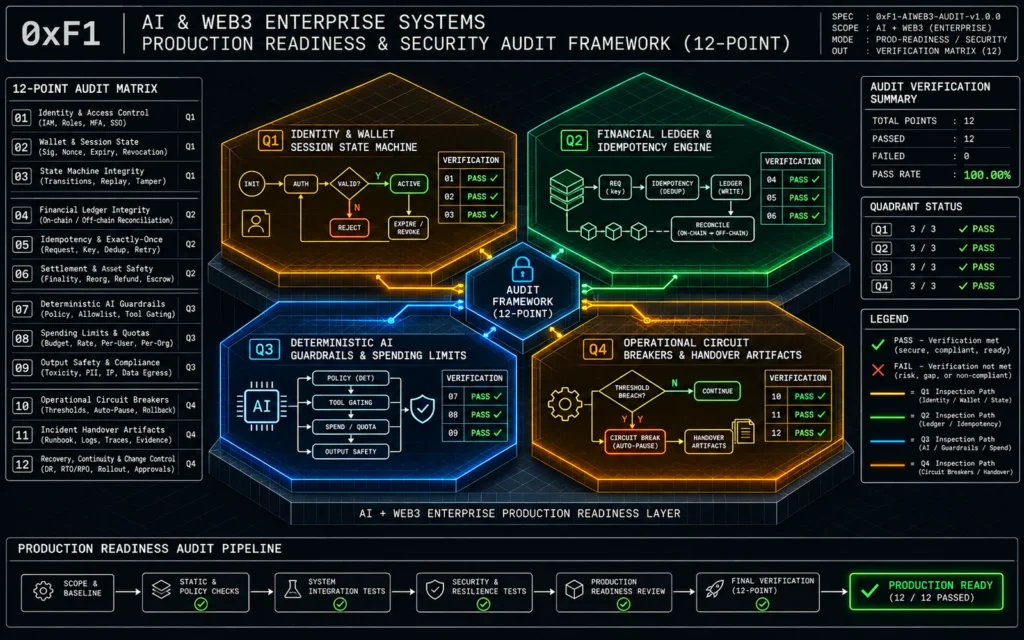
- Pass the 12-point launch audit: Before sign-off, the system completes the 12-Point Engineering Audit from AI Prototype to Production, ensuring no concurrency races, reorg double spends, or precision-truncation vulnerabilities remain;
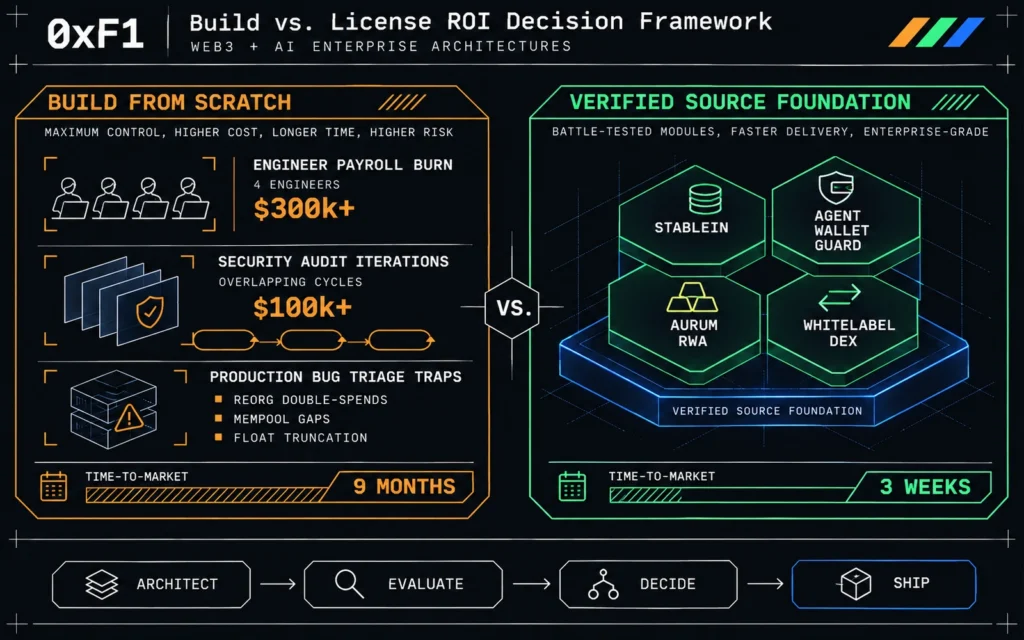
- Realize the value of white-label source: As discussed in the build-from-scratch versus source-verified foundation ROI guide, independent-operation handover standards are what let companies save 75% of trial-and-error costs and keep software assets under their own team’s control.
Architecture Consulting and Source-Code Delivery
If you are commissioning development, buying a white-label foundation, or standardizing internal handovers to prevent outages when key employees leave or vendors change:
- Visit Fone client deliveries and system demos for sample engineering packages, deployment scripts, and architecture documentation;
- Read our full-stack production engineering and launch audit guide;
- Book a one-to-one technical discussion through the Fone architecture consulting channel for a standard handover package with Docker templates, Ownable2Step scripts, and Runbooks.