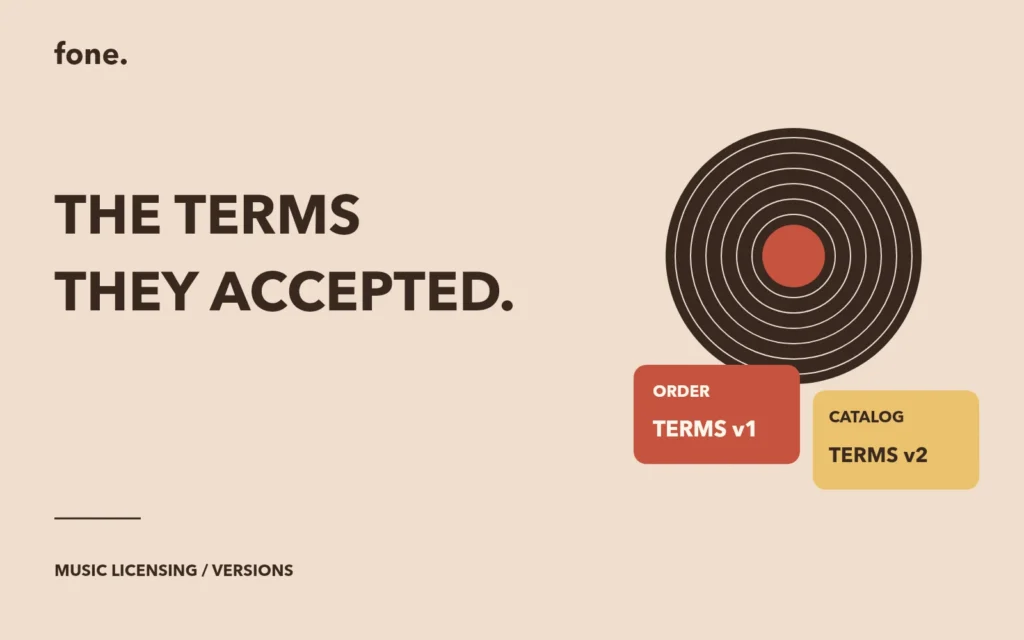
A buyer returns to a music platform to download a track licensed last month. The track page now shows revised terms. Which terms should the order display?
The order needs the version the buyer accepted. Store the readable terms and the work identity with the accepted quote, then keep later eligibility and delivery decisions separately. A link to today's offer cannot reconstruct yesterday's purchase.
This becomes especially useful in an AI music workflow, where the audio, artwork, collaborator agreement and permitted uses may change on different schedules. The data model needs to identify which versions were involved in each purchase.
Separate the work from the offer
Start with the asset being licensed. A track title is a display label. It can stay the same while the audio file changes. Preserve a work version and a hash of the delivered asset, together with the terms that apply to it.
The offer adds commercial information such as permitted uses, price and participating rights holders. The buyer then receives a quote. That quote needs enough information to explain the purchase later, even if the public offer is replaced.
A practical record connects these objects.
| Record | Retained information | Why it is useful later |
|---|---|---|
| Work version | Stable version ID and audio hash | Identify the file associated with the purchase |
| Quote | Readable terms, terms hash, price, asset and expiry | Reconstruct what was offered |
| Acceptance | Authenticated buyer, quote hash and terms hash | Identify the version explicitly accepted |
| Order | Frozen quote snapshot and payment domain | Match payment to the accepted purchase |
| Credential | Original work and terms, payment reference and effective period | Explain the issued license without querying today's offer |
| Current state | Suspension, expiry or revocation with its history | Decide whether another download is allowed now |
A hash helps detect a change when the original data and serialization rules are available. It cannot replace the readable terms. Back up the documents and assets needed to interpret the record.
Bind acceptance to the quote
Fone MusicFlow's current local implementation stores the quote snapshot and computes its quoteHash. The purchase request supplies both acceptedQuoteHash and acceptedTermsHash. The server compares them with the stored quote, checks expiry and current sale eligibility, and copies that snapshot into the order.
This makes an acceptance mismatch observable. If the screen displays one version while the request accepts another, the order creation should fail instead of silently substituting the latest terms. A refreshed quote should require fresh acceptance.
Retries also need a stable meaning. MusicFlow checks the buyer and request identifier so an identical retry returns the existing order. A different payload under the same identifier is rejected. A quote can only be consumed by one order. These are source-reviewed behaviors in the local implementation; this article does not report a new end-to-end payment run.
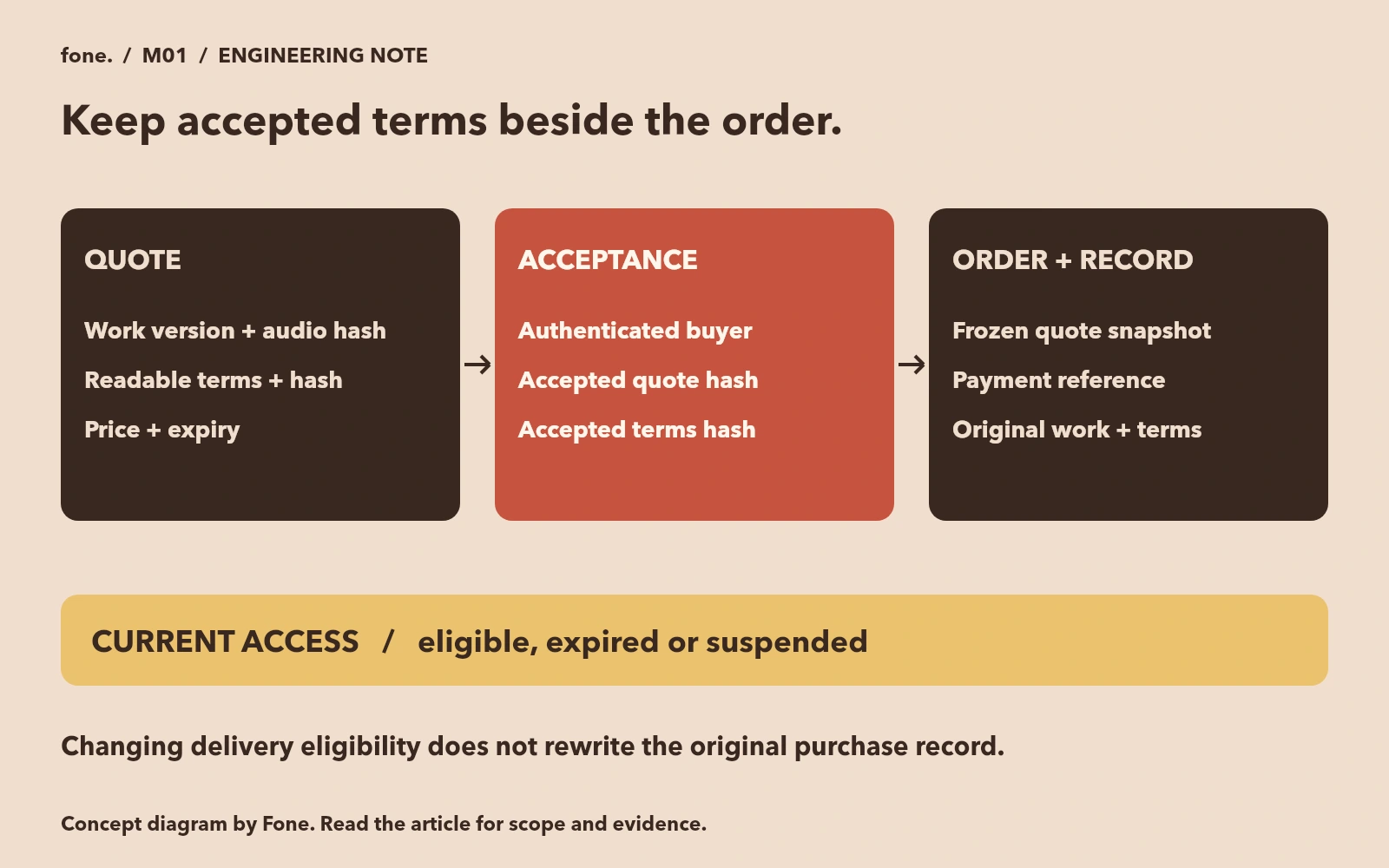
Keep the original purchase record readable when the current delivery decision changes.
Preserve the record when the catalog changes
The current credential-building path takes the work, terms and agreement from the accepted order snapshot. It adds the verified payment reference and effective period. A later public-page edit should not cause an older credential to be rebuilt from the newest catalog entry.
Two questions then have separate answers. What did the buyer accept? May this account download the asset now? A dispute or expiry may block a new download while the original record remains available to explain the purchase.
MusicFlow's documented local flow follows this separation. Removing a work from sale stops new sales and public audio, while an eligible existing buyer can still request the original version. Delivery checks the original asset hash and current entitlement. The implementation cannot withdraw bytes that someone has already downloaded.
If your product needs a different policy, specify it explicitly. A corrected file, a newly negotiated license and a refunded purchase are different events. Keeping their history is more useful than overwriting one status field and losing the reason for the change.
Try the version-change exercise
Download the snapshot exercise and review checklist. It contains a small Python example with synthetic records. The tests change the current offer after acceptance, reject mismatched acceptance hashes, check retries and preserve the old record when access is suspended.
The exercise uses in-memory objects to make the version relationship visible. It does not implement authentication, durable storage, concurrent purchases or payment verification. A real checkout still needs database constraints and a transaction around order acceptance. The SQLite transaction documentation is useful background for teams adapting the idea to a small relational implementation.
Use the checklist to decide what your own system must retain. In particular, decide who can read private project details and whether support staff can explain a historical order without seeing unrelated buyer information. A public credential page should not expose a buyer's private project reference by default.
What the MusicFlow example covers
Fone MusicFlow connects a creation workflow, license selection and buyer records in a local demonstration. Its sample audio is fixed Mock material and the payment asset is test USDC. The stored records demonstrate software behavior; they do not establish ownership of music or grant real commercial rights to the sample content.
For a licensing platform project, bring one proposed purchase journey and the versions it needs to retain. The useful starting point is the relationship between the delivered work, accepted terms and later access decisions. Model access and review of the underlying rights can then be scoped alongside that workflow.