Two hours after a new chain ecosystem or specialist Web3 community launches its branded decentralized exchange, widespread trading failures hit the frontend. Users click Swap, MetaMask estimates gas in the millions, and every submitted transaction reverts.
Logs reveal a basic but frequent engineering mistake: the team cloned Uniswap V2, changed management-fee distribution and naming in Pair.sol, and compiled new bytecode, but did not recompute and update the hardcoded hex'96e8ac063f614570944c2f899a50bcbfdd81149f5424c9346ff23876cb0d5adc', or INIT_CODE_PAIR_HASH, in UniswapV2Library.sol. The pool addresses predicted off-chain by the router using CREATE2 no longer match the pairs actually deployed by the factory. Every route and swap targets a nonexistent address.
A commercially deployable white-label DEX requires more than replacing the Uniswap V2 or PancakeSwap logo and redeploying contracts. It requires automated binding of AMM bytecode hashes, precision and zero-stake protections for the LP reward accumulator (accRewardPerShare), and token vesting risk controls.
1. Three Core Layers of a White-Label DEX
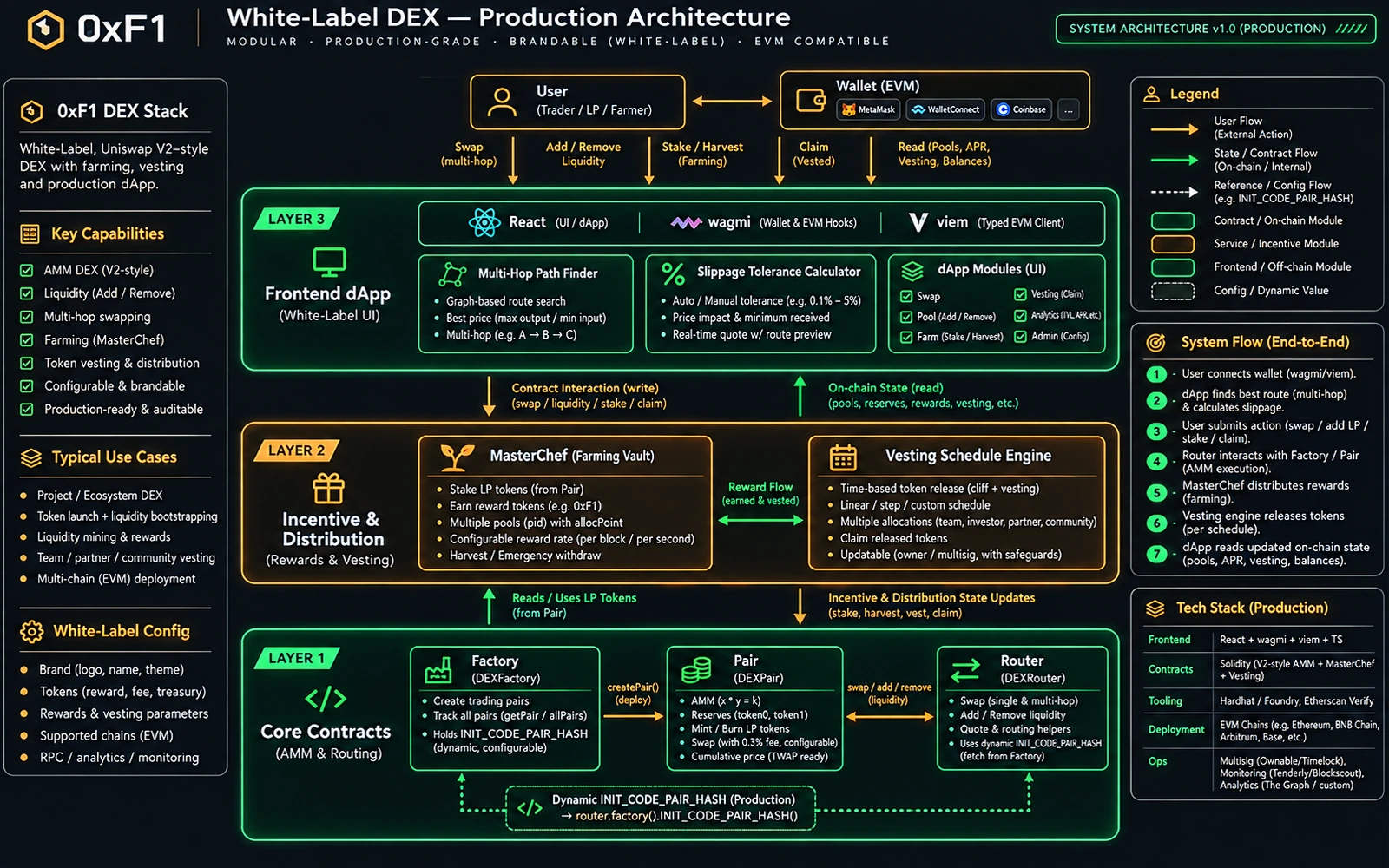
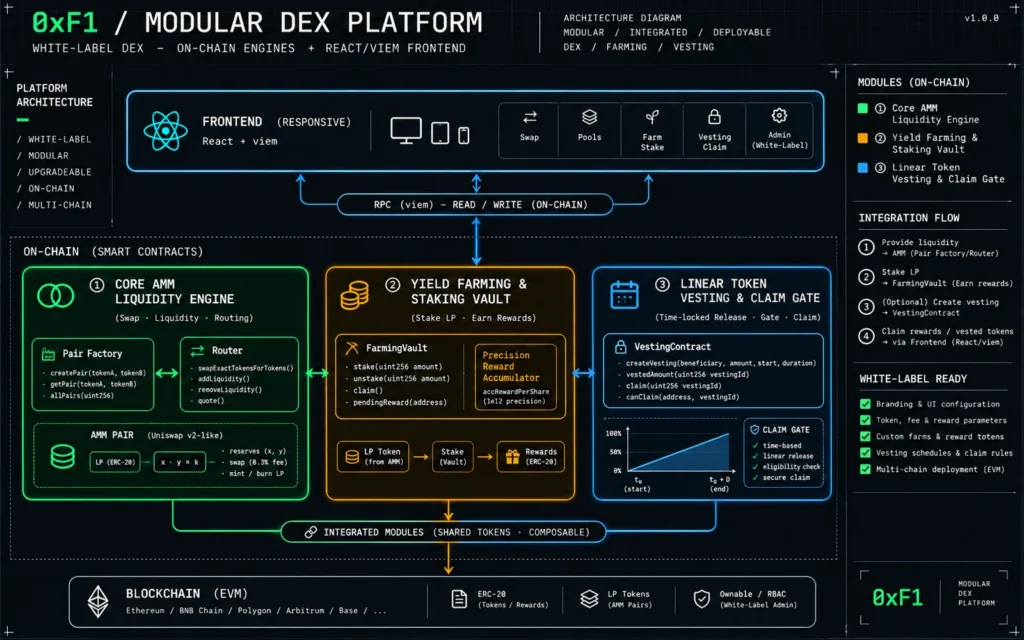
In the production White-Label DEX Launch Kit, three independent subsystems form the architecture:
+----------------------------------------------------------------------------------------------------+
|                               Production White-Label DEX: Three Engineering Layers                  |
+----------------------------------------------------------------------------------------------------+

   [ Layer 1: Core AMM Swaps and Liquidity ]
   ├── Factory (Pair deployment, protocol-fee switch, fee collection address)
   ├── Pair (constant-product x * y = k state machine, TWAP accumulator, flash-swap callback)
   └── Router (multihop routing, slippage protection, ETH/WETH wrapping, liquidity add/remove gateway)
            │
            ▼ Produces LP Token (ERC-20) liquidity receipts
   [ Layer 2: Liquidity Incentives and Token Distribution ]
   ├── MasterChef / MiniChef vaults (pool allocation, per-block/time reward accumulators)
   └── Linear Vesting vault (team/investor locks, cliff checks, reentrancy-safe withdrawals)
            │
            ▼ Web3 JSON-RPC / WebSocket
   [ Layer 3: Frontend and Deterministic Routing ]
   ├── React + Next.js + TailwindCSS (brand themes, localization, minimal dark technical UI)
   ├── viem / wagmi state machines (multichain wallet connections, network switching, pending-tx diagnostics)
   └── Client-side Route Splitter (microsecond local multihop search, price-impact alerts, simulation)
+----------------------------------------------------------------------------------------------------+
2. Two Critical Engineering Traps in AMM Customization
1. Automatically Align INIT_CODE_PAIR_HASH
In Uniswap V2, the router avoids cold on-chain factory.getPair(tokenA, tokenB) RPC reads during multihop swaps by using the deterministic CREATE2 address formula:
PairAddress = keccak256(0xff || Factory || keccak256(token0, token1) || INIT_CODE_PAIR_HASH)
Changing any line in UniswapV2Pair.sol, such as adding events, upgrading Solidity to 0.8.x, or introducing a custom ReentrancyGuard, changes the creation-bytecode hash completely.
Modern Foundry deployment scripts must compute and inject the hash dynamically rather than manually running cast keccak and hardcoding the result:
// whitelabel-dex/contracts/script/DeployDEXStack.s.sol
// SPDX-License-Identifier: MIT
pragma solidity ^0.8.20;

import "forge-std/Script.sol";
import "../src/core/CustomPairFactory.sol";
import "../src/periphery/CustomRouter.sol";
import "../src/core/CustomPair.sol";

contract DeployDEXStack is Script {
    function run() external {
        uint256 deployerPrivateKey = vm.envUint("DEPLOYER_PRIVATE_KEY");
        address feeToSetter = vm.envAddress("FEE_TO_SETTER");
        address wethAddress = vm.envAddress("WETH_ADDRESS");

        vm.startBroadcast(deployerPrivateKey);

        // 1. Deploy Factory
        CustomPairFactory factory = new CustomPairFactory(feeToSetter);

        // 2. Compute CustomPair creation-code hash dynamically at runtime
        bytes memory pairBytecode = type(CustomPair).creationCode;
        bytes32 initCodeHash = keccak256(pairBytecode);
        console.log("Calculated Pair Init Code Hash:", vm.toString(initCodeHash));

        // 3. Deploy a Router that accepts dynamic InitCodeHash (no hardcoding)
        CustomRouter router = new CustomRouter(address(factory), wethAddress, initCodeHash);
        console.log("CustomRouter deployed at:", address(router));

        vm.stopBroadcast();
    }
}
// whitelabel-dex/contracts/src/periphery/libraries/CustomDEXLibrary.sol
library CustomDEXLibrary {
function pairFor(address factory, address tokenA, address tokenB, bytes32 initCodeHash)
internal
pure
returns (address pair)
{
(address token0, address token1) = sortTokens(tokenA, tokenB);
pair = address(uint160(uint256(keccak256(abi.encodePacked(
hex'ff',
factory,
keccak256(abi.encodePacked(token0, token1)),
initCodeHash
)))));
}
}2. Protocol Fees (Fee-on-Transfer) and Precise Fee Distribution
Original Uniswap V2 defaults to taking five per thousand (that is, 0.05%) in liquidity tokens as protocol fees, measured through growth in at each mint/burn. Custom projects may want fifteen per ten thousand, no protocol fees, or support for transfer-tax tokens.
CustomPair.sol‘s swap must determine input from actual balance differences, never trust caller-supplied transfer parameters:
// whitelabel-dex/contracts/src/core/CustomPair.sol
function swap(uint amount0Out, uint amount1Out, address to, bytes calldata data) external lock {
    require(amount0Out > 0 || amount1Out > 0, "INSUFFICIENT_OUTPUT_AMOUNT");
    (uint112 _reserve0, uint112 _reserve1,) = getReserves();
    require(amount0Out < _reserve0 && amount1Out < _reserve1, "INSUFFICIENT_LIQUIDITY");

    uint balance0;
    uint balance1;
    {
        address _token0 = token0;
        address _token1 = token1;
        require(to != _token0 && to != _token1, "INVALID_TO");
        if (amount0Out > 0) _safeTransfer(_token0, to, amount0Out);
        if (amount1Out > 0) _safeTransfer(_token1, to, amount1Out);
        if (data.length > 0) ICallee(to).dexCall(msg.sender, amount0Out, amount1Out, data);

        // Read actual underlying balances after transfer (handles transfer-tax tokens)
        balance0 = IERC20(_token0).balanceOf(address(this));
        balance1 = IERC20(_token1).balanceOf(address(this));
    }

    uint amount0In = balance0 > _reserve0 - amount0Out ? balance0 - (_reserve0 - amount0Out) : 0;
    uint amount1In = balance1 > _reserve1 - amount1Out ? balance1 - (_reserve1 - amount1Out) : 0;
    require(amount0In > 0 || amount1In > 0, "INSUFFICIENT_INPUT_AMOUNT");

    {
        // Support configurable fees (e.g. 997 means 0.3%, 998 means 0.2%)
        uint feeMultiplier = factory.swapFeeMultiplier();
        uint balance0Adjusted = (balance0 * 1000) - (amount0In * feeMultiplier);
        uint balance1Adjusted = (balance1 * 1000) - (amount1In * feeMultiplier);
        require(balance0Adjusted * balance1Adjusted >= uint(_reserve0) * _reserve1 * 1000000, "K_INVARIANT_BROKEN");
    }

    _update(balance0, balance1, _reserve0, _reserve1);
    emit Swap(msg.sender, amount0In, amount1In, amount0Out, amount1Out, to);
}
3. LP Farming Accumulators and Overflow Protection
A newly launched DEX needs native-token rewards for staked LP tokens to bootstrap liquidity. Most teams use MasterChef, but failing to enforce mathematical invariants can lead to stolen pool funds or uncontrolled inflation.
1. Deriving accRewardPerShare
To settle rewards in O(1) time when users stake or withdraw, maintain a global monotonically increasing accumulator:
A user’s claimable reward is:
// whitelabel-dex/contracts/src/farming/CustomMasterChef.sol
// SPDX-License-Identifier: MIT
pragma solidity ^0.8.20;

import "@openzeppelin/contracts/token/ERC20/IERC20.sol";
import "@openzeppelin/contracts/token/ERC20/utils/SafeERC20.sol";
import "@openzeppelin/contracts/utils/ReentrancyGuard.sol";

contract CustomMasterChef is ReentrancyGuard {
    using SafeERC20 for IERC20;

    struct UserInfo {
        uint256 amount;     // User's staked LP Token amount
        uint256 rewardDebt; // Previously settled reward debt
    }

    struct PoolInfo {
        IERC20 lpToken;           // LP token address
        uint256 allocPoint;       // Pool allocation points
        uint256 lastRewardTime;   // Last update timestamp
        uint256 accRewardPerShare;// Accumulated per-share reward scaled by 1e18
    }

    IERC20 public immutable rewardToken;
    uint256 public rewardPerSecond;
    PoolInfo[] public poolInfo;
    mapping(uint256 => mapping(address => UserInfo)) public userInfo;
    uint256 public totalAllocPoint = 0;

    event Deposit(address indexed user, uint256 indexed pid, uint256 amount);
    event Withdraw(address indexed user, uint256 indexed pid, uint256 amount);
    event EmergencyWithdraw(address indexed user, uint256 indexed pid, uint256 amount);

    constructor(IERC20 _rewardToken, uint256 _rewardPerSecond) {
        rewardToken = _rewardToken;
        rewardPerSecond = _rewardPerSecond;
    }

    // Core defense: handle totalStaked == 0 before division or unnecessary reward issuance
    function updatePool(uint256 pid) public {
        PoolInfo storage pool = poolInfo[pid];
        if (block.timestamp <= pool.lastRewardTime) {
            return;
        }
        uint256 lpSupply = pool.lpToken.balanceOf(address(this));
        if (lpSupply == 0) {
            // No issuance while empty; advance timestamp to current block to protect token economics
            pool.lastRewardTime = block.timestamp;
            return;
        }
        uint256 multiplier = block.timestamp - pool.lastRewardTime;
        uint256 tokenReward = (multiplier * rewardPerSecond * pool.allocPoint) / totalAllocPoint;

        // Scale by 1e18 to prevent truncation to zero
        pool.accRewardPerShare += (tokenReward * 1e18) / lpSupply;
        pool.lastRewardTime = block.timestamp;
    }

    function deposit(uint256 pid, uint256 amount) external nonReentrant {
        PoolInfo storage pool = poolInfo[pid];
        UserInfo storage user = userInfo[pid][msg.sender];
        updatePool(pid);

        if (user.amount > 0) {
            uint256 pending = (user.amount * pool.accRewardPerShare) / 1e18 - user.rewardDebt;
            if (pending > 0) {
                rewardToken.safeTransfer(msg.sender, pending);
            }
        }

        if (amount > 0) {
            pool.lpToken.safeTransferFrom(msg.sender, address(this), amount);
            user.amount += amount;
        }
        user.rewardDebt = (user.amount * pool.accRewardPerShare) / 1e18;
        emit Deposit(msg.sender, pid, amount);
    }
}
4. Linear Vesting to Prevent Token Dumping
To demonstrate to institutional investors, the community, and auditors that the team cannot withdraw and sell unlimited tokens in the first week, native-token distribution must be constrained by an on-chain linear vesting contract.
// whitelabel-dex/contracts/src/vesting/LinearTokenVesting.sol
// SPDX-License-Identifier: MIT
pragma solidity ^0.8.20;

import "@openzeppelin/contracts/token/ERC20/IERC20.sol";
import "@openzeppelin/contracts/token/ERC20/utils/SafeERC20.sol";
import "@openzeppelin/contracts/utils/ReentrancyGuard.sol";

contract LinearTokenVesting is ReentrancyGuard {
    using SafeERC20 for IERC20;

    struct VestingSchedule {
        uint256 totalAmount;   // Total locked tokens
        uint256 releasedAmount;// Tokens already withdrawn
        uint64 startTimestamp; // Vesting start timestamp
        uint64 cliffSeconds;   // Cliff duration in seconds
        uint64 durationSeconds;// Total linear vesting duration in seconds
    }

    IERC20 public immutable token;
    mapping(address => VestingSchedule) public schedules;

    event ScheduleCreated(address indexed beneficiary, uint256 totalAmount);
    event TokensClaimed(address indexed beneficiary, uint256 amount);

    constructor(IERC20 _token) {
        token = _token;
    }

    function createSchedule(
        address beneficiary,
        uint256 totalAmount,
        uint64 startTimestamp,
        uint64 cliffSeconds,
        uint64 durationSeconds
    ) external {
        require(schedules[beneficiary].totalAmount == 0, "SCHEDULE_ALREADY_EXISTS");
        require(durationSeconds > cliffSeconds, "INVALID_DURATION");

        token.safeTransferFrom(msg.sender, address(this), totalAmount);
        schedules[beneficiary] = VestingSchedule({
            totalAmount: totalAmount,
            releasedAmount: 0,
            startTimestamp: startTimestamp,
            cliffSeconds: cliffSeconds,
            durationSeconds: durationSeconds
        });

        emit ScheduleCreated(beneficiary, totalAmount);
    }

    function computeReleasable(address beneficiary) public view returns (uint256) {
        VestingSchedule memory schedule = schedules[beneficiary];
        if (schedule.totalAmount == 0) return 0;
        if (block.timestamp < schedule.startTimestamp + schedule.cliffSeconds) {
            return 0; // Nothing releases during the cliff
        }
        if (block.timestamp >= schedule.startTimestamp + schedule.durationSeconds) {
            return schedule.totalAmount - schedule.releasedAmount; // Fully unlocked after the duration
        }

        uint256 timeFromStart = block.timestamp - schedule.startTimestamp;
        uint256 vested = (schedule.totalAmount * timeFromStart) / schedule.durationSeconds;
        return vested - schedule.releasedAmount;
    }

    function claim() external nonReentrant {
        uint256 releasable = computeReleasable(msg.sender);
        require(releasable > 0, "NO_RELEASABLE_TOKENS");

        schedules[msg.sender].releasedAmount += releasable;
        token.safeTransfer(msg.sender, releasable);
        emit TokensClaimed(msg.sender, releasable);
    }
}
5. Comparing a Basic Open-Source Fork with a Production White-Label Foundation
| Dimension | Basic Git Clone (Uniswap/Pancake) | Production white-label DEX delivery |
|---|---|---|
| INIT_CODE_HASH | Manually hardcoded; missed updates revert every route | Foundry computes it dynamically and injects it into the Router constructor |
| Transfer-tax tokens | False credited amounts break reserve balance or permanently revert trades | Enforced balance-delta checks adapt dynamically to arbitrary tax rates |
| Empty farming pools | Rewards keep accruing with zero stake; first stakers capture them in one block | The reward-issuance timestamp freezes automatically while the pool is empty, protecting token supply/demand |
| Accumulator precision | Common 1e12 scaling causes rounding with high-value assets such as WBTC | Consistent 1e18 scaling with boundary tests for high-frequency staking |
| Frontend routing | External Graph Node dependency; node lag freezes frontend | Client-side Multicall shadow pools provide direct routing and second-scale quotes |
| Operational delivery | Missing environment/test-asset scripts; multichain launch takes months of exploration | Complete local Anvil/testnet sample pairs and one-command deployment runbook |
6. Integrating Arbitrage and Cross-Chain Infrastructure
A successful DEX needs supporting infrastructure. Projects deploying a white-label exchange typically need two additional components:
- Market-making and arbitrage daemon (MEV Arbitrage Guard): New DEXs often have thin liquidity and diverge from major centralized exchanges. A dedicated Production EVM Multihop Flash-Loan Arbitrage Stack lets bots close spreads between the new exchange and major DEXs, protecting retail users from severe slippage and contributing real swap-fee revenue.
- Cross-chain connectivity: DEXs on a particular L2 or appchain need bridging infrastructure to attract external liquidity. The Passage Bridge Independent Message Review and Circuit-Breaker Architecture helps bring in stablecoins and established assets from Ethereum, Arbitrum, and Base safely.
Commercial Consulting and White-Label Delivery
If you are evaluating a branded DEX for a chain ecosystem, RWA platform, or gaming metaverse and want to avoid bytecode mismatches, distorted farming mathematics, and frontend routing failures:
- Visit Fone Client Deliveries and System Demos to explore White-Label DEX Launch Kit, including its trading interface, pool configuration, and farming console.
- Read our 12-Point Engineering Audit from Prototype to Production.
- Book a one-to-one technical discussion through Fone Architecture Consulting for a complete delivery package including contract source, deployment scripts, and branded frontend customization.