Authorize before payment. Revoke when the job ends.
The Owner reviews a policy and public key, the Agent signs independently, and authorization and payment states remain visible. Explore the permission lifecycle through a local demonstration.
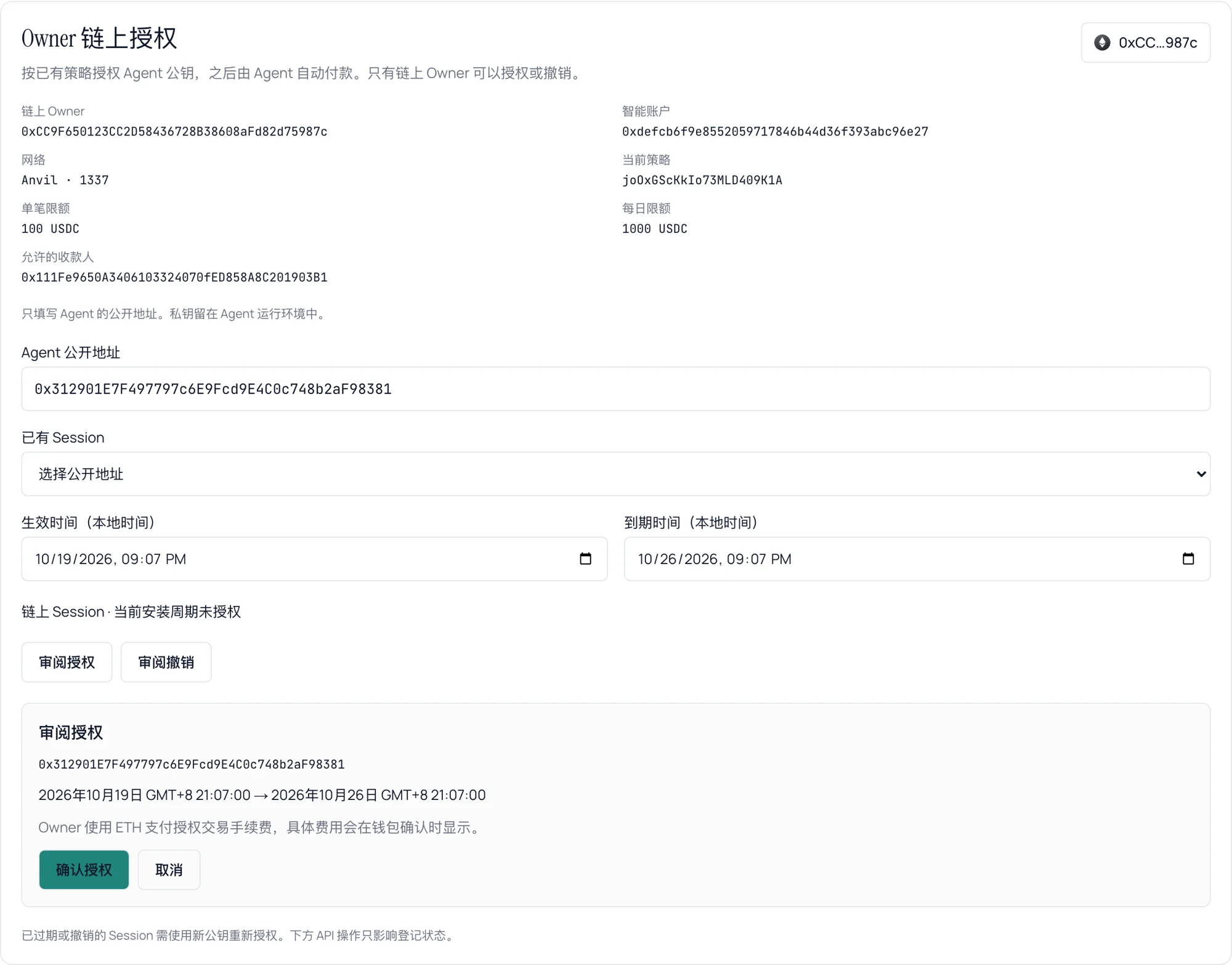
The Owner reviews an existing policy, limits, recipients and validity before granting a Session. The execution service signs independently, separating Agent payments from routine Owner actions.
Spending policyDemo excerpt · Full screenshot
02 / Permissions & execution
Understand the two refusal paths
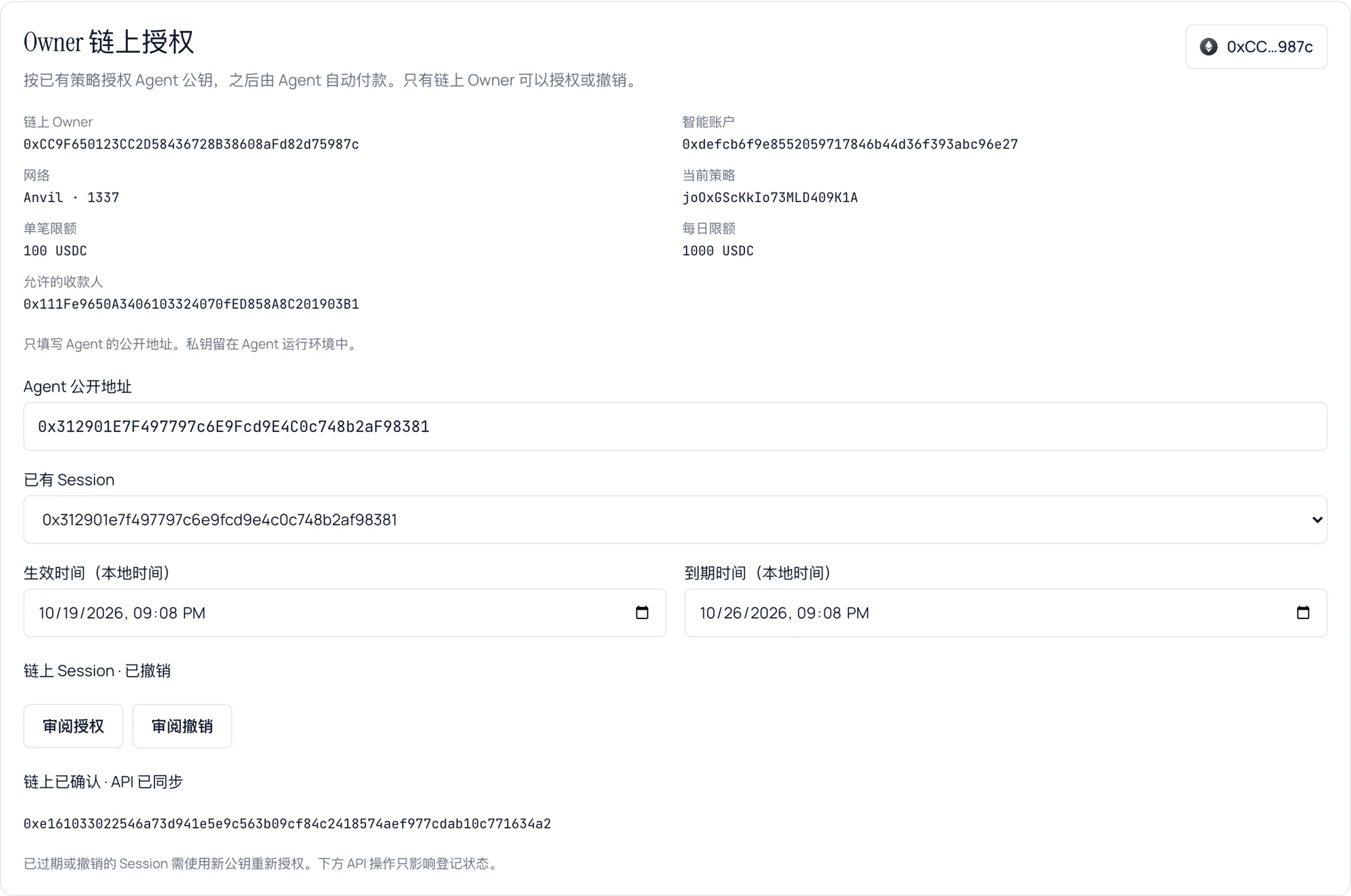
A 101 MockUSDC over-limit request is rejected during API preparation. After revocation, a previously signed operation sent directly to the bundler is rejected on-chain. These demonstrate separate checks.
Authorization reviewDemo excerpt · Full screenshot
THE BUSINESS & VALUE FLOW
The Agent economy starts with a task budget.
Funds pay for tools and services. An Owner supplies a controlled budget, the Agent pays under authorization, and the provider receives a fee. The product connects task costs to execution authority.
01
Budget
Choose the asset, limits and permitted recipients
02
Authorize
Review an existing policy and set expiry
03
Execute
The Agent signs and submits payment independently
04
Review and stop
Inspect spending and revoke when the task ends
THE MODEL IN A DEMONSTRATION
In the demo, an Agent pays 1 MockUSDC. After Owner revocation, subsequent payments under that Session are rejected.
01
Buyer value
A budget, execution path and expense record for paid tool usage.
02
Business direction
Customize an internal enterprise tool or develop a service priced by team, account or usage.
03
Running costs
Provider charges, chain execution, account maintenance and infrastructure contribute to the cost of a task.
The current authorization and execution flow is demonstrated on local chain 1337. Real providers, LLM decisions and service billing are custom integration directions. No native reward token is required.
BUILT BEHIND THE EXPERIENCE
See how the workflow is built.
01
Independent signing and smart accounts
A Node runner signs operations that pass through the API, Alto Bundler and EntryPoint into smart-account execution.
02
Guard verification
Guard validates authorization. The local demo also rejects an operation signed before revocation but submitted afterward.
03
State recovery
Separate chain confirmation from API registration. Retry synchronization without repeating a successful authorization transaction.
More from the product
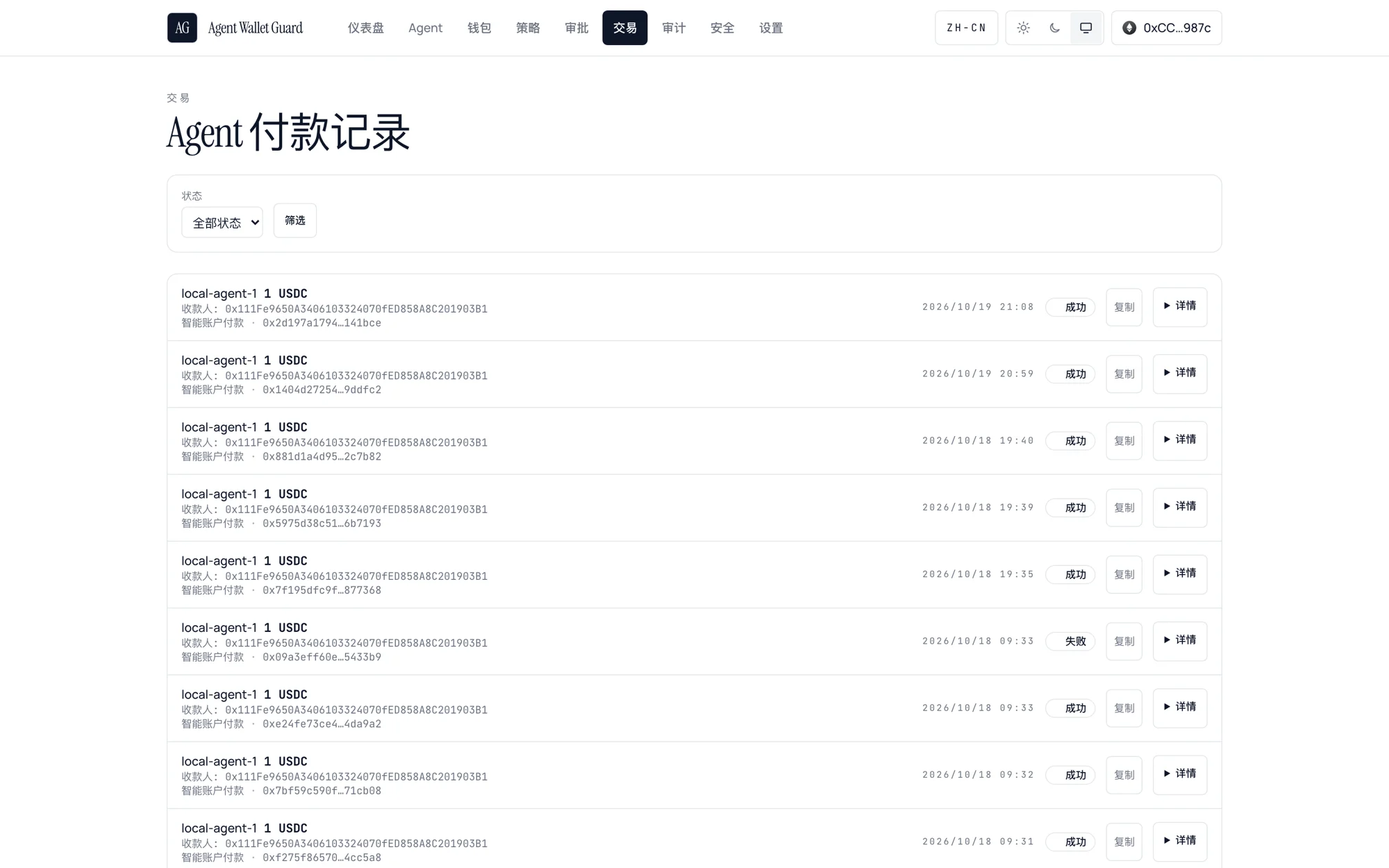
Payment historyDemo excerpt · Full screenshot Revoke authorityDemo excerpt · Full screenshot
BUILT BY 0xF1 / 2026-10-19
What I’m building here
My development focus connects Owner authorization, an independent Node signer and smart-account execution, including revocation and recovery after synchronization failures.
Independent signing and smart accounts
Guard verification
State recovery
Can an old signature still execute after revocation?
The local demo submits a previously signed operation directly to the bundler after revocation; it is rejected on-chain. This differs from an API preparation limit check, so the page explains each verification layer separately.
What comes next
The permission-focused Owner workspace is implemented. Real providers, LLM decisions and full policy creation require separately scoped integration.