Give AI agents a budget they can act on. Agent Wallet Guard adds EVM payment permissions, spending limits and a visible off switch—so you can build workflows that move beyond the chat window.
Tech stack
Solidity
EVM
ERC-4337
Next.js
TypeScript
viem
Foundry
Solidity smart-account permissions use ERC-4337 UserOperations and session keys for controlled AI agent payments on Ethereum Virtual Machine (EVM) networks, with a Next.js interface and Foundry tests.
Helping 4+ frontier teams turn AI agents into products that can act with bounded payment permissions.
4+
Frontier AI teams supported
Agent payment workflows
350+
Engineering hours saved per client, on average
Session permissions · Agent payments
0xF1
Architecture and delivery, directly with the builder
Your direct engineering partner
What comes with your head start
Source, validation and setup, assembled around your selected modules.
Next.js owner and permission-management source
Smart-account and Guard Solidity contracts
API, Node executor and bundler integration configuration
Foundry tests and authorization / revocation handover checks
A DELIVERY SCENARIO
AI product teams & wallet builders
From an Agent demo to a workflow that can act.
An Agent product needs to make bounded EVM payments as part of a task. Reuse the permission, execution and revocation flow, then connect the team’s runtime and tool providers.
Build the task your users want completed. Reuse the payment controls.
CLIENT FEEDBACK
“We needed our Agent to do more than recommend the next step—it had to complete the task. Bringing session permissions, spending limits and one-click revocation together finally took our product across the threshold into autonomous action.”
— Technical lead of an AI automation product
Your brand. Your source package.
Choose the product modules, branding and integrations around your launch.
A handover your team can use.
Walk through setup, the codebase and release checks directly with Fone.
A partner for the next chapter.
Add ongoing maintenance and iteration support as your product grows.
The Agent has a plan. Then payment stops it. You’re stuck between approving every transaction and building a permission system before the real product can move.
THE FONE WAY
Start with a working foundation.
Start with Agent Wallet Guard. Users set the budget, recipients and time window. The Agent pays within that permission. Activity and revocation stay in view.
YOUR RETURN
Put your time where it pays.
Stop rebuilding authorization, payment tracking and revocation for every Agent. Put that effort into the task your customer actually wants completed.
FROM FIRST CLICK TO BUSINESS OUTCOME
See the business take shape.
Explore the real product, one customer moment at a time. Screens show a demo workspace with sample data.
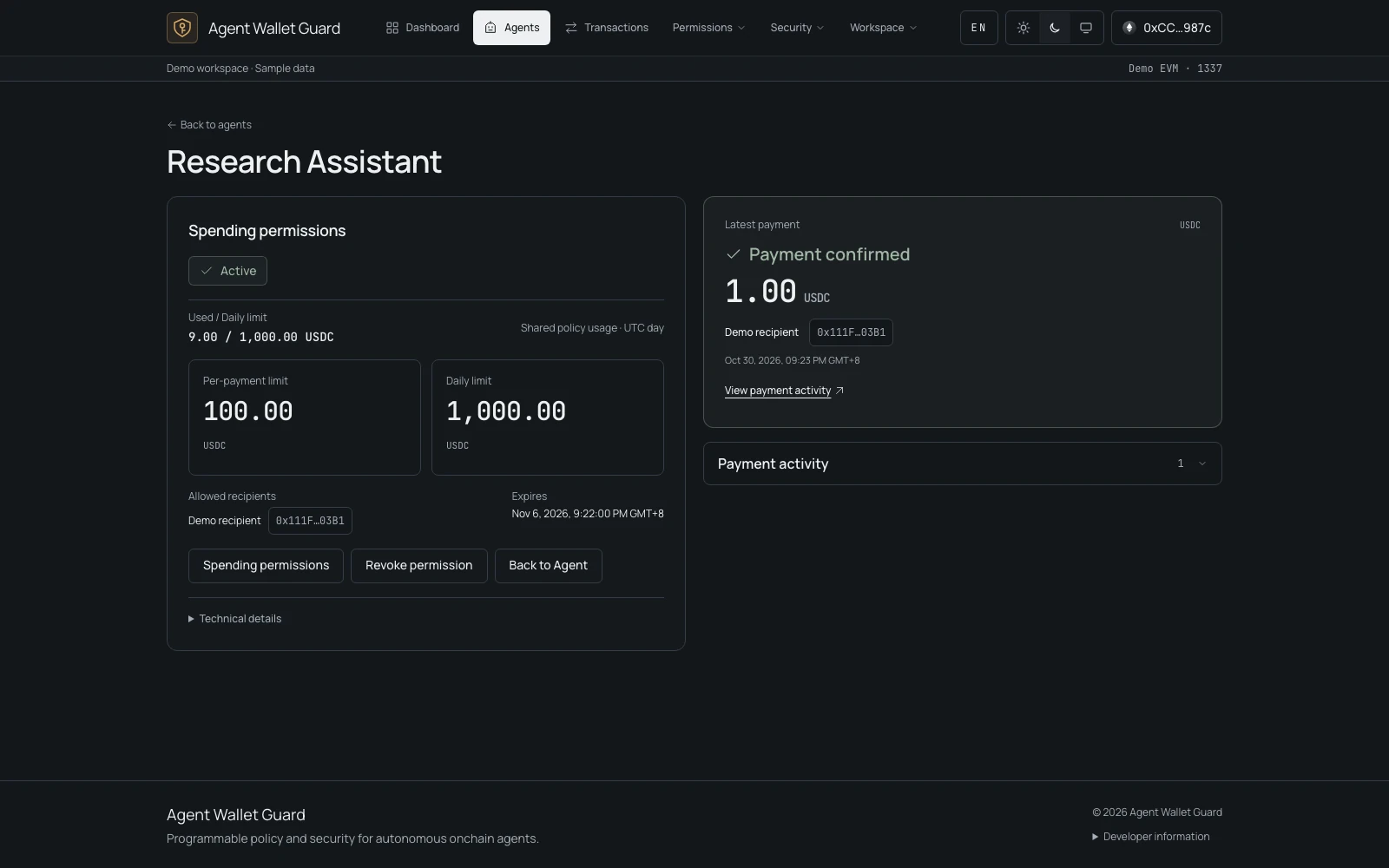
THE BUSINESS IN ACTION / 01
Make payment an action the Agent can finish.
Move from a suggested transaction to a confirmed payment within an authorized session. Give your workflow a concrete result to build on.
Make payment an action the Agent can finish. View the full interface
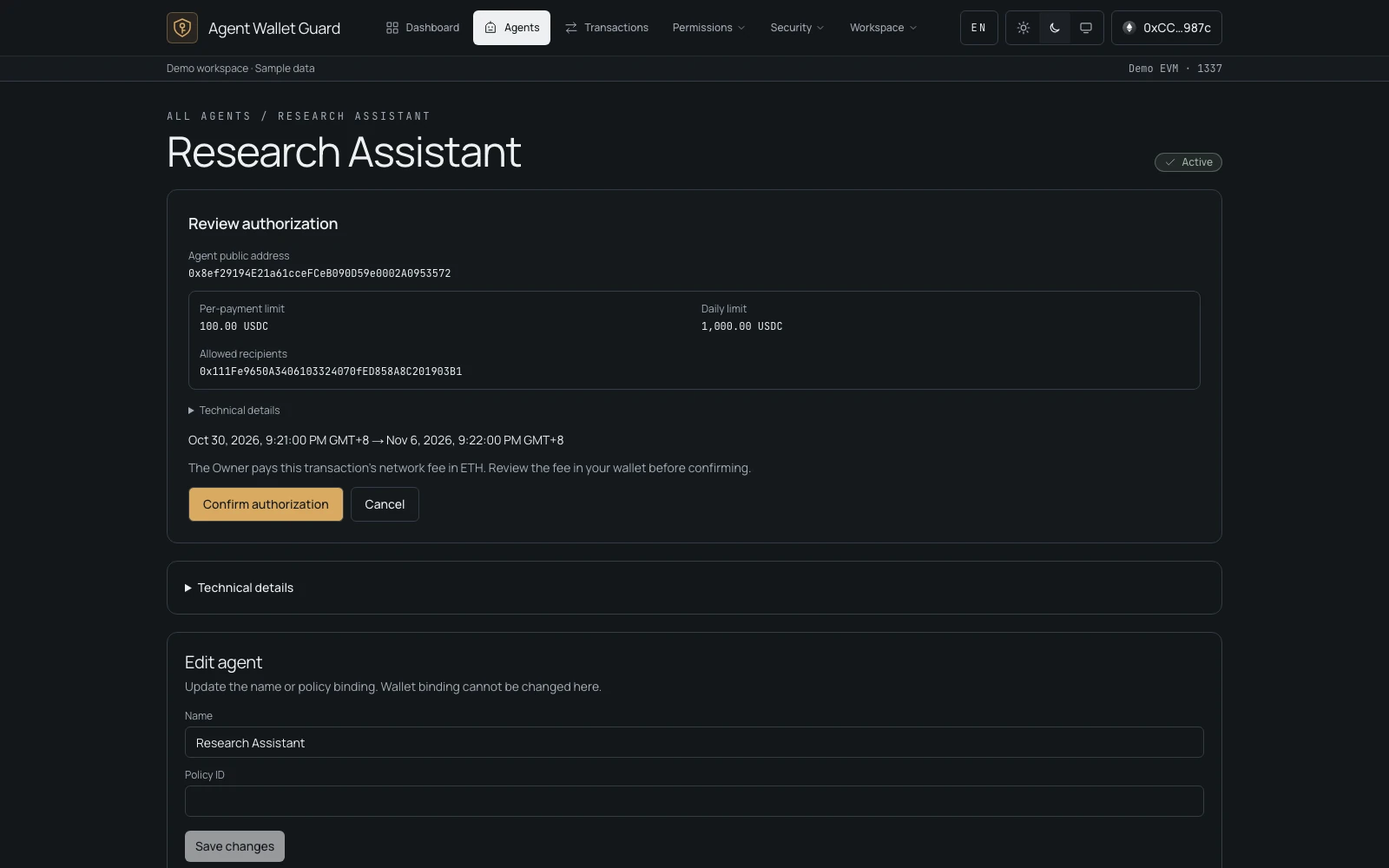
THE BUSINESS IN ACTION / 02
Make autonomy a choice users understand.
Show the spending limit, recipient scope and expiry before authorization. Users choose the room their Agent has to act.
Make autonomy a choice users understand. View the full interface
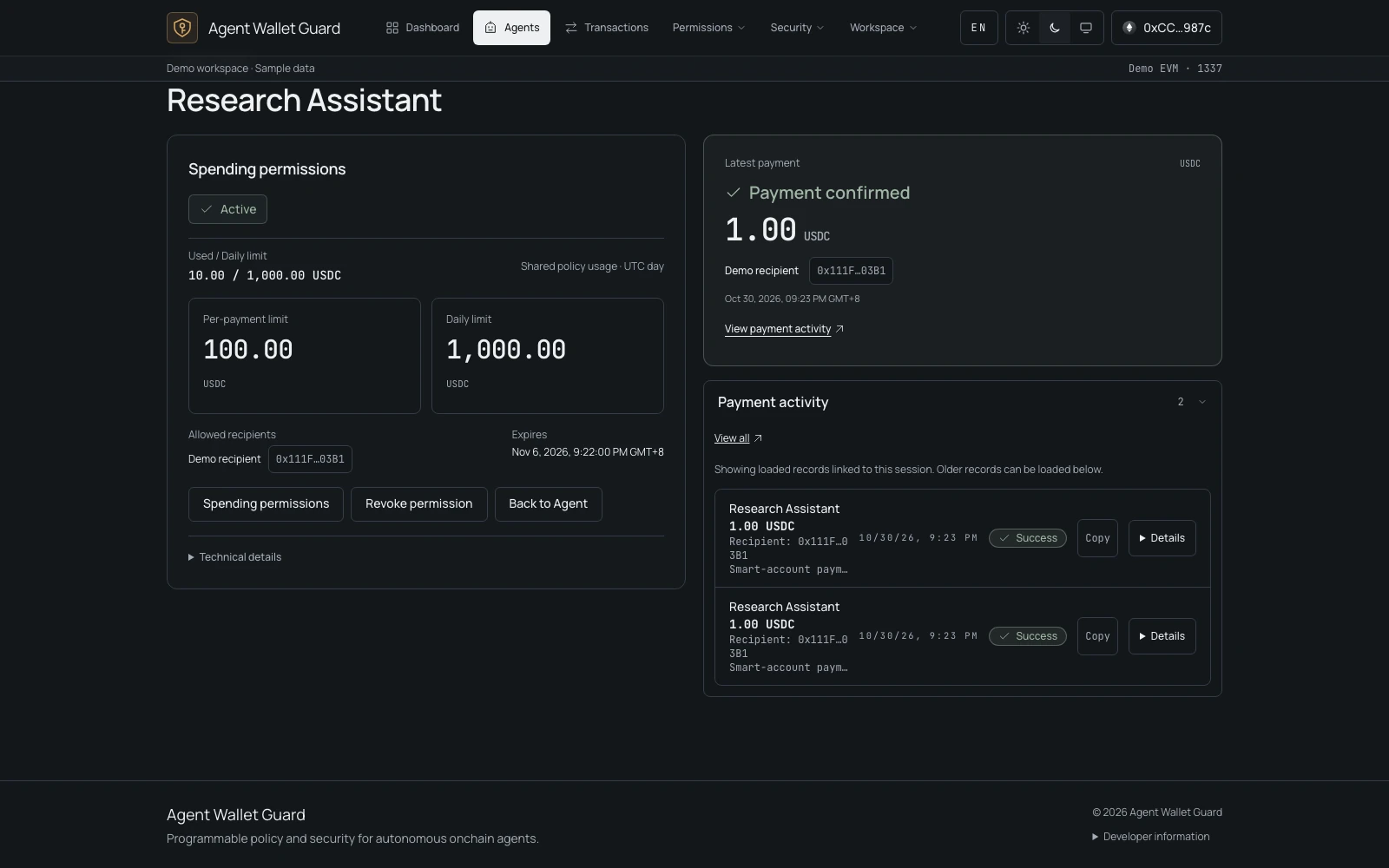
THE BUSINESS IN ACTION / 03
Keep the money trail close to the task.
Connect each payment to its Agent and permission. Give users a way to follow what happened without assembling a trail across separate tools.
Keep the money trail close to the task. View the full interface
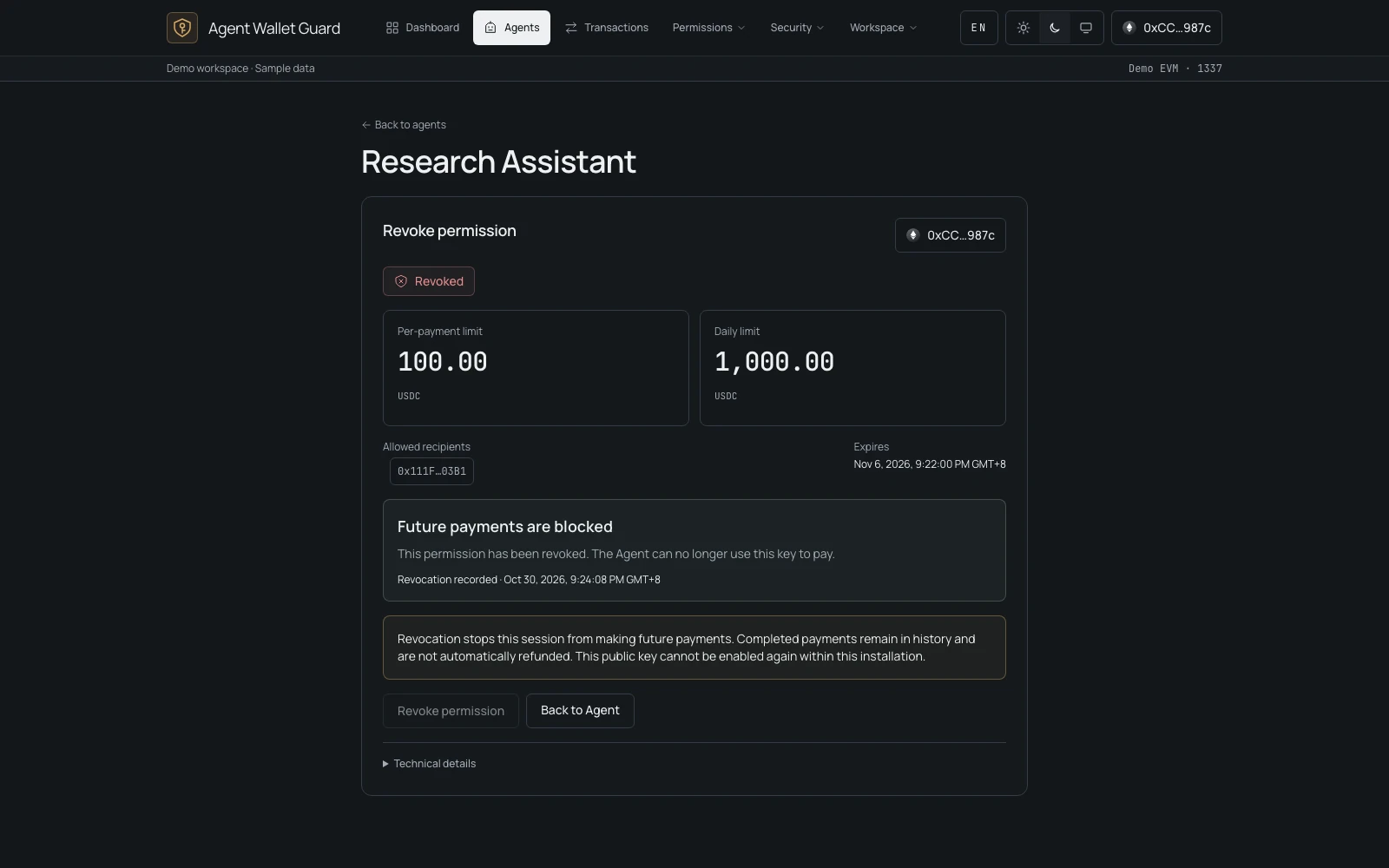
THE BUSINESS IN ACTION / 04
Give users a real off switch.
Revoke future payment access and keep past activity visible. Build a product where handing over a task does not mean losing the controls.
Give users a real off switch. View the full interface
BUSINESS MODEL
Add paid-task capability to your AI product
01
Connect payments to a useful task
Add a bounded payment path to your AI product, then connect the providers and services your customers need. Your commercial offer stays centered on the task.
02
Grow into team workflows
Team roles, richer policy management and reporting are available as custom development directions. Choose the controls your next customer segment needs.
03
Plan the cost of each action
Bring provider charges, network execution and signing operations into your pricing model. Use permission and activity records to keep spending explainable.
Start with source delivery and brand customization. Add maintenance when you need it, and shape your own customer pricing and operating model.
BUILT BY FONE / 0xF1
Know who’s building your advantage.
0xF1
Built by 0xF1. Delivered with you.
Work directly with Fone, the independent engineer behind this product. Discuss the business, review the code and shape the release with the same person.
Solidity contracts use OpenZeppelin cryptography and reentrancy-protection components. Foundry tests cover integration, edge cases and invariants around the permission system.
OpenZeppelin · Foundry · EVM
SEE IT BEFORE YOU BUILD
Follow a workflow. Ask the hard questions.
Use these product screens as the start of a live walkthrough. Review source, business flows and verification records with the person who built them.
Connect your runtime, task workflow and service-payment interface; actual provider purchases are a scoped integration.
02
Your policy experience
Adapt budgets, recipient workflows and reporting. Full policy creation and organizational roles need additional development.
03
Your network and operations
Target-chain deployment, real wallets, signer custody and monitoring are assessed and tested for the intended environment.
SEE THE PRODUCT IN ACTION
See the workflow. Talk to the builder.
The new walkthrough shows a confirmed Agent payment, authorization review, payment history and revocation. The delivery records include actual execution in the demonstration environment.
Walk through the product with Fone, then map the brand, modules and integrations your business needs.
Demo environment & implementation details
The demonstrated runner uses Demo EVM 1337 and test USDC. Target networks, production signing and paid-tool integrations are scoped for your product. Revocation stops future payments; previous payments remain in history and are not refunded by revocation.
Screens captured on 30 October 2026. Source snapshots, reproduction steps and product verification records are available for the technical walkthrough.
Go deeper with the engineering notes
Explore the decisions behind these workflows before planning your own integration.
Frontend source for permission review, session authorization and revocation, payment records and synchronization recovery.
02
The execution components
API and data layer, Node signing runner, smart-account and Guard contracts, plus bundler integration configuration.
03
An acceptance-driven handover
Agree setup instructions, source and dependency licenses, recovery cases and authorization / payment / revocation checks.
Choose the modules for your first release. We’ll put source access, licenses, setup, handover and optional support into one clear proposal.
Planning your Agent Wallet Guard business
Who is this product for?
Agent, wallet and automation teams. Give your AI product a controlled path to paid tools and services. Build around explicit authorization, independent signing and revocation, then integrate your agent and providers.
Once a session is authorized, the Agent signs within its allowed scope. The Owner does not sign each payment or need the Agent private key.
What happens when I revoke permission?
Future payments under that session are rejected. Prior payments remain and are not automatically refunded. Use a new public key for reauthorization in the same installation cycle.
What if chain confirmation succeeds but the API fails?
The workspace distinguishes those states and supports synchronization recovery. Historical acceptance checks cover recovering authorization registration without repeating the authorization transaction.
What determines launch timing and ongoing costs?
Start with your Agent runtime, wallet environment, spending rules and production signing setup. Fone maps the reusable modules and integrations into a first-release plan with milestones, workflow tests and deployment checks. The launch date follows that scope and any separately arranged security review. Budget for hosting, RPC and bundler services, transaction fees and paid tools. Maintenance and further development are optional, with their scope and price agreed separately.
Can I launch under my own brand with the source code?
Yes. Build your branded version around the agreed modules: Next.js owner and permission-management source; Smart-account and Guard Solidity contracts; API, Node executor and bundler integration configuration. The proposal specifies repository access, commercial-use licensing, setup documentation, available tests and deployment materials, plus the handover with Fone. Third-party components retain their own licenses; exclusive IP transfer, if needed, is agreed separately.
Agent Wallet Guard / FONE
Build an Agent that can act with permission.
Show me the action your Agent needs to take. We’ll map the spending rules, wallet integration and execution path around it.