In purely native DeFi, “not your keys, not your coins” is the governing principle: lose a wallet’s private key and its assets remain permanently inaccessible. If a protocol is hacked or a court orders assets returned, the contract cannot execute the enforcement orders available in fiat systems.
For real-world assets (RWA), including private credit, institutional real estate, tokenized government bonds, and high-net-worth custody, that principle becomes an unacceptable business and legal problem:
- Does losing a private key mean losing the asset? An overseas family office holds US$50 million in corporate-bond RWA tokens, but damaged cold-wallet hardware and a seed phrase destroyed in a fire leave it unable to sign. Legally, it still has valid registered creditor rights. The issuer cannot invoke “code is law” and tell the client its assets are gone. Securities and trust law require the issuer to verify legal identity, cancel the old address’s units, and reissue tokens;
- How do judicial freezes and counterterrorism/anti-money-laundering orders work? If a regulator or Interpol orders assets frozen for a sanctioned person or stolen funds, an issuer without mandatory on-chain freezing capabilities faces license revocation and criminal charges;
- Unrestricted backdoors destroy trust: conversely, adding a bare
function adminTransfer(address from, address to, uint256 amount)turns an RWA token into a centralized token whose administrator can take anyone’s funds at will. It cannot pass an auditor’s compliance review and will deter large institutional investors.
How can contracts give issuers legally required enforcement and lost-key recovery powers while preventing abuse through strict execution contexts, ledger invariants, and immutable hash-based auditing?
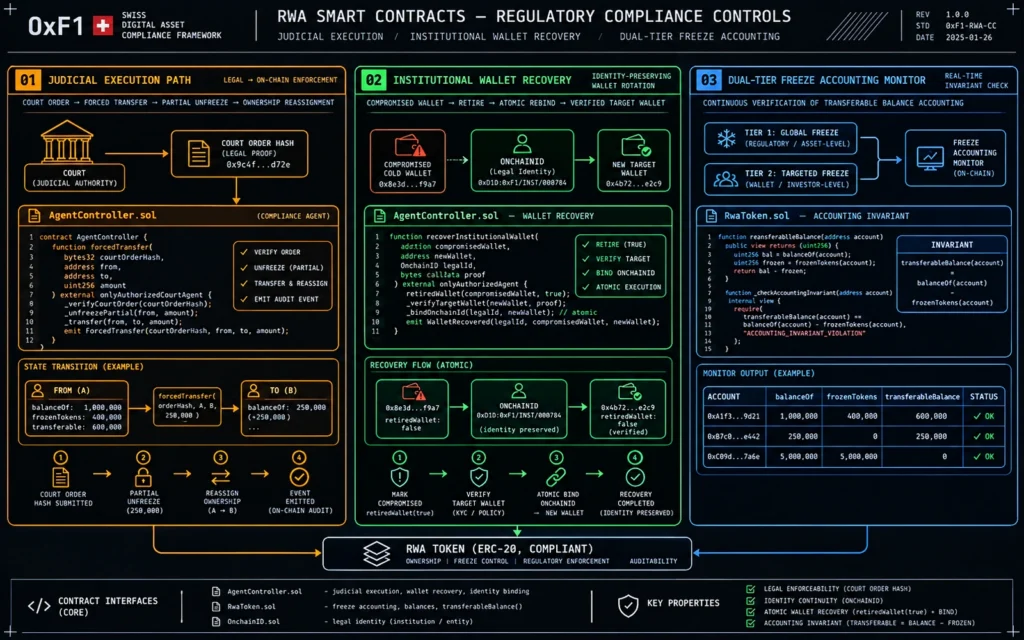
Using the production ERC-3643 and AgentController.sol architecture in Aurum RWA, this article examines judicial forcedTransfer contexts, lost-key wallet recovery with permanent retirement of old addresses, and the accounting invariants of freezePartialTokens.
The Judicial Control and Recovery State Machine
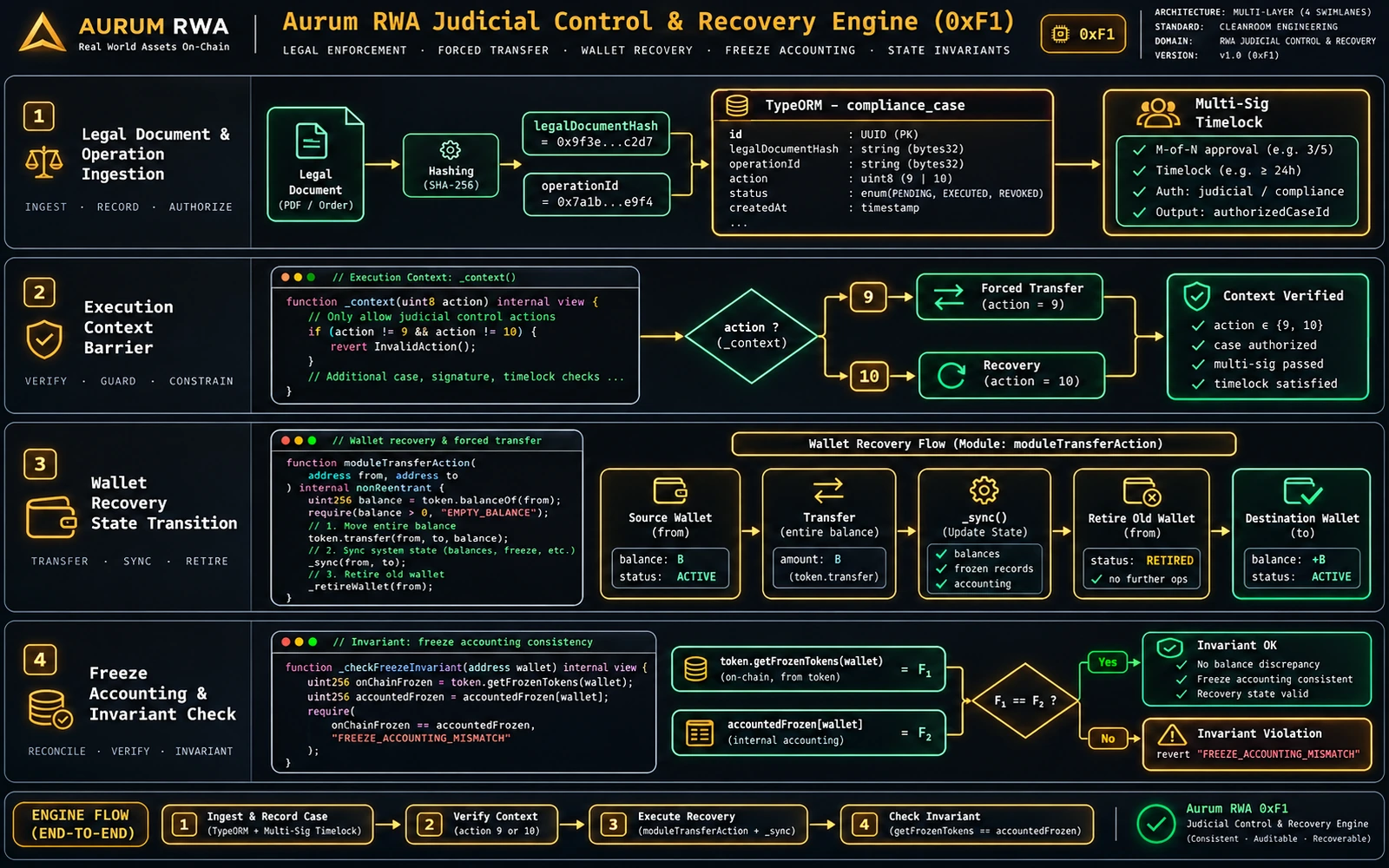
Aurum RWA combines a contract-level execution context barrier with backend multisig approvals to bind every regulatory operation to verified legal facts:
+-----------------------------------------------------------------------------------+
|                        Aurum RWA Judicial Enforcement and Recovery                |
+-----------------------------------------------------------------------------------+
|  1. Legal Fact Verification & Multi-Sig Approval                                  |
|     - Record judgment / inheritance-certificate hash: legalDocumentHash           |
|     - Create compliance_case linking oldWalletId and preverified newWalletId      |
|     - Two-Person Rule: requester and final approver must differ (no self-approval)|
+-----------------------------------------------------------------------------------+
                                       |
                                       v
+-----------------------------------------------------------------------------------+
|  2. Execution Context Barrier: AgentController.sol                                |
|     - Set _context = ExecutionContext(action, from, to, q, operationId)            |
|     - Action 9: Judicial Forced Transfer                                          |
|     - Action 10: Institutional Wallet Recovery after private-key loss             |
+-----------------------------------------------------------------------------------+
                                       |
                                       v
+-----------------------------------------------------------------------------------+
|  3. Forced Transfer with Coordinated Unfreezing (Action 9: forcedTransfer)        |
|     - Verify recipient compliance eligibility (checkEligible(to))                |
|     - If transfer exceeds free balance, unfreezePartialTokens covers the gap      |
|     - Complete transfer; emit TokensUnfrozen and Transferred; preserve ledger     |
+-----------------------------------------------------------------------------------+
                                       |
                                       v
+-----------------------------------------------------------------------------------+
|  4. Institutional Wallet Recovery and Permanent Retirement (Action 10)            |
|     - New wallet must be unused: walletBalance[to] == 0 and no other identity     |
|     - _sync(to, walletIdentity[from]) inherits investor identity and country       |
|     - moduleTransferAction atomically moves all units to the new wallet           |
|     - controller.retiredWallet[from] = true permanently disables the old address |
+-----------------------------------------------------------------------------------+
Comparing Authority and Safety in Three Asset-Control Models
| Architecture dimension | Traditional permissionless ERC-20 | Basic administrator backdoor | Aurum RWA controlled, auditable compliance (ERC-3643) |
|---|---|---|---|
| Lost-key recovery | 0% (permanent asset loss) | Supported, without audit constraints | 100% supported (identity migration and atomic retirement of old wallet, with compliance) |
| Judicial enforcement | 0% (cannot comply with court orders) | Admin can move anyone’s assets at will | Supported (requires a context containing immutable operationId) |
| Protection from malicious administrators | Very high, but cannot meet compliance requirements | Very poor (one private key can empty everything) | Very high (requires linked on-chain execution context and transfers only to compliant addresses) |
| Freeze granularity | Unsupported | Entire-account freezes only | Full-account and partial freezes precise to 1 unit |
| Historical audit trail | Transfer events only | Vague events without linked legal case files | On-chain events must emit legalDocumentHash and operationId |
Implementation 1: Judicial forcedTransfer and Coordinated Unfreezing
In the compliant token contract (aurum-rwa/contracts/lib/trex/contracts/token/Token.sol), a standard ERC-20 transfer can only be initiated by msg.sender.
The forcedTransfer function gives the privileged AgentController authority to transfer tokens under legally defined conditions.
1. Automatic Coordinated Unfreezing
Suppose an account under investigation holds 10,000 tokens, of which 3,000 are already partially frozen for other commercial collateral (_frozenTokens = 3000). Its available balance is 7,000. A court then orders 8,000 tokens transferred to a victim.
If the contract simply reverts whenever the available balance is below 8,000, a manipulated freeze can defeat the enforcement order.
ERC-3643 implements unfreeze first, then transfer:
// Excerpt from aurum-rwa/contracts/lib/trex/contracts/token/Token.sol
    /**
     * @dev Judicial forced transfer: callable only by the compliance controller (Agent) in a valid execution context
     */
    function forcedTransfer(
        address _from,
        address _to,
        uint256 _amount
    ) public override onlyAgent returns (bool) {
        // 1. Require sufficient total balance, whether frozen or not
        require(balanceOf(_from) >= _amount, "sender balance too low");

        // 2. Calculate the current unfrozen available balance
        uint256 freeBalance = balanceOf(_from) - (_frozenTokens[_from]);

        // 3. If the transfer exceeds free balance, automatically unfreeze the required amount
        if (_amount > freeBalance) {
            uint256 tokensToUnfreeze = _amount - (freeBalance);
            _frozenTokens[_from] = _frozenTokens[_from] - (tokensToUnfreeze);
            emit TokensUnfrozen(_from, tokensToUnfreeze); // Emit an unfreeze audit log
        }

        // 4. Recipient must pass identity-registry KYC and compliance checks
        if (_tokenIdentityRegistry.isVerified(_to)) {
            _transfer(_from, _to, _amount);
            _tokenCompliance.transferred(_from, _to, _amount);
            return true;
        }
        revert("Transfer not possible");
    }
This coordination lets judicial enforcement cross artificial collateral-freeze barriers while precisely maintaining _frozenTokens, avoiding any accounting overdraft.
Implementation 2: Lost-Key Wallet Recovery and Identity Migration
Institutional private-key loss is a major RWA operational problem. In Aurum RWA, recovery means executing a lawful identity-ownership transfer, not having an administrator crack the old private key.
1. Four Mandatory Preconditions for Institutional Wallet Recovery
In aurum-rwa/contracts/src/RwaComplianceModuleCore.sol, recovery uses the dedicated Action 10 context. The compliance module applies precise safety assertions to the destination wallet:
// Excerpt from aurum-rwa/contracts/src/RwaComplianceModuleCore.sol
    function moduleTransferAction(address from, address to, uint256 q) external override onlyCompliance {
        // Detect Action 10: lost-key wallet recovery context
        if (_context(10, from, to, q)) {
            // 1. System must be ready and the compliance suite intact
            if (!ready || !suiteIntact()) revert NotReady();

            // 2. Destination must be an unused clean address: zero holdings and no identity binding
            if (walletIdentity[to] != address(0) || walletBalance[to] != 0) {
                revert UnsafeRecoveryTarget();
            }

            // 3. Move the old wallet's entire balance in one operation; no incremental siphoning
            if (q != walletBalance[from]) revert UnsafeRecoveryTarget();

            _mapped(from);

            // 4. Atomically bind the new wallet to the old wallet's original legal identity (ONCHAINID)
            _sync(to, walletIdentity[from]);

            // 5. Verify the new wallet's jurisdiction eligibility
            checkEligible(to);
        } else {
            _validate(from, to, q);
        }

        // 6. Atomically move assets and synchronize the ledger
        _move(from, to, q);
        _post(from);
        _post(to);
    }
2. Permanent Old-Wallet Retirement (retiredWallet)
After recovery, a critical question remains: could an attacker later obtain the old key and use the old address to interfere with the system?
In AgentController.sol, successful recovery immediately marks the old address with a permanent retirement tombstone:
// Excerpt from aurum-rwa/contracts/src/AgentController.sol
retiredWallet[oldWallet] = true;
Once listed in retiredWallet, the address is rejected by every registration, transfer, subscription, and redemption entry point with WalletRetired. The key is permanently disabled throughout the RWA ecosystem.
Implementation 3: Regulatory Partial Freezes (freezePartialTokens) and Ledger Invariants
For routine compliance investigations, an issuer may need to preserve only 20,000 disputed units while leaving the investor free to use the remaining 80,000.
In aurum-rwa/contracts/src/RwaComplianceModuleCore.sol, the compliance module and token contract maintain a strict bidirectional accounting invariant:
// Excerpt from aurum-rwa/contracts/src/RwaComplianceModuleCore.sol
    function _freezeCheck(address from, uint256 q) internal view {
        uint256 f = _token().getFrozenTokens(from);

        // 1. Core accounting assertion: token-level frozen count must exactly equal the controller ledger
        if (f != controller.accountedFrozen(from)) {
            revert FreezeAccountingMismatch();
        }

        // 2. Basic invariant: frozen quantity cannot exceed the user's actual balance
        if (f > walletBalance[from]) {
            revert InsufficientAvailableBalance();
        }

        // 3. Transferable balance assertion: quantity q must not exceed the available balance
        if (q > walletBalance[from] - f) {
            revert InsufficientAvailableBalance();
        }
    }
This defense ensures that:
- The contract prevents excessive freezes and freeze/transfer races;
- The investor’s available funds always satisfy the exact conservation equation: walletBalance = transferableBalance + accountedFrozen
Implementation 4: Independent Off-Chain Approval and Privilege-Abuse Prevention (compliance/service.ts)
Every powerful on-chain enforcement call must be governed by strict enterprise permissions off-chain.
In aurum-rwa/server/src/modules/compliance/service.ts, we implement a tamper-resistant approval pipeline for compliance instructions:
// Excerpt from aurum-rwa/server/src/modules/compliance/service.ts
  async decide(a: Actor, key: string, id: string, b: any) {
    await this.permission(a, 'rwa.compliance.approve');

    const ap = await this.store.row('approval_request', id);
    check(ap.action_type === 'COMPLIANCE_COMMAND', 'APPROVAL_TYPE');

    return this.store.once(a, `compliance.approval.${id}`, key, b, async (m) => {
      const approval = await this.store.row('approval_request', id, m, true);

      // 1. Verify approval integrity and expiry
      check(
        approval.status === 'PENDING' &&
        approval.expires_at.getTime() > Date.now() &&
        hex(approval.request_hash).slice(2) === b.requestHash,
        'APPROVAL_STALE',
        409
      );

      // 2. Core authorization boundary: never allow requester self-approval
      check(String(approval.requester_id) !== a.id, 'SELF_APPROVAL_FORBIDDEN', 403);

      const payload = parsed(approval.immutable_payload);

      if (b.decision === 'APPROVE') {
        if (payload.type === 'RECOVERY') {
          // 3. Verify the old wallet's state
          const old = await this.s.row('investor_wallet', payload.oldWalletId, m, true);
          check(['ACTIVE', 'FROZEN', 'COMPROMISED', 'RECOVERING'].includes(old.status), 'WALLET_RETIRED');

          // 4. Set the old wallet to RECOVERING
          await m.query(
            "UPDATE rwa_investor_wallet SET status='RECOVERING', version=version+1 WHERE id=?",
            [old.id]
          );

          // 5. Coordinated recovery protection: invalidate all other pending approvals linked to the old wallet
          // Block every pending malicious request originating from the old wallet during recovery
          await m.query(
            "UPDATE rwa_approval_request SET status='INVALIDATED' WHERE status='PENDING' AND id<>? AND immutable_payload LIKE ?",
            [id, `%${old.id}%`]
          );
        }

        // Generate the on-chain call intent and submit to the multisig broadcast node ...
      }
    });
  }
Four Rules for Production RWA Judicial Controls
- Never expose an unconstrained administrator backdoor: forced transfers must pass through
AgentController, and on-chain events must include the immutable business-document hash and operation ID to prevent insider theft; - Atomically bind wallet recovery to old-address retirement (
retiredWallet): when migrating client assets, permanently disable the old address in the contract so attackers cannot revive it after obtaining the old key; - Distinguish account-wide freezes from partial token freezes: preserve the discrete accounting invariant
transferable = balance - frozen, allowing unaffected units to receive dividends and circulate lawfully; - Enforce the two-person rule in administration: hard-code self-approval rejection into backend services and multisig consoles. Every compliance transfer and recovery requires separate approval signatures from the legal requester and compliance manager.
Enterprise RWA Compliance Governance and Full-Stack Delivery
Fone specializes in RWA tokenization standards, ERC-3643 compliance extensions, on-chain judicial arbitration, and compliant asset portals. Our Aurum RWA solution implements a complete production lifecycle from investor KYC and transfer restrictions to judicial freezes and asset recovery:
- Read the full-stack compliant asset portal architecture: Building a Compliant RWA Asset Portal with React, NestJS, and Foundry
- Explore secondary-transfer risk controls: RWA Token Transfer Controls: Investor Eligibility and Jurisdiction Restrictions
- Explore asynchronous redemption and NAV snapshots: Designing RWA Asynchronous Redemption: Unit Locks and Settlement Reconciliation
- Book a senior RWA architect for compliant smart-contract auditing and technical assessment: Discuss Custom Requirements with Fone