In real-world asset (RWA) tokenization, almost every issuer claims “100% real-asset reserves and fully transparent audits” in its white paper and pitch deck. In practice, that transparency often amounts to a carefully presented quarterly PDF attestation from an accounting firm, or a static NAV figure manually updated by operations.
This disconnected form of proof of reserve has caused several devastating credibility failures. Without mandatory links between on-chain minting and actual assets, management or rogue operators use administrator privileges to mint millions of dollars in unbacked tokens to cover short-term liquidity gaps. Months later, large redemption requests reveal that the custodian bank account is already empty, sending the RWA pool into an irreversible run.
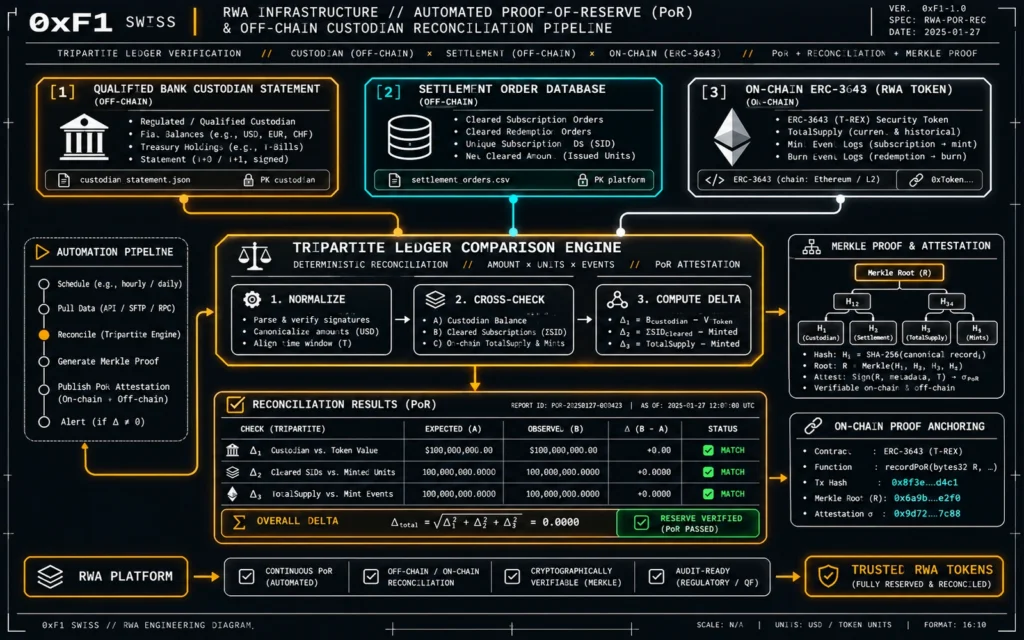
For institutional investors and regulators, reserves that cannot be reconciled automatically in real time are little more than paper claims. A tokenization platform with bank-grade credibility must prohibit undocumented minting in its contracts and build automated three-way reconciliation across “off-chain custodian statements → business-system settlement records → on-chain total token supply.”
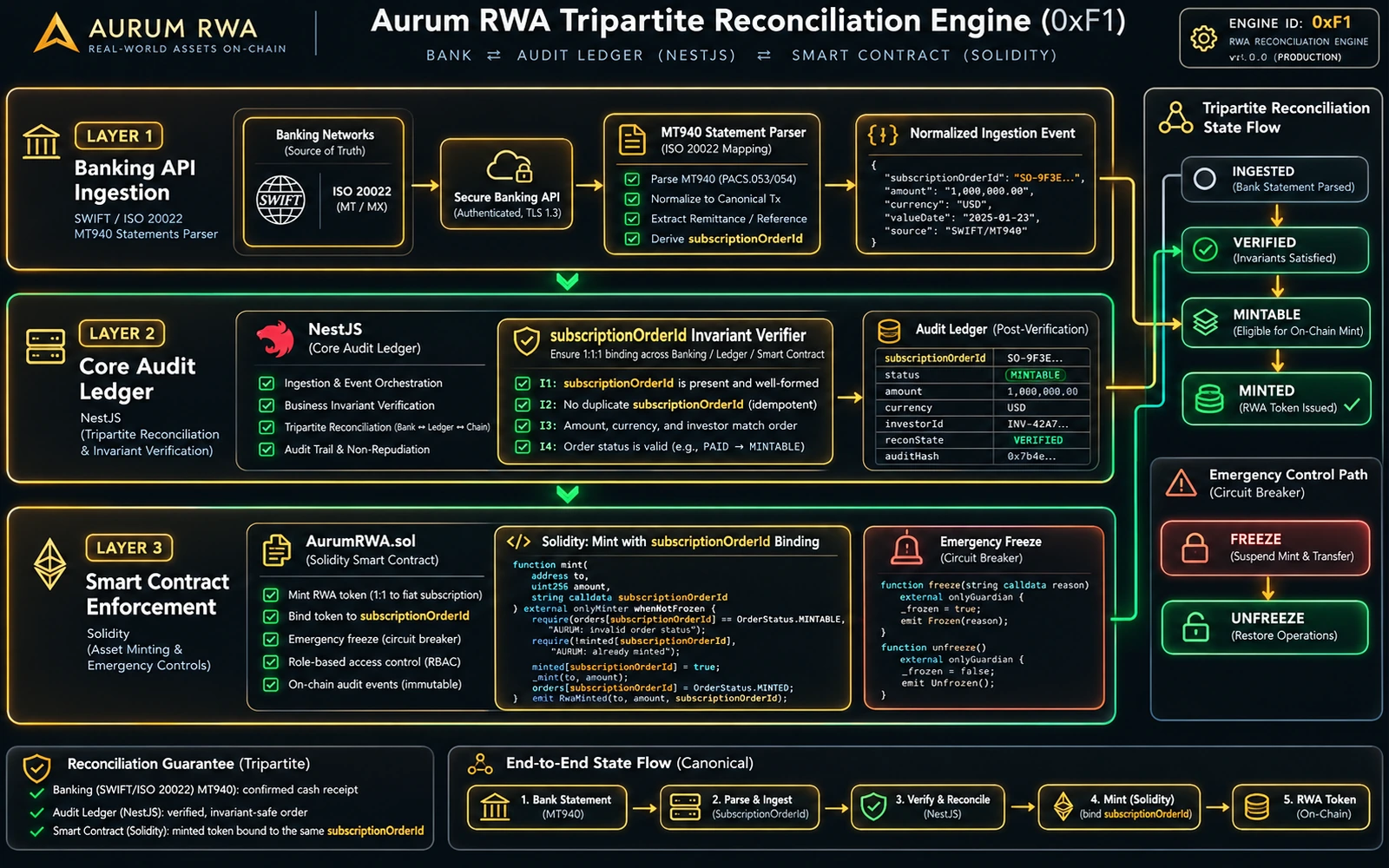
This article examines the production implementation in Aurum RWA: using NestJS, Solidity, and ISO 20022 message parsers to remove the proof-of-reserve trust black box.
1. Traditional PoR’s Core Weakness: Unrestricted Minting and Opaque Off-Chain Books
In many RWA projects quickly assembled from standard ERC-20 contracts, the token’s mint function looks like this:
// Unsafe traditional RWA mint entry: no binding to evidence of actual off-chain assets
function mint(address to, uint256 amount) external onlyOwner {
    _mint(to, amount);
}
This simple owner-controlled model has three critical compliance and risk-control gaps:
+----------------------------------------------------------------------------------------------------+
|                         Traditional RWA Reserves and Disconnected Ledger Model                     |
+----------------------------------------------------------------------------------------------------+

   [ Off-Chain Compliance and Custody ]                          [ On-Chain Asset Tokens ]

   Investor wires 100,000 USD
   (Received by a compliant custodian bank)
            │
            ▼ (No automated communication; manual Excel tracking)
   Operations confirms receipt internally                       Administrator private key (Admin EOA)
            │                                                            │
            │ [Critical gap: no mandatory on/off-chain linkage]           │ Can call mint(address, amount) anytime
            │ - Finance may omit or misrecord entries                    │ - Mint without receiving funds
            │ - Cannot prevent minting before payment                    │ - Delay burning redeemed tokens
            │                                                            │
            ▼                                                            ▼
   [ Custodian statement: $10,000,000 ] <──(Severe mismatch / black box)──> [ On-chain ERC-20 totalSupply: $14,500,000 ]
+----------------------------------------------------------------------------------------------------+- Unbacked minting: administrators can mint to market-making addresses at any time, with no on-chain evidence linking issuance to a specific bank wire.
- Delayed burning: after investors withdraw fiat from the bank, negligence or deliberate delay can leave the on-chain
burnunexecuted. Circulating supply then exceeds underlying NAV for extended periods, leaving the pool undercollateralized. - Settlement-window gaps: banking settlement cycles of T+1 / T+2 differ sharply from sub-second blockchain blocks. Without strict pending-settlement locks, the same assets can easily be subscribed more than once.
2. Automated Three-Way Reconciliation
To eliminate these vulnerabilities, Aurum RWA enforces strict invariants requiring three independent datasets to corroborate one another:
+----------------------------------------------------------------------------------------------------+
|                            Aurum RWA Automated Three-Way Reconciliation                            |
+----------------------------------------------------------------------------------------------------+

   [ Pillar 1: Custodian Asset Ledger ]      [ Pillar 2: Business Settlement Ledger ] [ Pillar 3: On-Chain Token Supply ]
   (Qualified Custodian Bank)               (Aurum RWA Core Ledger)             (ERC-3643 Token Contract)
                │                                       │                                     │
                │ MT940 / CAMT.053 messages              │ Unique order hash (UUID / Hash)     │ totalSupply() &
                │ Automatic end-of-day statements        │ Terminal status (SETTLED)           │ mint/burn Event logs
                │                                       │                                     │
                └───────────────────┬───────────────────┴─────────────────────────────────────┘
                                    │
                                    ▼
                     [ Automated Three-Way Reconciliation Engine ]
                                    │
               ┌────────────────────┴────────────────────┐
               │ Core equality assertion:                │
               │   BankSettledUSD == CoreLedgerShares == │
               │   OnChainTotalSupply                    │
               └────────────────────┬────────────────────┘
                                    │
            ┌───────────────────────┴───────────────────────┐
            │ [Exact match: zero deviation]                 │ [Any discrepancy: Delta != 0]
            ▼                                               ▼
   Generate signed PoR Merkle root; publish on-chain   Automatically trip vault emergency breaker (Pause Mints)
   Display live reserve ratio (100.00%) to institutions Notify risk control and independent auditors to investigate
+----------------------------------------------------------------------------------------------------+
3. The Contract-Level Defense: Mandatory Subscription Order Hashes (subscriptionOrderId)
Aurum RWA removes unrestricted mint calls that carry no business context. Every mint must supply an immutable, unique subscriptionOrderId in its arguments, and each order hash can execute successfully only once on-chain:
// aurum-rwa/contracts/src/token/CompliantRWAToken.sol
// SPDX-License-Identifier: MIT
pragma solidity ^0.8.20;

import "@openzeppelin/contracts/access/Ownable2Step.sol";
import "@openzeppelin/contracts/utils/Pausable.sol";

error OrderAlreadyMinted(bytes32 subscriptionOrderId);
error ZeroAddressNotAllowed();
error InvalidMintAmount();
error InvariantReconciliationBreached();

contract CompliantRWAToken is Ownable2Step, Pausable {
    string public name;
    string public symbol;
    uint8 public constant decimals = 18;
    uint256 public totalSupply;

    // Core ledger: track mint status for every settled off-chain subscription order
    mapping(bytes32 => bool) public mintedOrders;
    // Track burned redemption orders to prevent duplicate withdrawals
    mapping(bytes32 => bool) public burnedRedemptions;

    mapping(address => uint256) public balanceOf;

    event MintWithOrder(
        bytes32 indexed subscriptionOrderId,
        address indexed investor,
        uint256 amount,
        uint256 newTotalSupply
    );
    event BurnWithOrder(
        bytes32 indexed redemptionOrderId,
        address indexed investor,
        uint256 amount,
        uint256 newTotalSupply
    );

    constructor(
        string memory _name,
        string memory _symbol,
        address initialOwner
    ) Ownable(initialOwner) {
        name = _name;
        symbol = _symbol;
    }

    /**
     * @notice Compliant mint entry: requires a unique off-chain settlement order hash
     * @param to KYC-verified investor wallet address
     * @param amount Token units corresponding to the subscription
     * @param subscriptionOrderId Unique document hash generated after bank wire settlement
     */
    function mintForOrder(
        address to,
        uint256 amount,
        bytes32 subscriptionOrderId
    ) external onlyOwner whenNotPaused {
        if (to == address(0)) revert ZeroAddressNotAllowed();
        if (amount == 0) revert InvalidMintAmount();

        // Core defense: order ID must be unused, preventing duplicate accounting and multiple mints
        if (mintedOrders[subscriptionOrderId]) {
            revert OrderAlreadyMinted(subscriptionOrderId);
        }

        mintedOrders[subscriptionOrderId] = true;
        totalSupply += amount;
        balanceOf[to] += amount;

        emit MintWithOrder(subscriptionOrderId, to, amount, totalSupply);
    }

    /**
     * @notice Compliant redemption burn entry: requires a unique redemption request
     */
    function burnForRedemption(
        address from,
        uint256 amount,
        bytes32 redemptionOrderId
    ) external onlyOwner whenNotPaused {
        if (from == address(0)) revert ZeroAddressNotAllowed();
        if (amount == 0 || balanceOf[from] < amount) revert InvalidMintAmount();
        if (burnedRedemptions[redemptionOrderId]) {
            revert InvariantReconciliationBreached();
        }

        burnedRedemptions[redemptionOrderId] = true;
        balanceOf[from] -= amount;
        totalSupply -= amount;

        emit BurnWithOrder(redemptionOrderId, from, amount, totalSupply);
    }

    /**
     * @notice Emergency safety circuit breaker triggered by the automated reconciliation engine
     */
    function triggerEmergencyReconciliationFreeze(string calldata reason) external onlyOwner {
        _pause();
    }

    function liftReconciliationFreeze() external onlyOwner {
        _unpause();
    }
}
4. The Off-Chain Engine: Daily Three-Way Ledger Reconciliation in NestJS
On the server, Aurum RWA runs a reconciliation cron worker without manual intervention. At UTC 00:00 each day, it retrieves standardized bank messages—ISO 20022 CAMT.053 or MT940 statements—and reconciles them against actual on-chain state using millisecond-level snapshots:
// aurum-rwa/src/modules/audit/reconciliation.service.ts
import { Injectable, Logger } from '@nestjs/common';
import { Cron, CronExpression } from '@nestjs/schedule';
import { DataSource } from 'typeorm';
import { PublicClient, parseAbiItem } from 'viem';
import { CustodianBankStatementParser } from './bank-parser';

export interface ReconciliationReport {
  bankTotalUSD: bigint;
  databaseSettledShares: bigint;
  onChainTotalSupply: bigint;
  isBalanced: boolean;
  discrepancyDelta: bigint;
  timestamp: number;
}

@Injectable()
export class ReconciliationAuditService {
  private readonly logger = new Logger(ReconciliationAuditService.name);

  constructor(
    private readonly dataSource: DataSource,
    private readonly viemClient: PublicClient,
    private readonly bankParser: CustodianBankStatementParser,
    private readonly rwaTokenAddress: `0x${string}`
  ) {}

  /**
   * @notice Automatically perform strict three-way ledger reconciliation each midnight
   */
  @Cron(CronExpression.EVERY_DAY_AT_MIDNIGHT)
  public async executeDailyTripartiteReconciliation(): Promise<ReconciliationReport> {
    this.logger.log('Starting automated tripartite reconciliation pipeline...');

    // 1. Fetch actual bank-settled fiat totals (integer cents, e.g. $10M = 1,000,000,000 cents)
    const bankStatements = await this.bankParser.fetchDailyStatements();
    const bankTotalUSD = bankStatements.settledEndingBalance;

    // 2. Calculate net subscriptions and redemptions in terminal SETTLED state from the core database
    const queryResult = await this.dataSource.query(`
      SELECT
        COALESCE(SUM(CASE WHEN type = 'SUBSCRIPTION' AND status = 'SETTLED' THEN raw_amount ELSE 0 END), 0) -
        COALESCE(SUM(CASE WHEN type = 'REDEMPTION' AND status = 'COMPLETED' THEN raw_amount ELSE 0 END), 0) AS net_shares
      FROM rwa_settlement_ledger
    `);
    const databaseSettledShares = BigInt(queryResult[0].net_shares);

    // 3. Read the ERC-3643 contract's current totalSupply() directly through blockchain RPC
    const onChainTotalSupply = await this.viemClient.readContract({
      address: this.rwaTokenAddress,
      abi: parseAbiItem('function totalSupply() view returns (uint256)'),
      functionName: 'totalSupply',
    });

    // 4. Core conservation check (assume 1 unit = 1 USD, normalized to 18 decimals)
    // Zero tolerance: no unexplained discrepancy without supporting documentation is allowed
    const delta = onChainTotalSupply - databaseSettledShares;
    const isBalanced = (delta === 0n) && (databaseSettledShares === bankTotalUSD);

    const report: ReconciliationReport = {
      bankTotalUSD,
      databaseSettledShares,
      onChainTotalSupply,
      isBalanced,
      discrepancyDelta: delta,
      timestamp: Math.floor(Date.now() / 1000),
    };

    if (!isBalanced) {
      this.logger.error(
        `RECONCILIATION FAILED! Delta: ${delta.toString()}. Bank: ${bankTotalUSD}, DB: ${databaseSettledShares}, Chain: ${onChainTotalSupply}`
      );
      // Defense: automatically pause all new mints and redemptions to prevent exposure from growing
      await this.handleReconciliationBreach(report);
    } else {
      this.logger.log(`Reconciliation SUCCESS. All 3 ledgers perfectly matched at supply ${onChainTotalSupply}.`);
      await this.publishCryptographicProofOfReserve(report);
    }

    return report;
  }

  private async handleReconciliationBreach(report: ReconciliationReport): Promise<void> {
    // Send critical PagerDuty / Telegram alerts to the CTO and head of compliance
    // Automatically broadcast a freeze transaction on mainnet to block asset inflows and outflows
  }

  private async publishCryptographicProofOfReserve(report: ReconciliationReport): Promise<void> {
    // Publish the reconciliation summary hash on-chain as live transparent evidence for regulators and institutions
  }
}
5. Comparing Manual PoR with Aurum RWA’s Automated Reconciliation
The following table compares compliance, timeliness, and fraud resistance across reserve-proof implementations:
| Dimension | Traditional: quarterly third-party audit PDF | Common: self-reported Chainlink PoR oracle | This approach: strict three-way reconciliation (Aurum RWA) |
|---|---|---|---|
| Reconciliation timeliness | 30 ~ 90 days of delay, leaving a large blind interval | Every few hours, dependent on centralized oracle-node pushes | Millisecond event binding + automated daily midnight reconciliation |
| Issuance fraud prevention | None (Owner may freely mint) |
Limits minting above total assets but cannot prevent order misallocation | Strong (requires an unused subscriptionOrderId) |
| Bank statement integration | Disconnected; manual visual comparison of statements | Depends on custodian read-only APIs, often affected by format changes | Automated ISO 20022 bank statement parsing, without manual intervention |
| Anomaly response | Public discovery may follow failure by months | Delayed oracle feeds cannot proactively trip circuit breakers | Triggers CompliantRWAToken emergency shutdown within seconds |
| Institutional audit credibility | Relies on the signing accountant’s reputation; easy to falsify | Depends on oracle consortium independence | Every on-chain Mint event traces precisely to a fiat order reference |
6. Integrating Compliant Transfers and Asynchronous Redemption
Proof of reserve is closely coupled to the complete tokenized-asset lifecycle:
- Atomic coordination with the asynchronous redemption queue: Combined with the RWA Asynchronous Redemption Workflow, redemption tokens are locked in on-chain
RedemptionEscrow. The contract callsburnForRedemptiononly when the custodian bank actually pays out fiat and generatesredemptionOrderId, keeping funds leaving the vault exactly synchronized with tokens leaving circulation. - On-chain investor eligibility controls: Under the ERC-3643 Compliant RWA Asset Portal Architecture and RWA Secondary-Transfer Risk Controls, only KYC-verified eligible investors in permitted jurisdictions can hold units, preventing illicit or sanctioned funds from contaminating custodian bank accounts at the source.
Consulting and Source-Code Delivery
If you are preparing an RWA issuance for private credit, government bonds, gold, commodities, or commercial property, and need a reserve-proof architecture that meets stringent compliance requirements and is accepted by qualified custodians and law firms:
- Visit Fone’s Client Deliveries and System Demos to explore Aurum RWA investor portals, off-chain settlement records, and reconciliation dashboards;
- Read our End-to-End Engineering Guide for a Compliant RWA Portal;
- Book a one-to-one discussion through Fone Architecture Consulting for white-label source delivery covering ERC-3643 contracts, NestJS reconciliation middleware, and bank-system integration guidance.