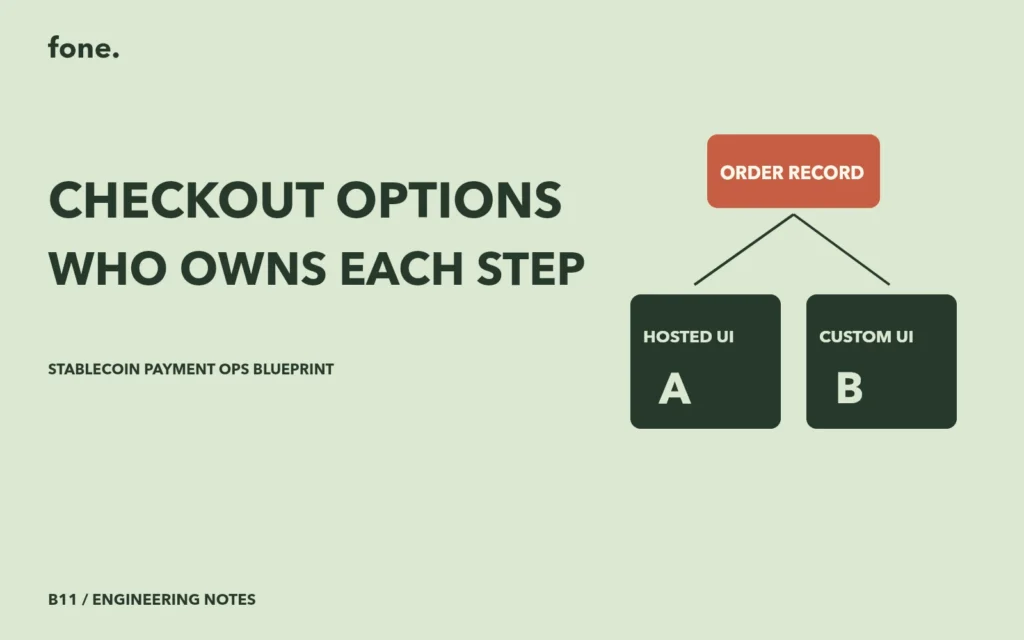
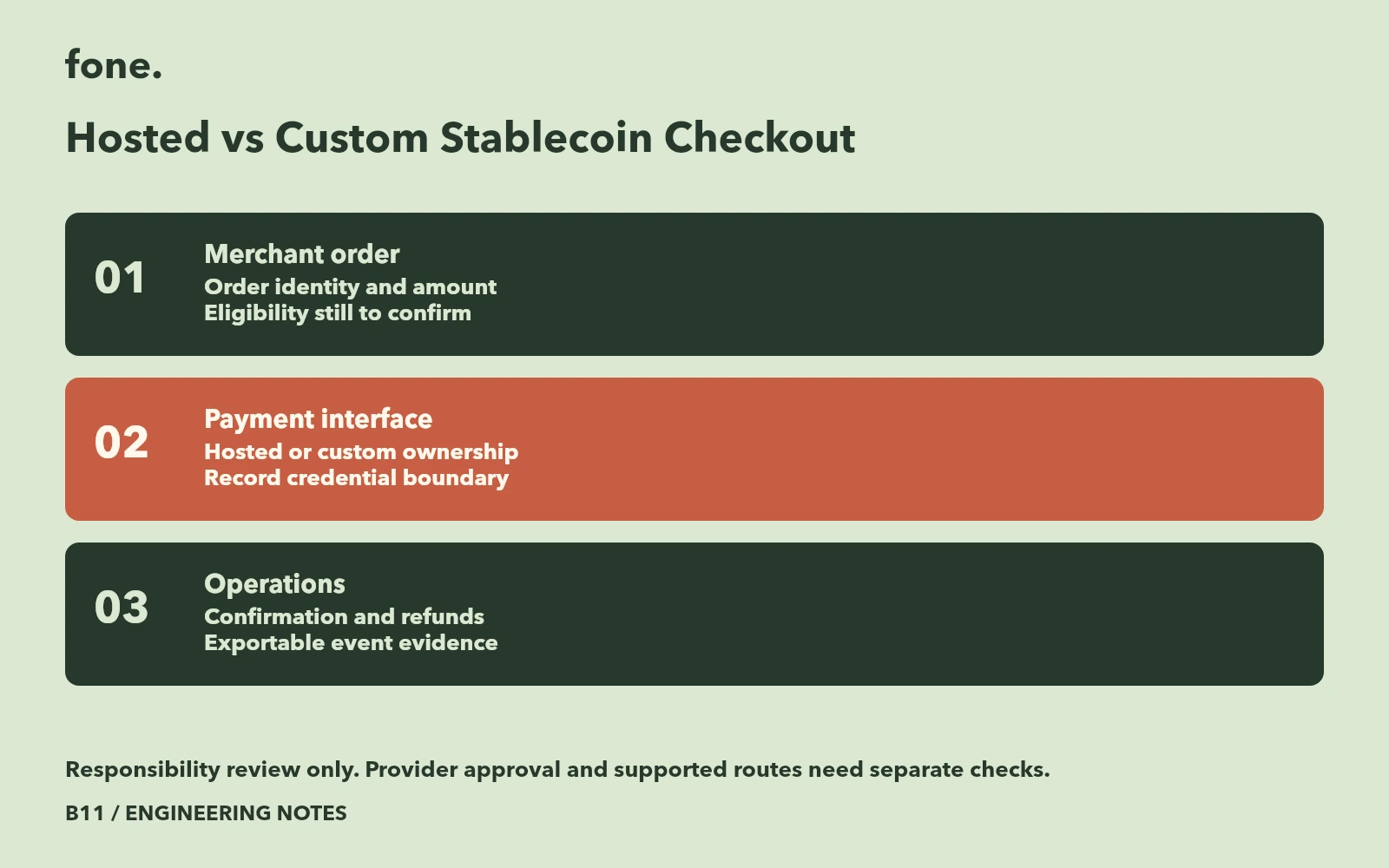
Compare checkout options by following an order through payment confirmation, fulfillment and refund. A hosted payment page changes which components your team operates. It does not remove the need to understand the provider's account rules or connect authoritative payment results to your orders.
This is an engineering responsibility review for the unimplemented Stablecoin Payment Operations blueprint. Provider eligibility, permitted business use and supported payment routes require a separate check for the actual account before implementation.
Separate the checkout interface from the funds path
A hosted checkout normally gives the merchant application a session or payment reference and moves the customer into a provider-controlled payment interface. Stripe documents creating a Checkout Session and directing the customer to its hosted payment page. This is an example of interface ownership, without asserting that any particular merchant can activate stablecoin payments. Hosted Checkout flow.
A custom interface can still use a provider to execute and confirm payment. Record that arrangement separately from a direct onchain integration. The phrase custom checkout should not conceal whether your team would be operating wallet infrastructure or simply controlling the surrounding user interface.
The Fone blueprint proposes no custody of funds or private keys. Any requirement to introduce custody would change that scope and needs a separate design decision. Begin the comparison by drawing the actual holder of each credential and the destination of funds.
Compare the operational responsibilities
| Responsibility | Hosted payment interface | Custom application flow |
|---|---|---|
| Payment page | Provider owns its core interface | Team owns more interaction and recovery states |
| Order reference | Merchant links provider session to order | Merchant defines and preserves the mapping |
| Confirmation | Merchant receives and checks provider evidence | Team integrates the selected evidence source |
| Exceptions | Provider tools plus merchant order review | More application-specific review may be needed |
| Refund workflow | Confirm provider-supported route | Design against the chosen payment route |
Treat these as questions for discovery. A provider's actual responsibilities come from its documentation and agreement. A polished hosted screen alone says nothing about the merchant's eligibility, the settlement destination or who resolves an unmatched order.
Require confirmation beyond the return page
Stripe explains that fulfillment cannot rely only on a customer reaching the success page, because the customer might never load it after payment. Its webhook guidance also requires signature verification and describes duplicate deliveries. These are obligations for the integration even when the payment page is hosted. Checkout confirmation and webhook handling.
For a custom onchain design, record exactly what evidence establishes payment. Ethereum transaction documentation distinguishes submission from inclusion in a block. ERC-20 specifies transfer events and makes token metadata such as decimals optional in the interface. A direct integration therefore needs an explicit chain, token-contract identity and amount interpretation before a transfer can be compared with an order. Ethereum transactions and ERC-20.
These technical references do not establish a suitable confirmation policy for every network or asset. Write the selected policy into the adapter requirements and identify who accepts a payment that arrives late, uses the wrong asset or cannot be matched to an order.
Ask how refunds and data access work
Stripe's stablecoin documentation describes its own refund behavior, including returning stablecoins to the original wallet. That is provider-specific behavior to verify for the selected route, rather than a rule that applies to all checkout designs. Stripe stablecoin payment documentation.
For each candidate, record which transaction references, event payloads and refund statuses the merchant can retrieve. Identify whether the operator can export the evidence needed to investigate an order after changing providers. Keep customer details, application secrets and signing credentials in distinct responsibility rows.
The decision worksheet asks for the candidate documentation, account eligibility confirmation and the owner of each unresolved question. It includes no recommendation score because the necessary account and business facts have not been supplied. Proposed integration checks are Not run.
Download the checkout responsibility worksheet and complete it with the merchant's region, business model, existing order flow and candidate provider. A narrower first build can be estimated once those dependencies are known.
Review the Stablecoin Payment Operations blueprint to scope one approved provider test environment, verified events and an exception queue. Provider connection and account approval are part of the implementation scope.