In a Web3 community challenge DApp offering a share of a prize pool for 21 days of early-rising check-ins, a core user with 19 consecutive days of perfect attendance suffers a frustratingly unfair outcome on the evening of day 20.
At 23:55, the user taps the check-in button in a mobile wallet, signs, and sends the transaction on time. Brief network congestion delays inclusion because of the gas fee. By the time validators include it in a block, block.timestamp reads 00:01:14 UTC the next day.
The challenge contract uses textbook integer division to assign days:
// Dangerous basic check: rigid day buckets using integer division
uint256 dayIndex = (block.timestamp - challengeStartTime) / 1 days;
The user’s check-in is marked late, eliminating them and slashing their 200 USDC deposit. The transaction is also recorded against the next day (dayIndex = 20), so that day’s state becomes “already checked in, but the prior attendance streak is broken.” The user posts 20 screenshots in the official Discord: “I clicked check-in at 23:55. Why are you taking my money?”
A centralized Web2 application can use server-side timezone conversion, local caching, and corrective handling. In the Ethereum Virtual Machine (EVM), maintained by distributed consensus, time is not a perfectly smooth, uniform axis: it includes abrupt boundaries, network delays, and small miner-controlled variations.
Using production practices from ChainPunch, this article examines block.timestamp drift, cross-timezone misunderstandings, and sliding Grace Periods in Solidity contracts and frontend interactions.
1. Three Engineering Traps in On-Chain Time
Contracts for recurring tasks—daily check-ins, habit challenges, or periodic investment vaults—must address three underlying constraints:
+----------------------------------------------------------------------------------------------------+
|                                  Three On-Chain Daily-Time Traps                                    |
+----------------------------------------------------------------------------------------------------+

   [ Trap 1: Boundary Cliff Gap ]
   - A user broadcasts at 23:58; the network queue delays inclusion until 00:02.
   - Traditional logic assigns it to the next day, breaking attendance and unfairly slashing principal.

   --------------------------------------------------------------------------------------------------

   [ Trap 2: Validator Timestamp Drift and Manipulation ]
   - Ethereum consensus allows slight drift (typically later than the parent block and at most 15 seconds ahead of current time).
   - Second-precise logic lets malicious validators adjust `block.timestamp` within 15 seconds to front-run for profit.

   --------------------------------------------------------------------------------------------------

   [ Trap 3: Timezone Disconnect ]
   - Contracts work only with Unix timestamps (UTC 0).
   - For a user in UTC+8 (Tokyo/Beijing time), "07:00 in the morning" is 23:00 UTC on the previous day on-chain.
   - Without timezone-offset normalization, frontend and contract definitions of "today" remain hours apart.
+----------------------------------------------------------------------------------------------------+
2. Timezone Normalization and Epoch Buckets
To let users across time zones compete fairly within their calendar days, a contract must accept a timezoneOffsetSeconds value at initialization.
1. Why a Fixed 24-Hour Cooldown Is Wrong
A common beginner approach is require(block.timestamp >= lastCheckIn + 24 hours). Its consequences are problematic:
- A user checking in at 08:00 on day one must wait until after 08:00 on day two;
- If they check in at 09:30 on day two, day three is pushed back to 09:30;
- Check-in times can only drift later. After a few days, the user may have to check in at midnight or in the early morning, defeating the purpose of a daily habit.
2. Deterministic Epoch Bucketing
Use Discrete Day Buckets with consistent timezone alignment:
tlocal = tutc + timezoneOffsetSeconds
Every check-in from 00:00:00 to 23:59:59 within a calendar day belongs to the same dayIndex, eliminating the one-way drift.
3. ChainPunch’s Grace-Window State Machine
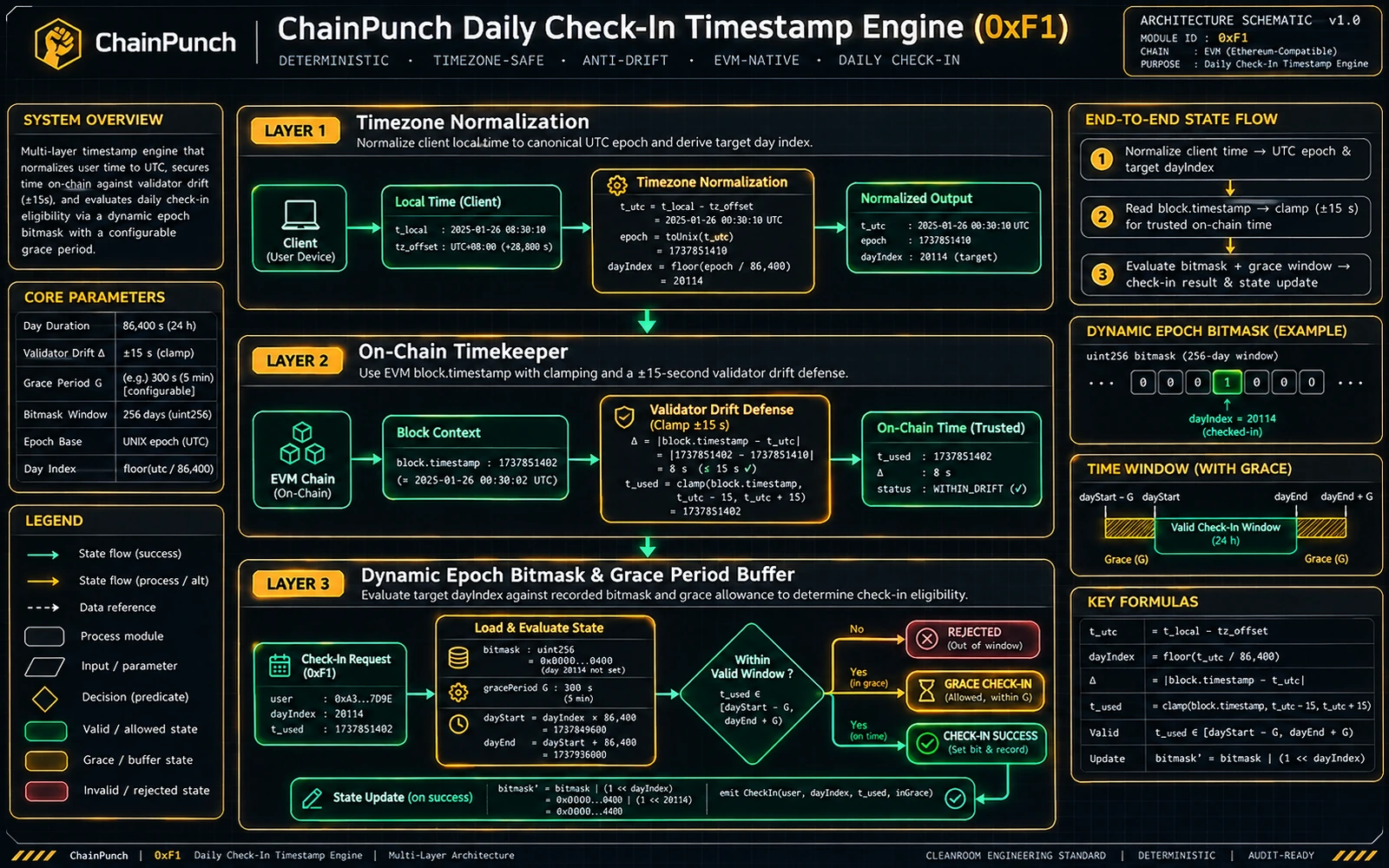
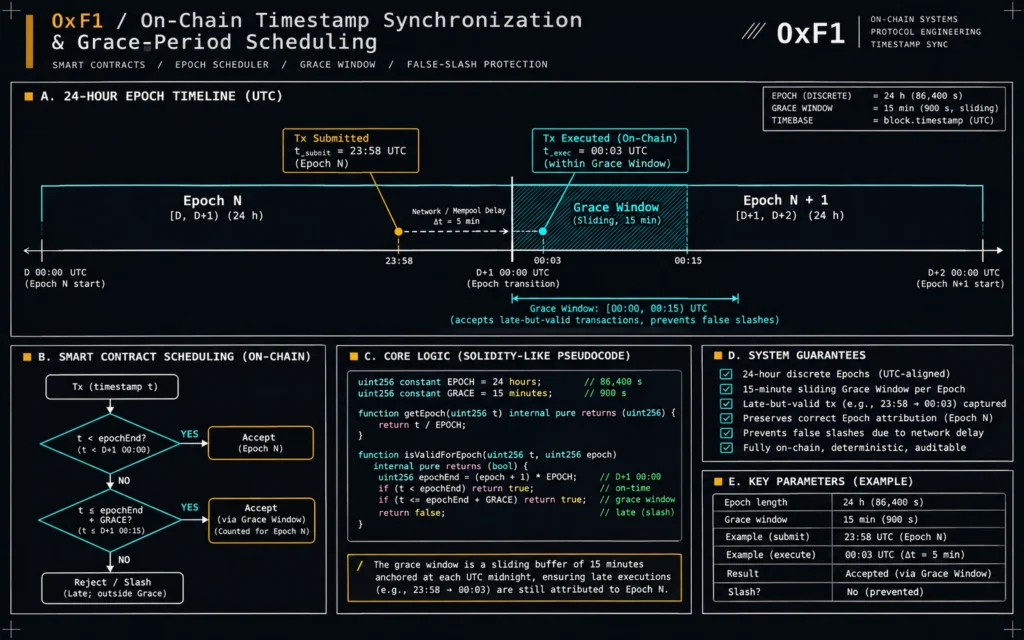
To prevent a transaction sent at 23:59 and included at 00:01 from unfairly failing, the production ChainPunch contract uses a Grace Period Buffer at the beginning of the following day:
+----------------------------------------------------------------------------------------------------+
|                               ChainPunch Sliding Grace-Window Timeline                             |
+----------------------------------------------------------------------------------------------------+

   Day N (valid window)                                     Day N+1 (next valid window)
   [00:00:00 UTC ────────────────────────── 23:59:59 UTC]   [00:00:00 UTC ───────────────────────────]
                                                    ▲       ▲
                                                    │       │ 00:04:15 UTC (delayed inclusion)
                                                    │       │
                                        Broadcast at 23:55  └── Trigger [15-minute Grace Window]
                                                                - Check that Day N has no check-in
                                                                - Within the first 900 seconds of the next day
                                                                - Accept as a makeup/delayed capture for Day N
                                                                - Preserve the user's attendance streak
+----------------------------------------------------------------------------------------------------+
The core Solidity implementation follows:
// checkin-task/contracts/src/ChainPunchChallenge.sol
// SPDX-License-Identifier: MIT
pragma solidity ^0.8.20;

import "@openzeppelin/contracts/access/Ownable2Step.sol";
import "@openzeppelin/contracts/utils/ReentrancyGuard.sol";

error ChallengeNotActive();
error ChallengeAlreadyEnded();
error AlreadyCheckedInForDay(uint256 dayIndex);
error InvalidTimezoneOffset(int256 offsetSeconds);
error TargetDayNotInWindow(uint256 requestedDay, uint256 currentDay);

contract ChainPunchChallenge is Ownable2Step, ReentrancyGuard {
    uint256 public immutable challengeStartTime;
    uint256 public immutable totalDays;
    int256 public immutable timezoneOffsetSeconds; // For example, UTC+8 is +28800 seconds (+8h)
    uint256 public constant GRACE_WINDOW_SECONDS = 15 minutes; // 15-minute grace window across day boundaries

    // userAddress => 256-bit check-in bitmap (up to 256 days in one storage slot)
    mapping(address => uint256) public userCheckInBitmap;

    event CheckedIn(address indexed user, uint256 indexed dayIndex, bool usedGracePeriod, uint64 timestamp);

    constructor(
        uint256 _startTime,
        uint256 _totalDays,
        int256 _timezoneOffset,
        address initialOwner
    ) Ownable(initialOwner) {
        require(_totalDays <= 256, "MAX_256_DAYS");
        challengeStartTime = _startTime;
        totalDays = _totalDays;
        timezoneOffsetSeconds = _timezoneOffset;
    }

    /**
     * @notice Compute the calendar-day Epoch index for the current block timestamp
     */
    function computeCurrentDayIndex(uint256 blockTime) public view returns (uint256) {
        int256 localTime = int256(blockTime) + timezoneOffsetSeconds;
        int256 localStartTime = int256(challengeStartTime) + timezoneOffsetSeconds;
        if (localTime < localStartTime) revert ChallengeNotActive();

        return uint256(localTime - localStartTime) / 1 days;
    }

    /**
     * @notice Get the seconds elapsed within the current calendar day
     */
    function getSecondsIntoCurrentDay(uint256 blockTime) public view returns (uint256) {
        int256 localTime = int256(blockTime) + timezoneOffsetSeconds;
        int256 localStartTime = int256(challengeStartTime) + timezoneOffsetSeconds;
        return uint256(localTime - localStartTime) % 1 days;
    }

    /**
     * @notice Production daily check-in with grace-period latency compensation
     * @param targetDayIndex The day the user intends to check in for (frontend supplies it using local time)
     */
    function checkIn(uint256 targetDayIndex) external nonReentrant {
        uint256 currentEpochDay = computeCurrentDayIndex(block.timestamp);
        if (targetDayIndex >= totalDays) revert ChallengeAlreadyEnded();

        uint256 bitmap = userCheckInBitmap[msg.sender];
        bool isAlreadyCheckedIn = (bitmap & (1 << targetDayIndex)) != 0;
        if (isAlreadyCheckedIn) revert AlreadyCheckedInForDay(targetDayIndex);

        bool usedGrace = false;

        // Branch 1: Normal check-in (target day matches the current on-chain day)
        if (targetDayIndex == currentEpochDay) {
            // Allow
        }
        // Branch 2: Cross-day grace (checking in for yesterday between 00:00 and 00:15 today)
        else if (targetDayIndex + 1 == currentEpochDay) {
            uint256 secondsIntoToday = getSecondsIntoCurrentDay(block.timestamp);
            if (secondsIntoToday <= GRACE_WINDOW_SECONDS) {
                // Within the grace window: accept delayed inclusion after midnight
                usedGrace = true;
            } else {
                revert TargetDayNotInWindow(targetDayIndex, currentEpochDay);
            }
        }
        else {
            revert TargetDayNotInWindow(targetDayIndex, currentEpochDay);
        }

        // Persist state with bitmap operations (only ~2,900 ~ 5,000 gas)
        userCheckInBitmap[msg.sender] = bitmap | (1 << targetDayIndex);

        emit CheckedIn(msg.sender, targetDayIndex, usedGrace, uint64(block.timestamp));
    }

    /**
     * @notice Check full attendance over a range (e.g. N consecutive days)
     */
    function isStreakMaintained(address user, uint256 requiredDays) external view returns (bool) {
        uint256 bitmap = userCheckInBitmap[user];
        // Build a mask with the first requiredDays bits set; for 7 days, (1 << 7) - 1 = 127
        uint256 requiredMask = (1 << requiredDays) - 1;
        return (bitmap & requiredMask) == requiredMask;
    }
}
4. Frontend Experience: Duplicate Prevention, Countdown, and State Prereads
In the Next.js frontend using ethers.js / viem, the client must translate on-chain Epochs into clear local-time guidance so users do not have to reason about UTC:
// checkin-task/src/hooks/useCheckInCountdown.ts
import { useState, useEffect } from 'react';

export function useCheckInCountdown(timezoneOffsetSeconds: number) {
  const [countdownString, setCountdownString] = useState<string>('');
  const [isInGraceWindow, setIsInGraceWindow] = useState<boolean>(false);

  useEffect(() => {
    const timer = setInterval(() => {
      const now = new Date();
      // Get the current UTC timestamp
      const nowUtc = Math.floor(now.getTime() / 1000);
      const nowLocal = nowUtc + timezoneOffsetSeconds;

      // Calculate seconds remaining until 23:59:59 today
      const secondsIntoDay = nowLocal % 86400;
      const secondsRemaining = 86400 - secondsIntoDay;

      // Between 00:00 and 00:15 (the first 900 seconds), display a grace countdown warning
      if (secondsIntoDay <= 900) {
        setIsInGraceWindow(true);
        const graceSecondsLeft = 900 - secondsIntoDay;
        setCountdownString(`宽限期仅剩 ${Math.floor(graceSecondsLeft / 60)} 分 ${graceSecondsLeft % 60} 秒`);
      } else {
        setIsInGraceWindow(false);
        const hours = Math.floor(secondsRemaining / 3600);
        const mins = Math.floor((secondsRemaining % 3600) / 60);
        const secs = secondsRemaining % 60;
        setCountdownString(`今日打卡剩余: ${hours}时 ${mins}分 ${secs}秒`);
      }
    }, 1000);

    return () => clearInterval(timer);
  }, [timezoneOffsetSeconds]);

  return { countdownString, isInGraceWindow };
}
5. Comparison: Fixed Cooldown, Calendar Days, and Grace-Window Epochs
The three time models differ in retention, complaints, and defenses:
| Dimension | A: Fixed 24-Hour Cooldown | B: Simple UTC Calendar-Day Division | C: ChainPunch Grace-Window Epochs |
|---|---|---|---|
| Freedom to check in | Very poor (drifts later each day toward midnight) | Good (any time within each 24-hour day) | Excellent (flexible daily check-in plus a cross-day buffer) |
| Network-delay tolerance | Weak (queues can cause missed windows) | Very poor (23:59 broadcast / 00:01 inclusion unfairly breaks a streak) | Excellent (built-in 15-minute grace window prevents unfair failures) |
| Timezone support | Cannot align with actual sleep/work rhythms | UTC dependency confuses Asian/American users | On-chain timezoneOffset aligns naturally with local time |
| Validator time manipulation | A 15-second adjustment can break boundaries | Boundaries are sensitive to slight drift | 15 minutes greatly exceeds 15-second drift, providing complete immunity to validator manipulation |
| Storage gas | A lastCheckIn slot per user |
Multiple slots for historical arrays | One-slot Bitmap, minimizing whole-challenge gas |
6. Integration with Pool Settlement and Hybrid Task Verification
Time handling underpins the check-in growth DApp and connects to two other components:
- Efficient bitmap settlement: Combined with the on-chain check-in challenge and two-phase settlement architecture, grace-validated check-ins are written through
bitmap |= (1 << dayIndex). After the challenge, the reward pool can settle thousands of participants instantly at O(1) constant complexity; - Signed off-chain tasks (EIP-712): For challenges involving GitHub Commits, step counts, or social tasks, hybrid task verification with EIP-712 permits and on-chain check-ins adds expiry validation when the backend signs completion permits, aligning off-chain activity with on-chain timestamps.
Architecture Consulting and Source-Code Delivery
If you are planning a high-activity Web3 community incentive tool, habit bootcamp, branded check-in challenge, or fitness GameFi product, and want to resolve congestion- and timezone-driven dropout complaints before launch:
- Visit Fone client deliveries and system demos to explore ChainPunch on-chain check-ins, grace compensation, and reward-pool settlement panels without gas blockage;
- Read our full-stack guide to on-chain check-in challenges and two-phase settlement;
- Book a one-to-one technical discussion through the Fone architecture consulting channel for a white-label delivery package with Foundry contract source, Next.js countdown components, and timezone test suites.