In custom software development, outsourced engineering, and enterprise technology procurement, many projects are set up to fail on day one.
A technical founder or business lead sends a brief: “We need an AI-powered decentralized multi-chain arbitrage and smart-wallet system. Users should connect wallets, analyze price differences across DEX pools, and execute arbitrage. The interface should feel polished and smooth. Budget: $35,000. Timeline: 6 weeks.”
Two months later, the $35,000 is gone and the project is deadlocked:
- The founder says, “Why does the bot keep losing money when long-tail pools have high slippage? Why doesn’t the wallet switch networks automatically? Why do dozens of transactions get stuck in the Mempool every day? This isn’t what we asked for!”
- The developers are equally frustrated: “Your requirements only said arbitrage and wallet connection. They never mentioned honeypot protection, atomic private-key session reservations, or multi-node RPC failover. We delivered every stated feature. These changes are Scope Creep and need another $20,000 and 4 weeks.”
Legal disputes and accusatory emails follow, and the project is abandoned.
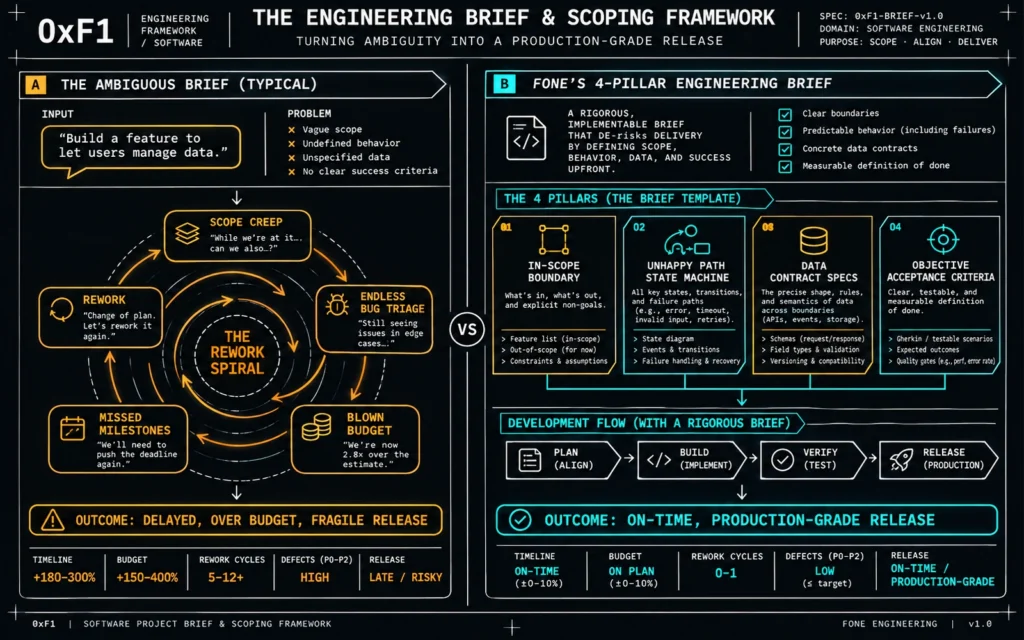
Across years of full-stack delivery and architecture consulting, we have reached a firm view: 80% of rework, delays, and budget overruns in custom software come from engineering and scope gaps in the Project Brief, rather than weak coding skills.
A useful brief is an engineering agreement that anticipates failure, rather than a broad vision statement. This article shares the 4-Pillar Engineering Brief Framework used internally by fone.cc, with real-case comparisons to help founders and technical leads eliminate much of their trial-and-error cost before work starts.
1. A Poor Brief and an Engineering Brief: A Real-Case Comparison
Consider two briefs for an AI-driven decentralized arbitrage system:
+----------------------------------------------------------------------------------------------------+
|                                  Brief Comparison: Vision vs. Engineering Agreement                 |
+----------------------------------------------------------------------------------------------------+

   [ The Disaster Brief - Causes 80% Rework ]
   "Build a multi-chain arbitrage bot modeled on 1inch and Uniswap.
    Requirements:
    1. Connect mainstream Web3 wallets;
    2. Use AI to scan Base and Arbitrum for arbitrage opportunities;
    3. Automatically borrow flash loans and profit from price differences;
    4. Build a striking dark-mode dashboard;
    5. Make it fast and smooth; launch the MVP in two weeks."

   [Critical gaps]:
   - No failure states; unhappy paths are entirely absent;
   - No specific DEX protocol versions or token types (long-tail pools? high-tax tokens?);
   - No gas-bribe rate cap or rollback requirements;
   - "Smooth" is subjective, unquantifiable, and impossible to accept objectively.

   --------------------------------------------------------------------------------------------------

   [ Fone 4-Pillar Engineering Brief - Accepted on First Delivery ]
   Define hard requirements across four dimensions:
   1. [Scope]: Launch only on Base with Aerodrome V2 (Volatile) and Uniswap V3; exclude Rebasing and fee-on-transfer tokens;
   2. [Unhappy paths]: Atomically Revert when gross profit < flash-loan fee + Gas; define 3-node failover for RPC 429 limits;
   3. [Data contract]: Off-chain calculation completes within 40ms and exactly matches the FlashSwapParam Solidity Struct;
   4. [Acceptance]: Supply deterministic arbitrage regression tests at 5 specified block heights on a Foundry Local Anvil Fork; 100% pass rate.
+----------------------------------------------------------------------------------------------------+
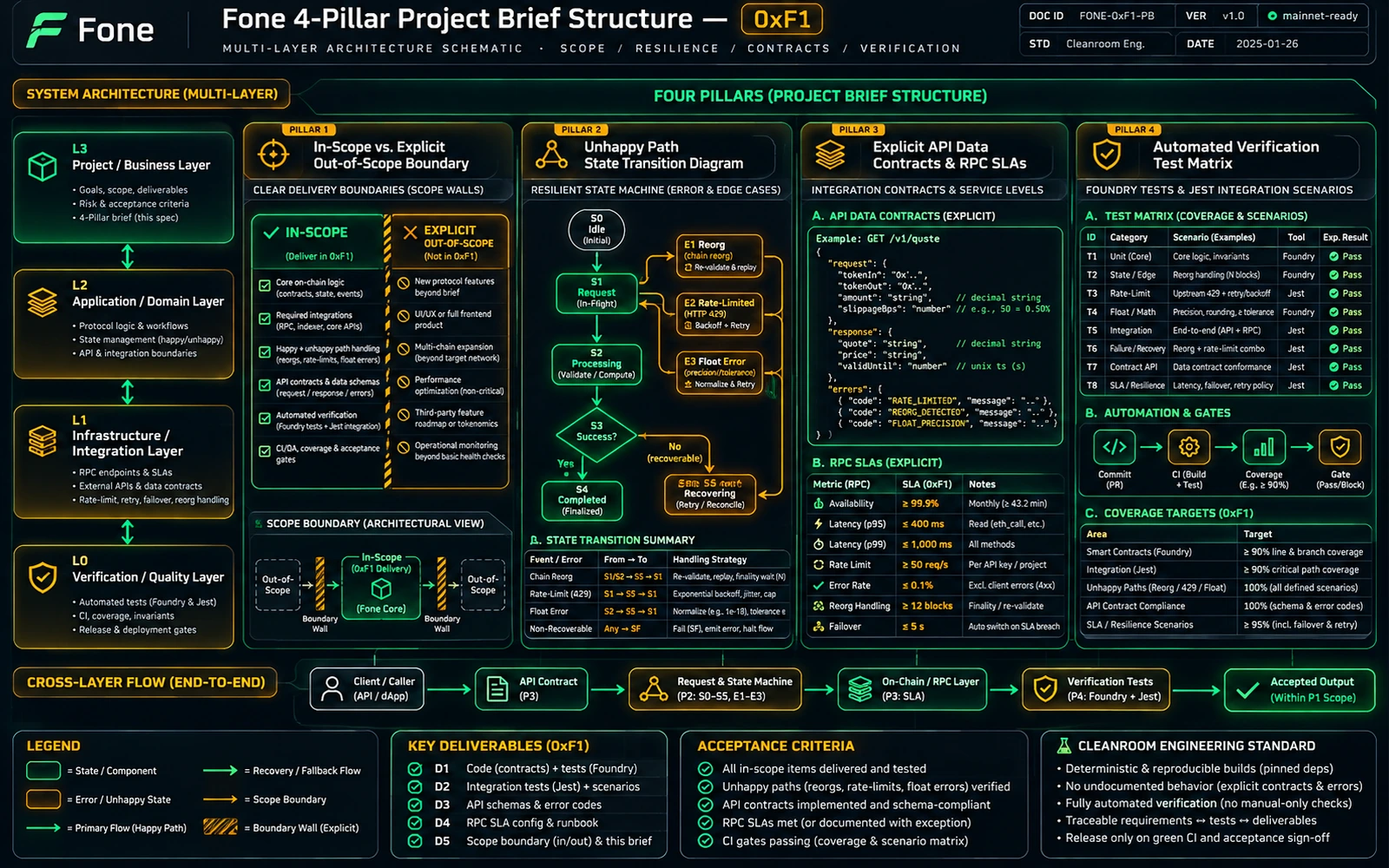
2. Fone’s 4-Pillar Engineering Brief Framework
A brief that supports accurate estimates and prevents disputes needs four pillars:
+----------------------------------------------------------------------------------------------------+
|                                   Fone 4-Pillar Engineering Brief                                  |
+----------------------------------------------------------------------------------------------------+

   [ Pillar 1: Core Value Path and Explicit Scope Boundary ]
   - List the complete In-Scope workflow this iteration must deliver
   - Give equal space to explicitly Out-of-Scope items to prevent uncontrolled expansion
                 │
                 ▼
   [ Pillar 2: Unhappy Paths & Failure FSM ]
   - Go beyond successful-click happy paths
   - Enumerate handling for 7 typical failures, including lost connectivity, signing timeouts, precision truncation, and reorg-lost orders
                 │
                 ▼
   [ Pillar 3: Data Contracts & External SLAs ]
   - Specify frontend/backend JSON Schemas and strong field types
   - Fix latency bounds, retries, and fallbacks for third-party APIs (RPC, LLM, payments)
                 │
                 ▼
   [ Pillar 4: Verifiable Acceptance Criteria ]
   - Remove vague terms such as "visually attractive" and "good experience"
   - Define quantified automated tests: Foundry assertions, Jest pass criteria, and stress-test thresholds
+----------------------------------------------------------------------------------------------------+
1. Core Value Path and Scope Boundaries: In-Scope vs. Explicitly Out-of-Scope
The main driver of delays is often the stream of “could you also add this?” requests during development. A mature brief must state the boundaries clearly:
- In-Scope: Focus on the minimum complete business workflow: Happy Path plus core risk controls;
- Explicitly Out-of-Scope: State exclusions in writing. Examples: “No multilingual internationalization in the initial release”; “No self-hosted decentralized indexer; use existing Alchemy/Infura RPC”; “No native Bitcoin network support.”
2. Unhappy Paths and Failure State Machines
Experienced architects anticipate failure states more deeply than junior developers. In systems involving assets and networks, 80% of code handles exceptions. The brief must explicitly answer:
- How are stale credentials invalidated if a user confirms 5 minutes after the signing prompt opens? See Web3 wallet-login failure engineering and Cancel Stale Wallet Prompts;
- How does checkout roll back orders after a 2-block Reorg? See block reorg and finality defenses for multi-chain stablecoin payments;
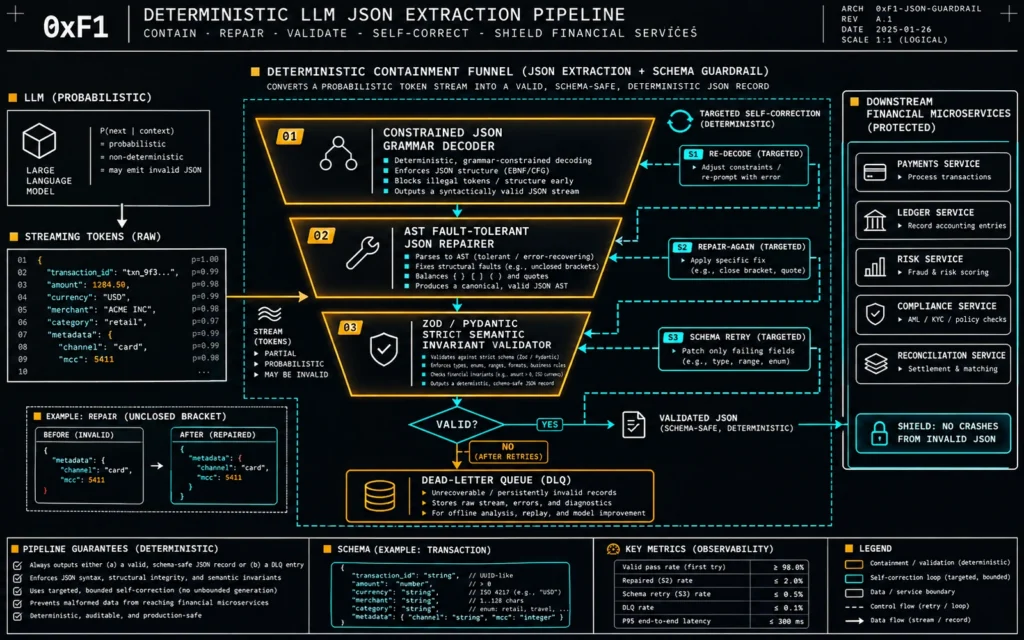
- How does the backend repair a syntax tree when model output hits Max Tokens? See production LLM JSON extraction and business guardrails.
3. Data Contracts and External SLAs
Failures often occur at integration boundaries. The brief must constrain uncertainty in external services:
- RPC limits: A free public node allows 10 requests per second and returns
HTTP 429above that; design automatic switching and rotation across nodes; - Token precision: Store minimum-unit integers (Wei / Atomic Units) in
VARCHAR(78)throughout the ledger. Never pass floating-point amounts between modules. See precision-safe stablecoin accounting.
4. Verifiable Acceptance Criteria
Acceptance must be objective: any third-party engineer should be able to run a test script and obtain one unambiguous Pass or Fail:
- “Submit 10 orders on Sepolia, including 3 simulated malicious Underpaid transfers. The system must mark them
UNDERPAIDand display a QR code for the remaining amount in the console”; - “Run
forge testlocally. All 45 unit tests for reentrancy and overflow must pass, for a 100% success rate.”
3. A Reusable Technical Project Brief Template
For teams planning a new project, here is the standard Markdown template fone.cc refined across dozens of commercial deliveries:
# [Project Name] Technical Project Brief

## 1. Overview and Core Business Objective
- **Business background**: [Explain why the project exists in 1-2 sentences]
- **North Star Metric**: [Example: settlement latency < 3 seconds per order, zero missed payments]
- **Delivery target**: [Example: 4-week sprint; deploy to testnet before 2026-12-01]

## 2. Scope Boundaries
### In-Scope (Core features required in this delivery)
1. ...
2. ...
### Explicitly Out-of-Scope (Excluded from this iteration)
1. No automated cross-chain bridging; Base only;
2. No native iOS/Android app; responsive Web delivery only;
3. No self-built private-key custody vault; externally connected Non-Custodial wallets only.

## 3. User Roles and Key Journeys
- **Role 1 (User)**: Connect wallet -> Browse products -> Lock quote -> Scan and pay -> Receive receipt automatically.
- **Role 2 (Platform admin)**: Sign in -> Review exceptional orders -> Trigger refund to original source / Pause service.

## 4. Unhappy Paths and Failure Modes
| Error Code | Trigger | Required Defensive Action | User Feedback |
| :--- | :--- | :--- | :--- |
| **ERR_REORG_DETECTED** | The transaction's block is rolled back | Set REORG_PENDING; suspend automatic delivery | "Transaction confirming, please wait" |
| **ERR_STALE_QUOTE** | Transfer starts after quote expiry (90s) | Check current slippage; route to reconciliation exceptions if above threshold | "Quote expired; generating a refund order" |
| **ERR_WALLET_SWITCH** | Account changes during signing | Invalidate prior pending signatures and destroy temporary Session | "Account change detected; please confirm again" |

## 5. Technical Stack and Data Contracts
- **Frontend**: Next.js (App Router) + TailwindCSS + viem / wagmi
- **Backend**: NestJS + TypeORM + MySQL 8.0 + Redis
- **Contracts**: Solidity 0.8.20 + Foundry
- **Amount precision**: BigInt strings throughout; no Float/Double

## 6. Acceptance Criteria and DoD
- [ ] **Test 1**: Foundry coverage of at least 90%, with no untested Revert;
- [ ] **Test 2**: Order endpoint sustains 200 QPS for 5 minutes without idempotency deadlocks or duplicate orders;
- [ ] **Test 3**: Delivery includes complete one-command Docker Compose startup and an example environment-variable dictionary.
4. Comparison: Vague Requests, Product PRDs, and Engineering Briefs
Traditional Word/Axure specifications can still lead to rework; an engineering brief establishes more decisive criteria:
| Dimension | A: Verbal Discussion + Vague One-Line Request | B: Traditional Product PRD | C: Fone 4-Pillar Engineering Brief |
|---|---|---|---|
| Estimate accuracy | Usually 200% ~ 500% deviation (major delays) | 30% ~ 50% deviation (technical pitfalls underestimated) | < 10% deviation (scope and external SLAs fixed beforehand) |
| Rework rate | > 80% (repeated architectural rebuilds) | 30% ~ 50% (unplanned failures block integration) | < 5% (unhappy paths exhaustively defined before work) |
| Responsibility and disputes | Conflicting accounts, often litigation | Diffuse ownership, frontend/backend friction | Clear accountability; objective acceptance matrix is the sole legal basis |
| Developer cognitive load | Constantly guessing the founder’s intent | 100 pages, but key technical issues get one sentence | Directly actionable implementation detail, ready for test writing |
| Handover quality | Undocumented code nobody wants to maintain | Business docs without code/operations standards | Naturally paired with the independent-operations handover checklist |
5. Connecting the Full Delivery Lifecycle
The brief establishes quality requirements across the software lifecycle:
- A basis for architecture and cost decisions: With firm boundaries, teams can use the build-from-scratch versus source-verified white-label foundation ROI guide to decide between customizing an established foundation and hiring a full-time team to build from zero;
- Direct connection to production audits and independent handover: After implementation, the system passes the 12-Point Engineering Audit from AI Prototype to Production, then is transferred under the independent software operations handover checklist, allowing the client to take over without vendor lock-in.
Architecture Consulting and Scope Assessment
If you are planning a new Web3 protocol, AI agent product, or enterprise SaaS system and want experienced architects to assess feasibility and technical boundaries before committing hundreds of thousands to development:
- Visit Fone client deliveries and system demos to see how complex specifications become production software;
- Read our full-stack production engineering and audit guide;
- Submit your initial idea or draft through the Fone architecture consulting channel. Using this framework, we will provide architecture boundaries, budget and timeline estimates, and custom development recommendations within 24 hours.