When a technology startup plans a commercial Web3 or AI product, its CTO and cofounders often fall into a costly scheduling trap. At the planning meeting, “connect EVM wallets, monitor stablecoin deposits, and call an LLM API to orchestrate trades” sounds like 6 weeks for 2 full-stack engineers. Three months after going live, the team has spent $180,000 on salaries and is still dealing with underpaid and missed payments caused by multi-chain Reorgs, Session Key budget overruns from concurrent AI sessions, and 14 high-severity reentrancy findings returned by external auditors.
As infrastructure evolves rapidly, delivery efficiency and Runway often depend less on writing elegant business logic than on avoiding hundreds of hidden protocol-integration pitfalls. Using actual troubleshooting data from 9 production products, this article compares the financial and development costs of Build from Scratch and License Source-Verified Foundation for Web3 and AI founders.
1. Visible Development Costs and the Hidden Balance Sheet
Many startups budget only “monthly engineer salary × development months.” For systems involving on-chain asset transfers, cryptographic verification, and Autonomous Agents, much of the real cost lies elsewhere.
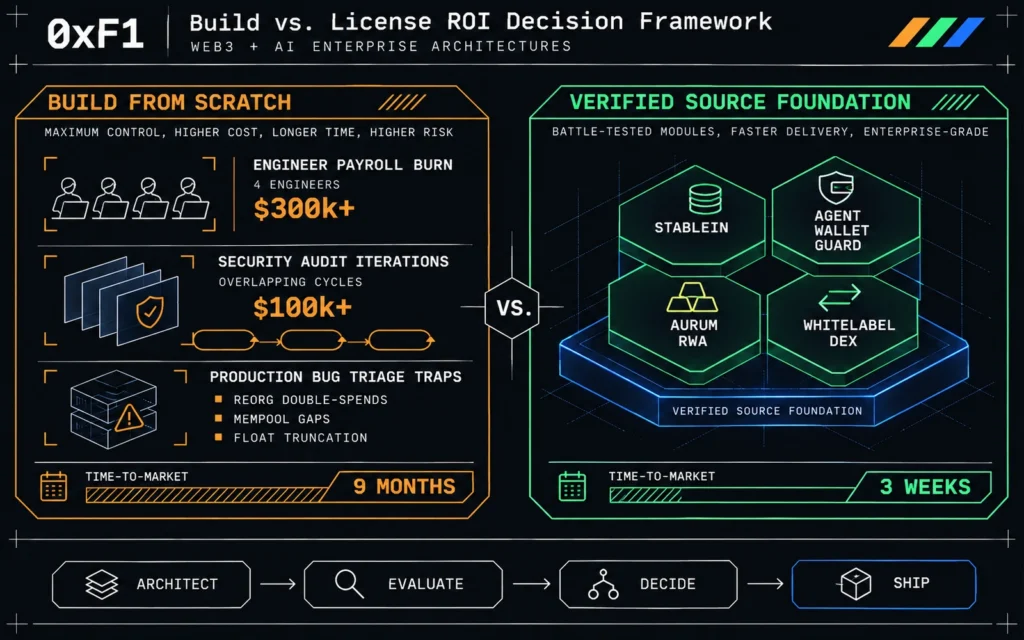
Typical Web3 / AI core-system build-from-scratch costs (9-month delivery estimate):

[ Visible Salaries ]
   ├── 1 senior contract engineer ($12k/mo × 9m = $108,000)
   ├── 1 backend/systems architect ($10k/mo × 9m = $90,000)
   ├── 1 full-stack/frontend engineer ($8k/mo × 9m = $72,000)
   └── 1 QA / automation engineer ($6k/mo × 9m = $54,000)
   Subtotal: $324,000

[ Required Security and Compliance Audits ]
   ├── Third-party core contract audit (Code4rena / Halborn / CertiK initial round): $45,000 ~ $80,000
   └── Remediation rounds and re-audit fees: $15,000 ~ $25,000
   Subtotal: $60,000 ~ $105,000

[ Hidden Trial-and-Error and Recovery Costs ]
   ├── Mainnet/testnet RPC fees and self-built indexing infrastructure: $12,000
   ├── Production edge-case debugging (reorgs, Webhook idempotency failures, rollback adjustments): at least 2.5 months of team-wide disruption
   └── Missed market window and opportunity cost: difficult to quantify
----------------------------------------------------------------------
Total funding threshold for building from scratch: $400,000 ~ $500,000+
Actual mainnet launch timeline: 7 ~ 11 months
1. What Derails In-House Development: Hidden Protocol Traps
Teams writing everything from scratch typically pay three substantial learning costs:
-
Uncertainty in distributed on-chain state machines: Building multi-chain stablecoin checkout, many full-stack engineers bring monolithic database ACID assumptions and poll for
Transferevents. On subsecond-block networks such as Arbitrum, Base, or BSC, node changes, soft-confirmation forks, and reorgs can overwrite dozens of transactions that already have orders. Without sliding confirmation-height windows and strict exclusive database row locks, the platform can accumulate tens of thousands in accounting losses within weeks. -
Races in AI sessions and transaction credentials: When an Agent uses ERC-4337 Session Keys for on-chain automation, a model request may take 800ms to 5s. If it issues multiple concurrent Tool Calls during that interval and frontend memory and off-chain state lack atomic budget reservations, it can exceed the period’s spending cap or even expose private-key credentials to in-flight interception.
-
Contract gas limits and concurrency lockups: In community check-ins, liquidity revenue sharing, or decentralized trading pools, a
forloop over holders can exceed Ethereum’s30,000,000gas limit once participation reaches more than 500 addresses. Principal becomes permanently locked, recoverable only through an emergency hard fork or manual intervention that breaks decentralization commitments.
2. What a Source-Verified Foundation Provides
Licensing a Source-Verified Foundation does not mean buying an opaque SaaS or closed SDK. For teams prioritizing asset control and customization, a strong foundation has three essential qualities: complete source delivery, a defensive architecture tested under production traffic, and modular, decoupled interfaces.
White-label foundation collaboration model:

┌────────────────────────────────────────────────────────┐
│             Custom Business Presentation and Brand UI  │
│       (Next.js / TailwindCSS / Custom Theme / viem)    │
└───────────────────────────┬────────────────────────────┘
                            │ Clean API / Typed RPC
┌───────────────────────────▼────────────────────────────┐
│           Verified Core Engineering Engine (Source)    │
│  ├── Ledger (Distributed Idempotency & Reorg Guard)     │
│  ├── Session Limits (Dual-Checkpoint Session Gate)      │
│  ├── On-Chain Core (ERC-4337 / ERC-3643 / O(1) Gas Core)│
│  └── Async Workflows (Temporal Queues / KMS State Engine)│
└───────────────────────────┬────────────────────────────┘
                            │ Deterministic State Machine
┌───────────────────────────▼────────────────────────────┐
│               EVM Mainnet Nodes / LLM Inference        │
│       (Ethereum / Base / Arbitrum / DeepSeek / Claude) │
└────────────────────────────────────────────────────────┘
Compared with building from scratch, verified source shifts engineering effort from rebuilding infrastructure and closing security gaps toward distinctive business functionality and growth:
- Runnable code immediately: Instead of spending 6 months on infrastructure, start with strict Foundry + Jest coverage and one-command, end-to-end local Docker validation.
- Avoid repeated mistakes: Wallet chain-switch disconnections, expired SIWE signatures, out-of-order Webhooks, and concurrent MySQL lock contention have already been resolved into deterministic standard code through tens of thousands of real calls.
- Control 100% of IP and deployment: Deploy directly to the project’s own AWS / Cloudflare infrastructure and independent RPC nodes, without third-party centralized relayers or fee-skimming logic, eliminating Vendor Lock-in.
3. Technical ROI Comparison Across Four Dimensions
For technical leads and investors, the main delivery metrics compare as follows:
| Dimension | A: Build from Scratch | B: Custom Delivery on a Verified Foundation |
|---|---|---|
| Time to market (TTM) | 7 ~ 10 months (requirements, architecture, repeated debugging, initial integration) | 3 ~ 5 weeks (extend an established codebase, customize branding and core business details) |
| Initial spending | $350,000 ~ $500,000+ (9 months of a highly paid full-time team plus rework) | $30,000 ~ $80,000 (white-label buyout license or custom architecture delivery, saving about 75%) |
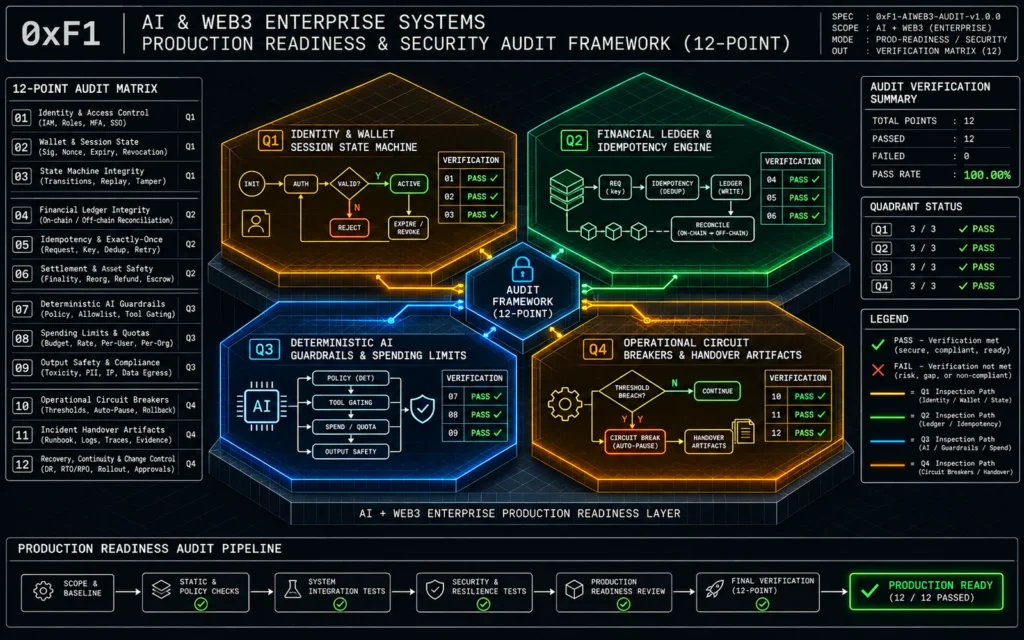
| Security audit risk | Very high (many initial flaws, 2~3 audit-remediation rounds delay launch) | Very low (standard audit foundation and formal invariant verification already in core logic) |
| Boundary failure rate | High (timezone drift, reorg-lost orders, and floating-point rounding failures after launch) | Near zero (state machines already cover detailed Unhappy Paths and defensive handling) |
| Team cognitive load | Protocol details consume attention and delay validation of the business model | Focus on frontend experience, referrals, and monetization to reach the market quickly |
| Later operational independence | Inconsistent code quality can leave an untouchable legacy system after staff leave | Complete brief, architecture diagrams, Runbook, and key-handover ceremony make takeover clear |
4. Fone’s Nine Commercial Source Foundations
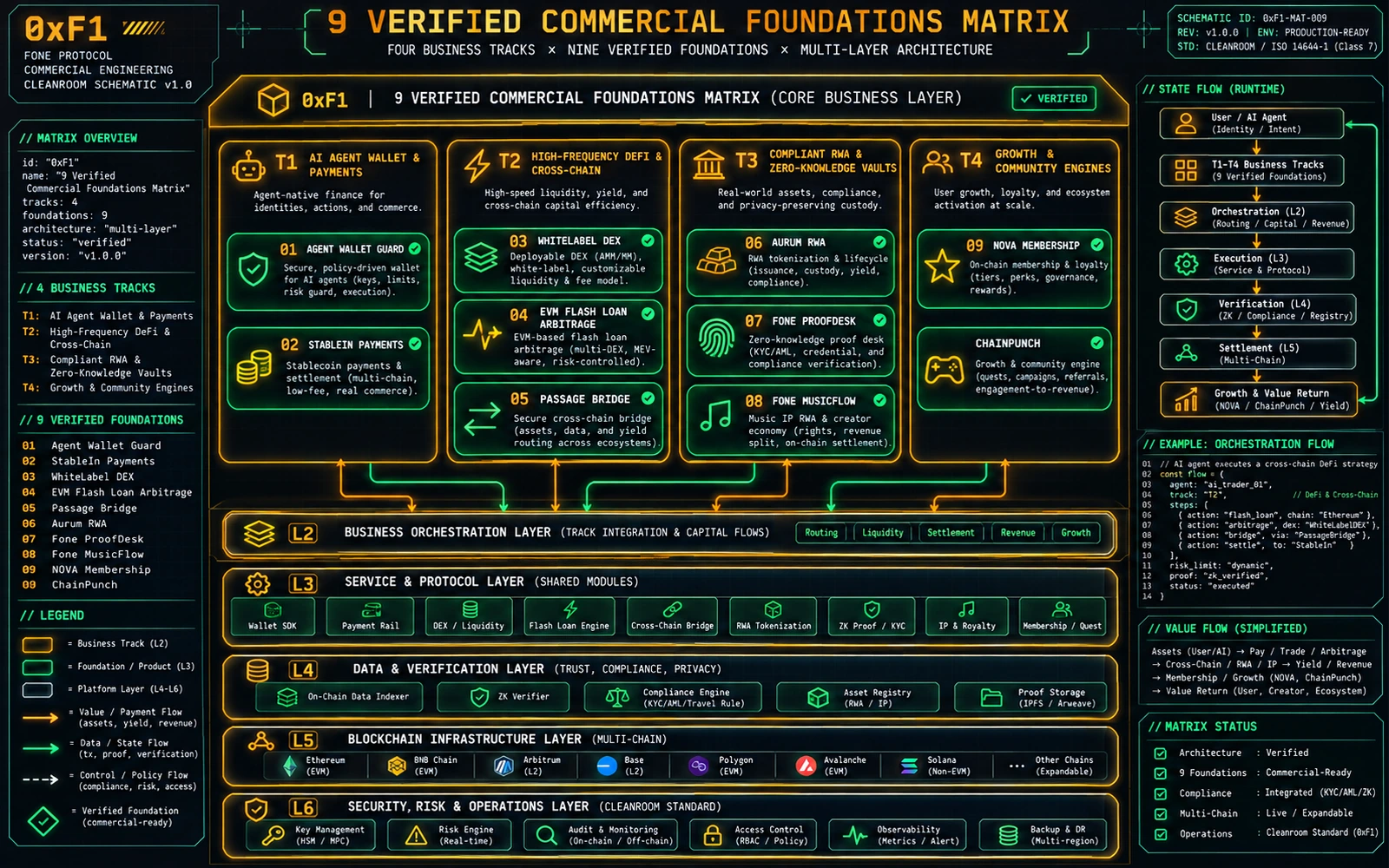
Across years of intensive engineering delivery, we independently developed and verified 9 core foundations covering agents, DeFi, RWA, and community growth. Each includes complete engineering source without hidden external-dependency traps:
+----------------------------------------------------------------------------------------------------+
|                                  Nine Established Foundations: Technology and Use Cases            |
+--------------------------+-----------------------+-------------------------------------------------+
| Foundation               | Core Stack            | Business Problem Addressed                      |
+--------------------------+-----------------------+-------------------------------------------------+
| 1. Agent Wallet Guard    | ERC-4337 / viem / Zod | Dual-checkpoint risk controls and budget enforcement for agent payments |
| 2. StableIn Platform     | NestJS / MySQL / EVM  | Concurrent multi-chain stablecoin checkout resistant to reorgs and missed orders |
| 3. WhiteLabel DEX Engine | Uniswap v2/v3 / React | Gas-efficient, censorship-resistant trading and liquidity infrastructure |
| 4. EVM Multi-Hop Arb     | Solidity / Rust / RPC | Production zero-slippage multi-hop flash-loan arbitrage and long-tail pool monitoring |
| 5. Passage Bridge        | Solidity / KMS / Relayer| Cross-chain replay defense, independent dual signatures, manual large-transfer breakers |
| 6. Aurum RWA Platform    | ERC-3643 / ONCHAINID  | Jurisdictional compliance, off-chain reserve reconciliation, compliant securitization |
| 7. Fone ProofDesk        | WebCrypto / AES-GCM   | Zero-trust confidential consulting/research delivery and on-chain escrow |
| 8. Fone MusicFlow        | ERC-1155 / Foundry    | Digital-media royalties, O(1) tiered splits, tamper-resistant rights credentials |
| 9. NOVA Membership       | Foundry / React / viem| Prepublication rule simulation, anti-Sybil referrals, tiered membership cards |
+--------------------------+-----------------------+-------------------------------------------------+
1. AI Agents and Automated Payments
- Agent Wallet Guard: An on-chain loss-prevention gateway for autonomous agents such as AutoGPT and Eliza. Its ERC-4337 wallet spending guards and concurrent Session Key budget locks keep model hallucinations from exceeding per-transaction and daily spending caps.
- StableIn Platform: Commercial stablecoin payment aggregation with a multi-chain reorg-resistant state machine tested at million-request scale, distributed order idempotency locks, and automatic amount-exception reconciliation.
2. High-Frequency DeFi and Liquidity Infrastructure
- WhiteLabel DEX Engine: A complete decentralized exchange implementation with automatic routing, millisecond depth-chart updates, and minimal liquidity market-making contracts.
- EVM Multi-Hop Arbitrage: A complete capital-free flash-loan arbitrage engine built on gas-efficient assembly and virtual-pool folding.
- Passage Bridge: Cross-chain asset infrastructure with independent dual-relayer signature review and multiple replay defenses.
3. Compliant Assets and Digital Rights
- Aurum RWA Tokenization: A compliant tokenized-asset portal based on ERC-3643, with an Identity Registry and an off-chain bank-grade asynchronous redemption pipeline.
- Fone ProofDesk: Encrypted on-chain delivery for premium business consulting, using browser-native WebCrypto for end-to-end confidentiality and milestone escrow.
- Fone MusicFlow: Web3 digital music and creator-rights distribution with fully automated O(1) royalty accumulation and settlement.
4. Web3 Retention and Community Growth
- NOVA Membership: On-chain membership with prepublication Rule Simulation and protection against multi-level circular self-referrals.
- ChainPunch: A low-gas Bitmap-based on-chain check-in and challenge growth platform.
5. Choosing a Route for Your Team’s Stage
Whether to adopt a white-label foundation depends on what the team considers its core advantage:
Decision tree:

1. Is your core advantage "underlying EVM state machines and cryptographic communication"
   or "vertical-market integration, AI orchestration, and user growth"?
   ├── The former (e.g. inventing a new Rollup sequencer or zero-knowledge proof scheme)
   │     └── Decision: Build in-house with a leading cryptography and compiler team.
   │
   └── The latter (most Web3 SaaS, AI Agents, asset managers, decentralized business platforms)
         │
         ├── More than 2 years of runway, and comfortable with competitors reaching market 8 months earlier?
         │     └── Decision: Building in-house is an option; prepare for repeated audit delays and security remediation.
         │
         └── Need production stability and institutional audit standards within 1 month?
               └── Decision: A verified source foundation offers the best capital efficiency and ROI.
Once a team chooses a strong foundation, the most robust approach is “foundation verification + custom delivery”: begin with production code and direct engineering resources toward distinctive features and customer experience. After launch, the team retains full source ownership and can independently maintain and scale the system through the accompanying handover standards, without outside dependence.
Architecture Consulting and Custom Engineering
If you are planning a commercial product involving Web3 funds, AI agent wallets, or high-concurrency on-chain settlement, or want to assess how Fone’s 9 foundations could accelerate delivery:
- Visit Fone client deliveries and system demos to inspect production operating metrics and interactions for these foundations;
- Read our full-stack production engineering and audit guide to align internal technology-selection standards;
- Book a one-to-one discussion through the Fone architecture consulting channel for practical development timelines, technical cost breakdowns, and foundation customization proposals for your business.