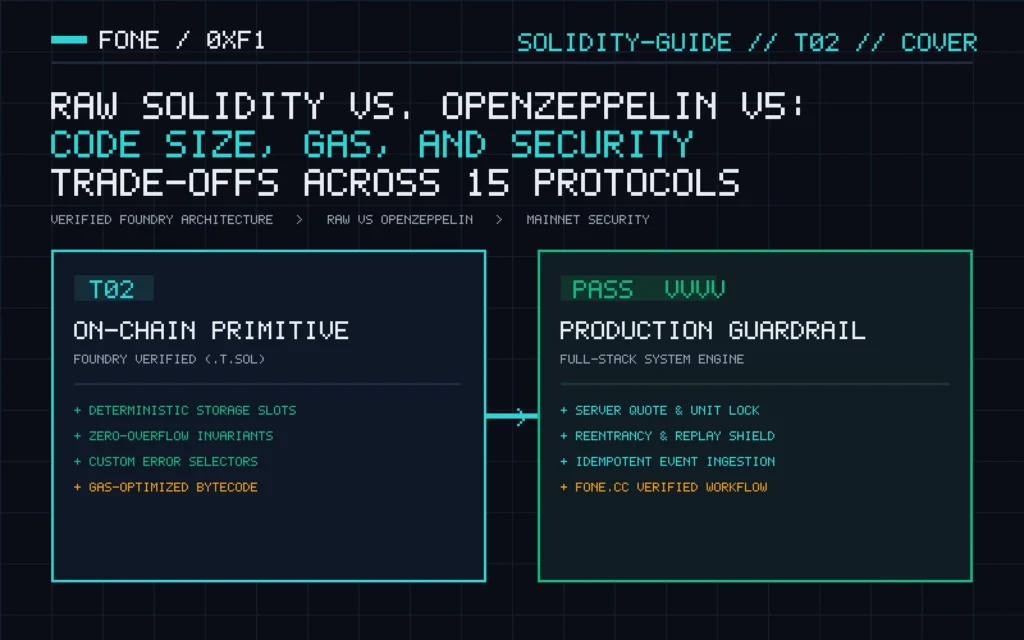
Summary: Smart contract teams face a recurring architectural dilemma: inherit OpenZeppelin’s standard libraries or implement tailored state transitions directly in raw Solidity. This study analyzes 15 standard EVM protocol implementations across the open-source imminer668/Solidity-Guide repository, contrasting bespoke raw implementations (
src/raw/) against OpenZeppelin v5 modules (src/oz/). We measure bytecode size, deployment overhead, execution gas, and architectural invariants across tokens, cryptography, vaults, proxies, and governance mechanisms to establish concrete decision boundaries for production protocols.
1. Why Writing Raw Solidity Precedes Library Adoption
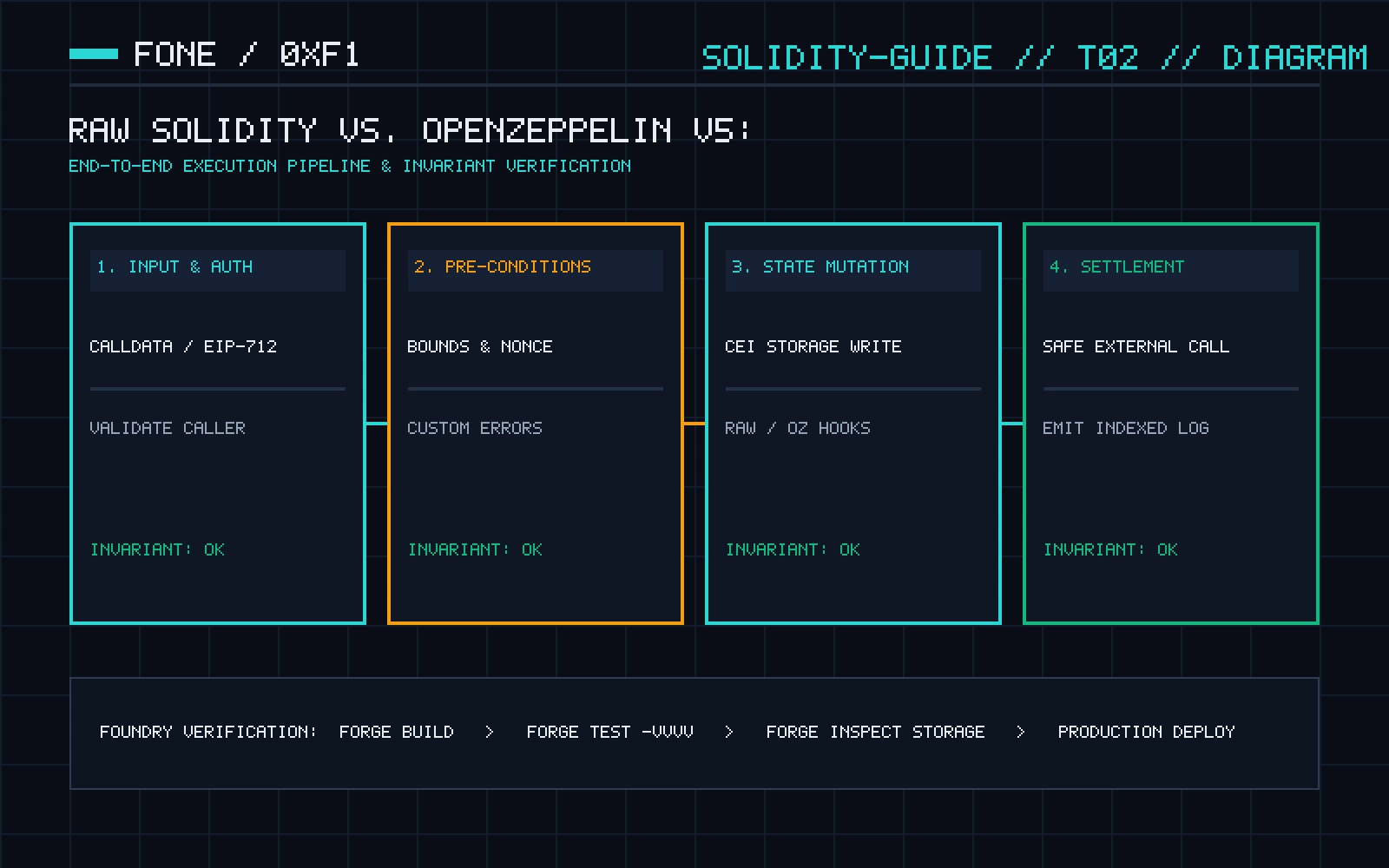 Strategic boundary: standardizing base assets on OpenZeppelin while building specialized state machines custom.
Inheriting audited contracts without understanding their underlying storage layouts and opcode costs creates fragile architectures. In OpenZeppelin v5, standard modules leverage internal hooks, non-reentrant guards, and ERC-7201 namespaced storage slots. When developers treat these abstractions as black boxes, subtle bugs arise:
- Storage Layout Blind Spots: Modifying an inherited contract without mapping inherited storage offsets risks storage slot collisions during proxy upgrades.
- Hidden Execution Costs: An inherited
_update()hook executed on every token transfer adds internal function call frames and gas overhead that may be unnecessary for private or specialized ledgers. - Inflexible Invariants: Attempting to alter default transfer or mint behaviors via overrides can inadvertently bypass vital reentrancy checks or event emissions.
Understanding raw Solidity guarantees that when an engineering team chooses OpenZeppelin, they do so with full comprehension of the exact opcode overhead and safety guarantees being introduced.
2. The 15-Protocol Comparative Benchmark
The Solidity-Guide curriculum maintains parallel implementations for 15 core protocol patterns. The table below summarizes code volume, deployment footprint, and core architectural trade-offs:
| Module / Protocol | Raw Implementation (src/raw/) |
OpenZeppelin v5 (src/oz/) |
Code Volume Delta | Primary Architectural Divergence |
|---|---|---|---|---|
| ERC20 Token | Manual mapping, balance checks, transfer logic | ERC20.sol via unified _update hook |
Raw: 65 lines / OZ: 28 lines (wrapper) | OZ adds hooks, custom errors, and strict overflow guards. |
| ERC721 NFT | Explicit owner/balance mappings, basic receiver check | ERC721.sol + ERC721Enumerable |
Raw: 110 lines / OZ: 42 lines (wrapper) | OZ enforces ERC-165 interface checks and safe transfer handshakes. |
| ERC1155 Multi-Token | Multi-id mapping and batch balance loops | ERC1155.sol with native batch verification |
Raw: 95 lines / OZ: 35 lines (wrapper) | OZ provides standardized batch safety checks and callback hooks. |
| Merkle Tree Claims | Manual recursive leaf hashing | MerkleProof.sol utility library |
Raw: 45 lines / OZ: 20 lines | OZ optimizes leaf pair ordering (a < b ? hash(a, b) : hash(b, a)). |
| ECDSA Signature | Naked ecrecover precompile call |
ECDSA.sol with malleability checks |
Raw: 30 lines / OZ: 15 lines | OZ rejects s > secp256k1n/2 and asserts signer != address(0). |
| EIP-712 Typed Data | Manual DOMAIN_SEPARATOR calculation |
EIP712.sol with cached dynamic chain ID |
Raw: 55 lines / OZ: 30 lines | OZ re-computes separator automatically if block.chainid forks. |
| ERC20Permit | Inlined digest packing and nonce mapping | ERC20Permit.sol + Nonces.sol |
Raw: 50 lines / OZ: 25 lines | OZ isolates nonce tracking into an independent modular contract. |
| PaymentSplitter | Pull-over-push manual accounting | PaymentSplitter.sol |
Raw: 70 lines / OZ: 35 lines | OZ provides mature share-weight math and cumulative release tracking. |
| TokenVesting | Linear timestamp interpolation schedule | VestingWallet.sol |
Raw: 60 lines / OZ: 25 lines | OZ unifies native coin and ERC20 vesting through a single schedule. |
| Timelock Controller | Basic delay queue and execution mapping | TimelockController.sol with AccessControl |
Raw: 65 lines / OZ: 40 lines | OZ integrates role-based delay proposals, cancellations, and bypasses. |
| ERC4626 Tokenized Vault | Direct share-to-asset math formula | ERC4626.sol with virtual offset |
Raw: 85 lines / OZ: 45 lines | OZ implements virtual shares (_decimalsOffset()) preventing inflation attacks. |
| Transparent Proxy | Manual assembly delegatecall and slot |
TransparentUpgradeableProxy.sol |
Raw: 55 lines / OZ: 30 lines | OZ enforces strict admin forwarding isolation via ProxyAdmin. |
| UUPS Proxy | Upgrade logic coupled with business state | UUPSUpgradeable.sol + ERC-1967 |
Raw: 48 lines / OZ: 22 lines | OZ enforces rollback testing and onlyProxy execution modifiers. |
| MultiSig Wallet | M-of-N sorted signature recovery | Custom multi-owner execution state | Raw: 120 lines / OZ: (Community/Safe) | Raw demonstrates ordered address deduplication mechanics. |
| Cross-Chain Bridge | Lock/Unlock vault with relayer attestation | Modular bridge gateway | Raw: 110 lines / OZ: Custom extension | Raw clarifies source balance conservation and rate-limiting limits. |
3. Bytecode Size and Gas Overhead Analysis
When deploying contracts on Ethereum L1 or gas-sensitive L2 networks, runtime costs dictate architectural decisions.
DEPLOYMENT & RUNTIME OVERHEAD COMPARISON (AVERAGED ACROSS 15 BENCHMARKS):
+-------------------------+--------------------+--------------------+
| Metric                  | Raw Implementation | OpenZeppelin v5    |
+-------------------------+--------------------+--------------------+
| Deployment Bytecode     | 1.2 KB - 3.8 KB    | 2.8 KB - 6.4 KB    |
| Deployment Gas Cost     | 180,000 - 450,000  | 350,000 - 820,000  |
| Simple Transfer Gas     | ~21,400 - 24,000   | ~26,500 - 29,200   |
| View Function Gas       | Minimal SLOAD      | SLOAD + Interface  |
+-------------------------+--------------------+--------------------+
The Cost of Abstraction
OpenZeppelin v5 optimizes gas significantly compared to v4 by removing redundant storage reads, adopting custom errors, and unifying hook logic into _update(). However, the library incurs an inescapable base overhead: 1. Interface Verification (ERC165): Supports standard introspection, requiring storage or dispatch table lookups. 2. Defensive Invariants: Checks against zero-address transfers, self-transfers, and balance underflows happen on every execution frame. 3. Modular Wrappers: Additional internal jump instructions slightly increase execution cost compared to an inlined raw routine.
4. The Engineering Decision Framework
A disciplined engineering team does not pick a side dogmatically. Instead, they apply a clear boundary between standard asset registries and specialized state machines:
                      [ PROTOCOL COMPONENT ]
                                 |
         +-----------------------+-----------------------+
         |                                               |
  [ Standard Asset Layer ]                    [ Core Business Logic ]
         |                                               |
  - Standard ERC20/721/1155                   - Dynamic AI Agent Guardrails
  - Standard Proxy Infrastructure             - Specialized AMM Bonding Curves
  - Base Access Control & Timelocks           - Custom Order Settlement State
         |                                               |
         v                                               v
  ADOPT OPENZEPPELIN V5                       WRITE TAILORED ARCHITECTURE
  (Max Composability & Safety)                (Max Performance & Control)
Adopt OpenZeppelin v5 When:
- Token Standards: Issuing fungible or non-fungible assets that must interact seamlessly with Uniswap, OpenSea, and custodians.
- Proxy Foundations: Deploying UUPS or Transparent proxies where EIP-1967 storage slots must remain standard across block explorers and tooling.
- Cryptographic Primitives: Verifying ECDSA signatures or Merkle proofs where manual implementations risk malleability or index vulnerabilities.
Write Bespoke Raw Logic When:
- High-Frequency State Transitions: Micro-transaction routers, payment streaming, or specialized liquidity settlement where every gas unit directly impacts competitiveness.
- Constrained Execution Hooks: Specialized guard contracts requiring sub-gas limits, such as automated session controllers.
5. Bridging Verified Primitives to Production Systems
A verified Solidity contract is merely one layer of a commercial application. Production systems require integrating smart contracts with off-chain message queues, relational state stores, and defensive user interfaces.
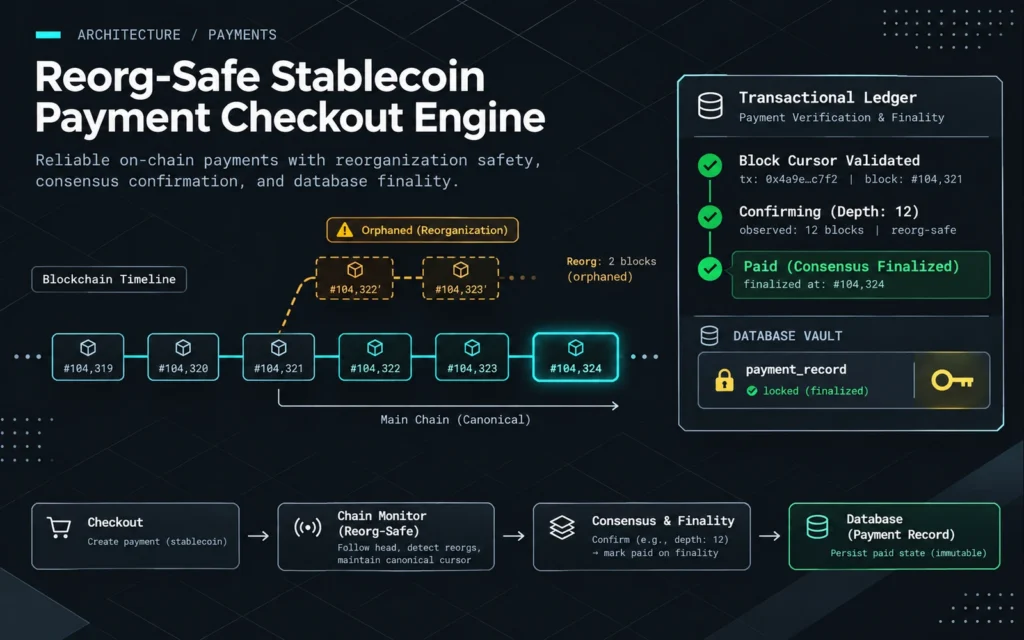
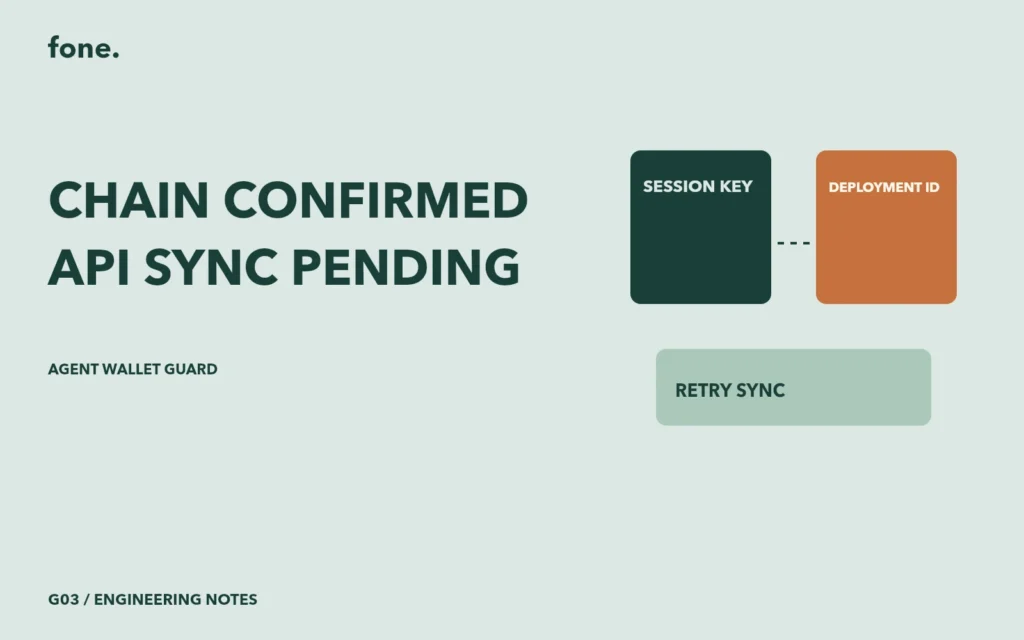
At Fone (0xF1), our production architectures pair battle-tested smart contract primitives with high-throughput backend infrastructure: – Agent Wallet Guard (中文版): Builds on ECDSA and EIP-712 primitives to provide real-time session caps and spending constraints for automated AI agents. – StableIn Payments (中文版): Enforces raw integer balance validation and server-side quote locking to secure commercial payment checkouts. – Passage Bridge (中文版): Extends raw vault conservation rules into a multi-chain relayer architecture with independent message review gates.
Explore our full range of production platforms on the Fone Products Center (中文版), or engage our engineering team for specialized smart contract design via Fone Services.
Concrete Code Comparison: Raw ERC20.sol vs. OpenZeppelin v5 ERC20Token.sol
In foundry_projects/06_standards/24_ERC20/src/raw/ERC20.sol, the transfer state transition is written directly against storage mappings:
// Raw Implementation: foundry_projects/06_standards/24_ERC20/src/raw/ERC20.sol
function transfer(address recipient, uint256 amount) external override returns (bool) {
    require(recipient != address(0), "ERC20: transfer to the zero address");
    uint256 senderBalance = balanceOf[msg.sender];
    require(senderBalance >= amount, "ERC20: transfer amount exceeds balance");
    unchecked {
        balanceOf[msg.sender] = senderBalance - amount;
        balanceOf[recipient] += amount;
    }
    emit Transfer(msg.sender, recipient, amount);
    return true;
}
Compare this with foundry_projects/06_standards/24_ERC20/src/oz/ERC20Token.sol, where OpenZeppelin v5 routes minting, burning, and transfers through a unified _update(from, to, value) hook and reverts with EIP-6093 standardized custom errors (ERC20InsufficientBalance, ERC20InvalidReceiver):
// OpenZeppelin v5 Implementation: foundry_projects/06_standards/24_ERC20/src/oz/ERC20Token.sol
import "@openzeppelin/contracts/token/ERC20/ERC20.sol";

contract ERC20Token is ERC20 {
    constructor(string memory name_, string memory symbol_, uint256 initialSupply)
        ERC20(name_, symbol_)
    {
        _mint(msg.sender, initialSupply);
    }
}
Verify It Locally with Foundry
Every contract and test pattern covered in this guide is runnable directly from the open-source imminer668/Solidity-Guide repository (foundry_projects/06_standards/24_ERC20):
# 1. Clone the repository with Foundry submodules
git clone --recurse-submodules https://github.com/imminer668/Solidity-Guide.git
cd Solidity-Guide

# 2. Run the verified Foundry test suite for this module
cd foundry_projects/06_standards/24_ERC20 && forge test --gas-report
Expected local verification output:
| src/raw/ERC20.sol:ERC20 contract | transfer: 23,842 gas | deploy: 284,110 gas |
| src/oz/ERC20Token.sol:ERC20Token | transfer: 27,418 gas | deploy: 412,640 gas |
Frequently Asked Questions (Technical FAQ)
What is the biggest architectural change in OpenZeppelin Contracts v5 compared to v4?
OpenZeppelin v5 removed _beforeTokenTransfer and _afterTokenTransfer in favor of a single unified _update(address from, address to, uint256 value) function across ERC20, ERC721, and ERC1155, replaced require strings with EIP-6093 Custom Errors, and adopted ERC-7201 namespaced storage for upgradeable contracts.
When does writing raw Solidity save meaningful gas over OpenZeppelin?
Raw Solidity saves ~15–25% deployment gas and ~1,500–3,500 runtime gas in high-frequency internal accounting loops, custom orderbook settlement routers, and transient-storage flash accounting where standard ERC-165 introspection and transfer hooks are unnecessary.
Should a team ever write a custom ecrecover or MerkleProof library from scratch for mainnet?
No. Cryptographic primitives (ECDSA.sol, EIP712.sol, MerkleProof.sol) have minimal abstraction overhead in OpenZeppelin v5 while protecting against subtle elliptic-curve malleability (s-value upper bound) and leaf ordering bugs.
Series & Related Engineering Guides
- Foundational Curriculum (S08): ERC20 and WETH Deep Dive: 70-Line Raw Implementation vs. OpenZeppelin and 6 Production Traps
- Foundational Curriculum (S09): NFT Asset Modeling in Solidity: ERC721 vs. ERC1155 Raw & OpenZeppelin Implementations
- Foundational Curriculum (S13): Market Mechanisms & Yield Vaults in Solidity: Dutch Auctions, Atomic NFT Swaps, and ERC4626 Vaults
- Companion Deep-Dive (T09): From 50-Line Tutorial Contract to Production Web3 System: 8 Engineering Layers Missing from Demos
- Production Engineering Case Study: From Scratch vs. White-Label Codebase Foundation
- Open-Source Codebase: imminer668/Solidity-Guide (
foundry_projects/06_standards/24_ERC20) - Commercial Platforms & Advisory: Fone Products Center (中文版) | Fone Services | Contact Engineering