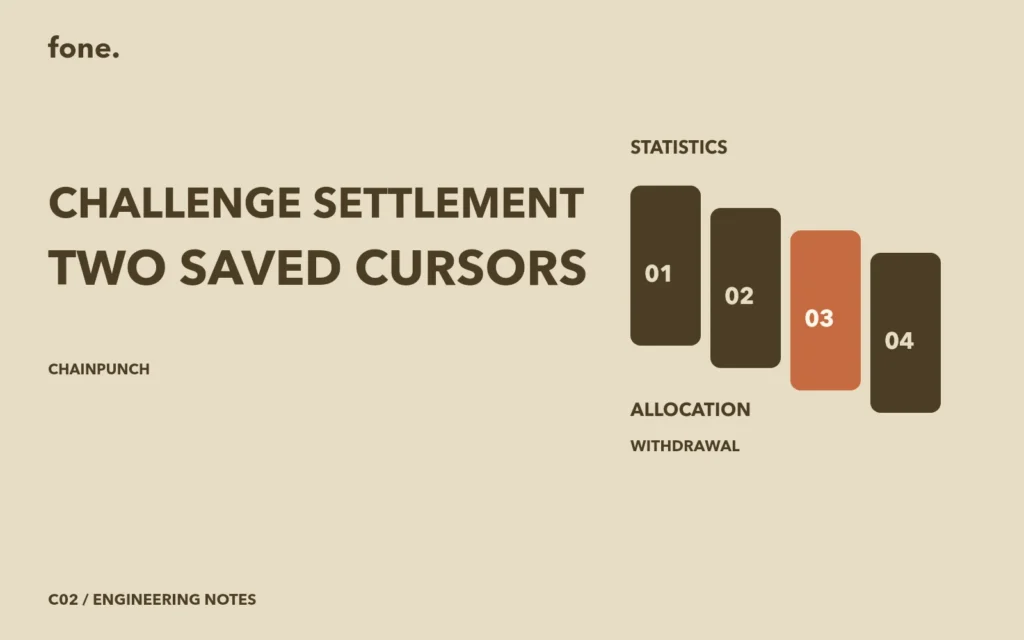
ChainPunch's settlement entry point can require several transactions even when every transaction succeeds. The inspected contract first gathers participant statistics, then allocates the resulting pool. Each phase advances its own cursor. A progress screen needs to show which phase is moving, because finishing the count still leaves the allocations to perform.
The source bounds each batch at 100 participant slots and limits task creation to 1,000 participants. Those are implementation limits. They do not establish transaction cost on a particular network or prove that a production deployment can support that workload under every condition. This article reviews the local prototype's mechanism and provides a test plan without claiming new test execution.
Finish the count before allocating
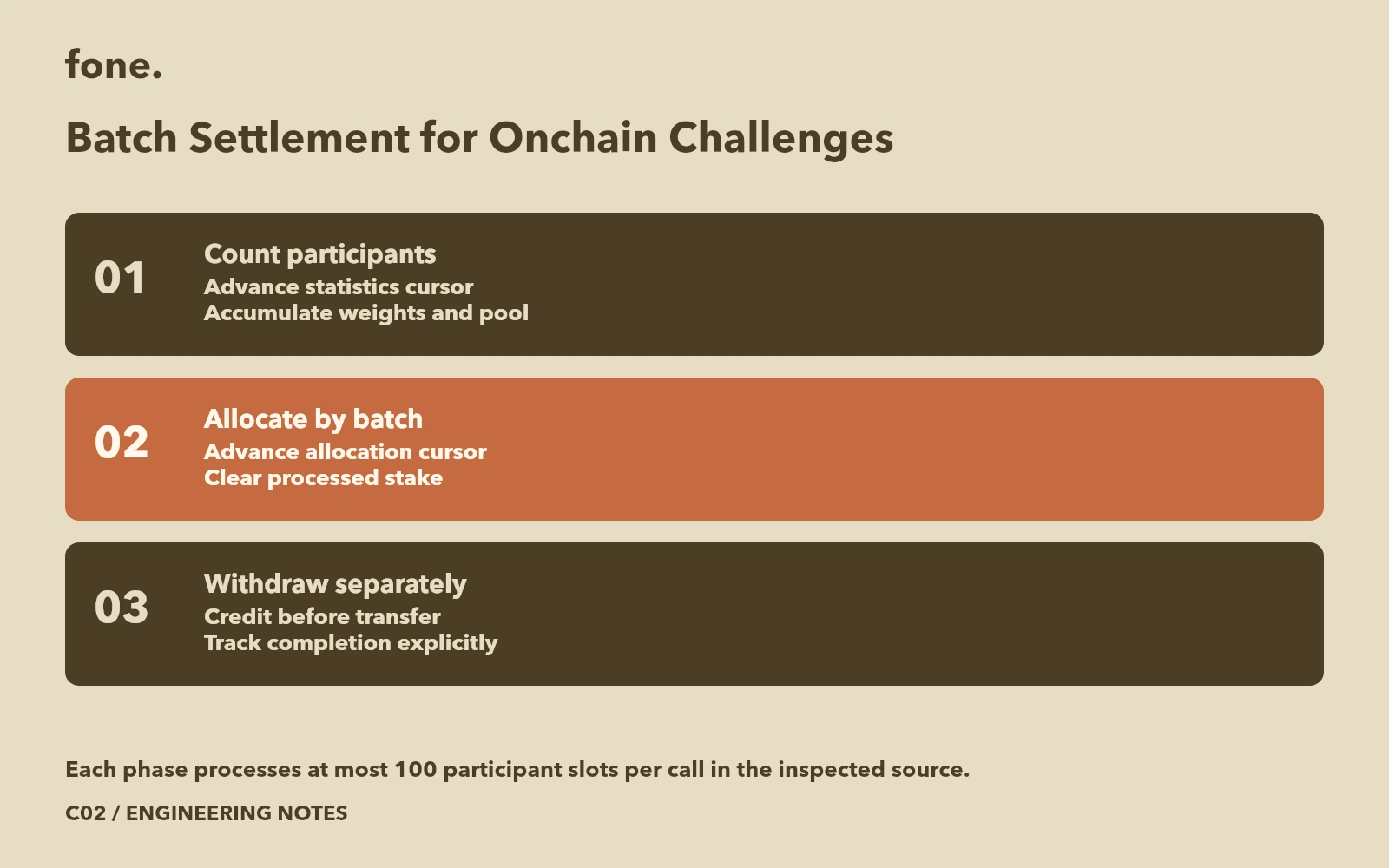
At the start of settlement, the contract moves collected make-up fees into the settlement pool and marks the task as settling. The statistics loop visits the next range of participant addresses. It accumulates penalties, remaining stake and participation weight while skipping a participant whose stake is already zero.
Once the statistics cursor reaches the participant count, the contract derives fees and the amount available for distribution. It also chooses a fallback weighting method if the total participation weight is zero. That decision depends on the aggregate, so an early participant cannot receive a final allocation while the denominator is still changing.
The entry point returns after the statistics phase. Even the transaction that finishes counting does not also start distribution. This makes a useful UI boundary. Show statistics complete and allocation pending until a later transaction advances the second phase.
| Phase | Persistent progress | Completion condition |
|---|---|---|
| Statistics | Statistics cursor, pool and total weight | Cursor equals participant count |
| Distribution | Settlement cursor and remaining allocation | Cursor equals participant count |
| Task completion | Claimed flag | Final distribution branch completes |
| Withdrawal | Participant credit and withdrawn amount | Individual transfer succeeds |
Resume from committed state
The distribution loop starts from the saved settlement cursor. For each processed participant, it computes the principal and additional allocation, clears that participant's stake, records the allocation and credits the recipient. It then saves the end of the processed range.
The cursor supplies forward progress; clearing stake provides another guard against processing the same active stake again. A successful transaction commits those changes together. If a call reverts, the caller should inspect the chain state and receipt before deciding what remains. Sending another call after a confirmed batch should continue from the saved cursor rather than from a browser's remembered participant index.
The residual pool and remaining weight decrease during allocation. A later eligible participant receives a calculation based on those remaining values. This is a specific rounding approach in the inspected contract. A separate implementation that calculates every share independently would need its own remainder policy and should not assume identical individual results.
Keep transfers outside the participant loop
The contract credits amounts during settlement and exposes a separate withdrawal function. That function clears the caller's credit, updates the withdrawn total and then transfers tokens. The interface can therefore distinguish a computed allocation from a completed transfer.
This structure also keeps the settlement loop away from one token transfer per participant. Solidity's security guidance discusses the risk of unbounded loops and recommends withdrawal patterns where a failing recipient could obstruct progress. Those principles explain the design tradeoff, without constituting a security assessment of this contract. Solidity security considerations
Pause behavior deserves a separate check. In the inspected code, starting settlement requires the contract to be unpaused, while an already-started settlement may continue. Emergency withdrawal requires a paused contract and is blocked once the task is settling. Those rules affect what an operator can promise when work stops midway.
Review the edges around each batch
Use participant counts of zero, one, 100 and 101 to exercise the phase boundaries before increasing the scope. Inspect the count and distribution cursors after every transaction. Include a participant with zero stake and a task with no participation weight, since those paths change how the aggregate and allocation behave.
A repeated completion request should not create another allocation. A participant's withdrawal should not change either settlement cursor. Record transaction identifiers and actual before-and-after values so these conclusions come from evidence in the target environment.
The batch settlement review worksheet starts every case at Not run. Bring the activity period, participation rules and settlement responsibilities to ChainPunch to review the product scope. The demonstration uses a local test chain and test CIT; participant outcomes depend on the task rules and collected penalties and make-up fees.