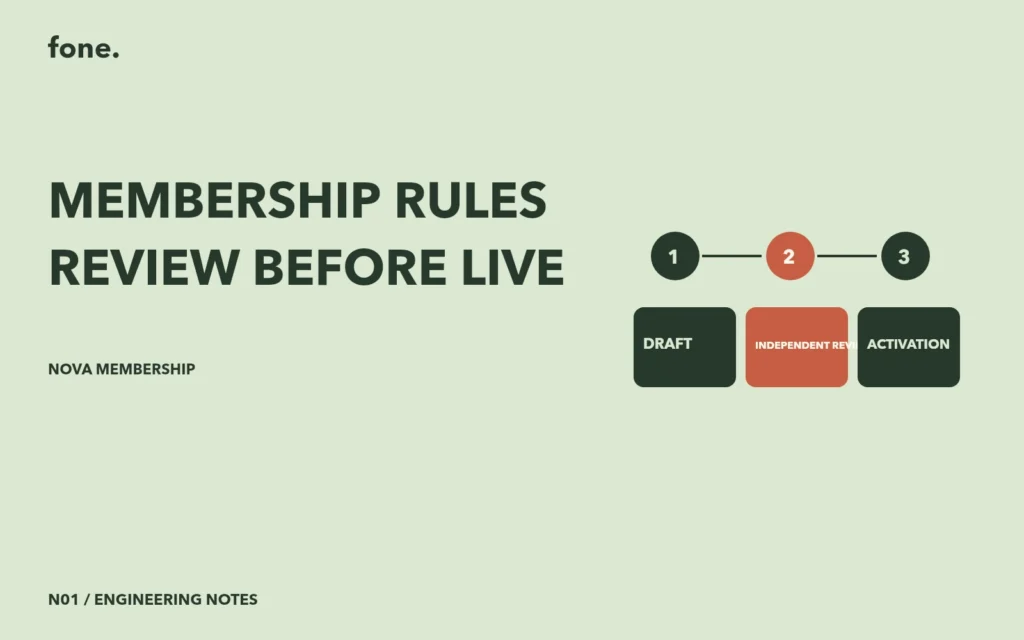
A membership operator can prepare tomorrow's rules without changing today's active version. NOVA Membership's inspected backend provides a release sequence that moves a rule set through draft, validation, review and scheduling before activation. The meaningful question for a developer is what each transition checks and which decisions retain a reference to the resulting version.
The current product is a local demonstration. Its rule release controls are concrete source behavior, while universal historical-order binding and rollback remain outside what this review establishes. Those two limits deserve attention before a team treats a version label as a complete record of past behavior.
Give the draft its own records
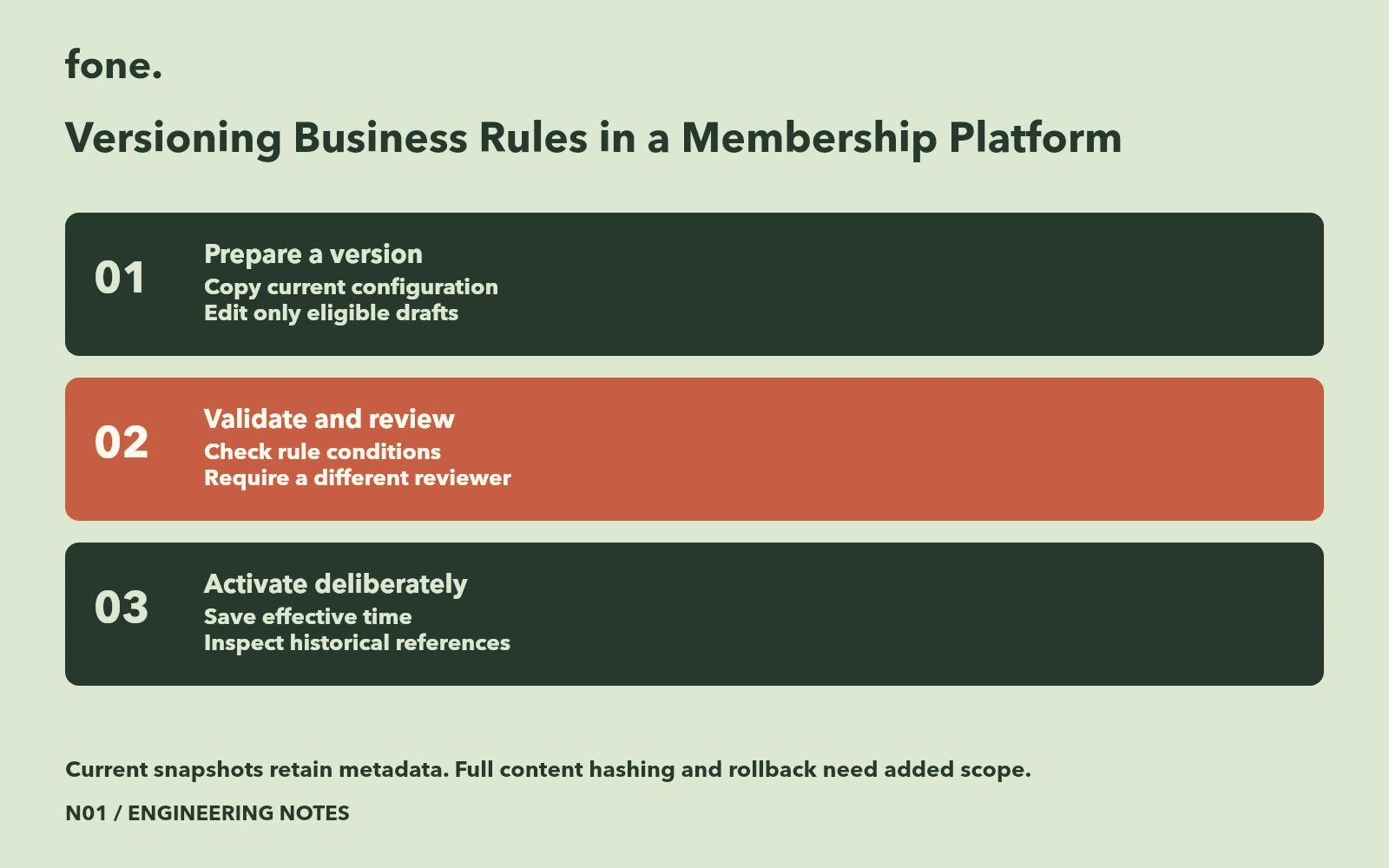
Creating a rule set records its version, name and creator. When an active rule set exists, the service copies related definitions and configuration into the new version. The copied material includes level definitions, business-time policy and pass definitions. An operator can therefore start from the current configuration rather than rebuilding every field by hand.
Rule-definition insertion is restricted to a draft. The level configuration service also requires draft status for supported edits and protects its baseline levels. These checks sit below the screen, so hiding an edit button is not the only restriction. A direct request still has to satisfy the stored status requirement.
Validation checks for required configuration and evaluates rule conditions. The level validator checks that level codes and ordinals form a contiguous sequence and that references point to valid conditions. Passing validation moves the draft to validated status. It does not activate the version.
| Transition | Observed guard | Evidence to retain |
|---|---|---|
| Draft to validated | Required configuration and condition checks | Validation result for this version |
| Validated to reviewed | Reviewer differs from creator | Creator and reviewer identities |
| Reviewed to scheduled | Effective time supplied | Agreed UTC effective time |
| Scheduled to active | Expected stored state still matches | Activation record and snapshot reference |
| Active to retired | Another version activates | Link between successive active versions |
Separate approval from the effective time
The review function rejects the creator as reviewer. Controller permissions also distinguish creation, review and publication actions. This gives the application a specific separation of responsibility, though the organization's actual user assignments still determine how those permissions are used.
Scheduling stores an effective time and immediately checks for versions that are already due. A separate immediate-activation action takes a reviewed version through a scheduled state at the current UTC time, retires the active version and activates the new one. If a project requires a minimum notice period, that is an additional rule to specify; scheduling alone does not imply one.
State updates include the expected previous status. If another operation has changed that status, the service reports a conflict. The operations screen should refresh the record after such a response. Repeating the same button press without reading the new state can obscure which release action actually happened.
Inspect what the snapshot proves
Activation inserts a configuration snapshot with a version reference and counts of related record types. Its stored hash is derived from the rule-set identifier, version and version counter. It is not a hash of every rule condition and pass definition. Describing it as a complete immutable configuration fingerprint would overstate the inspected implementation.
For stronger reproduction, an extension could serialize the full relevant configuration in a defined order and hash those bytes. That proposal also needs a retention policy for referenced records. A hash without the underlying content cannot reproduce how a past decision was calculated.
The source's pass-confirmation path selects an active configuration snapshot during processing. This shows why historical behavior needs its own investigation. Determine whether the intended version is chosen at purchase, confirmation, activation or another business event. Those moments can straddle a release boundary. The presence of a snapshot table alone cannot answer that policy question.
The reviewed release service has no general rollback operation. A corrective version can be planned as a new reviewed release, but the handling of decisions already made under the earlier version must be specified separately. Reinstating old configuration also does not automatically undo completed actions.
The rule release review worksheet includes release conflicts, delayed processing and snapshot-content checks, all initially Not run. NOVA Membership provides the matching local membership workflow. Bring the rule changes, effective-time policy and operator roles to a scope discussion so historical references are reviewed alongside the publishing screen.