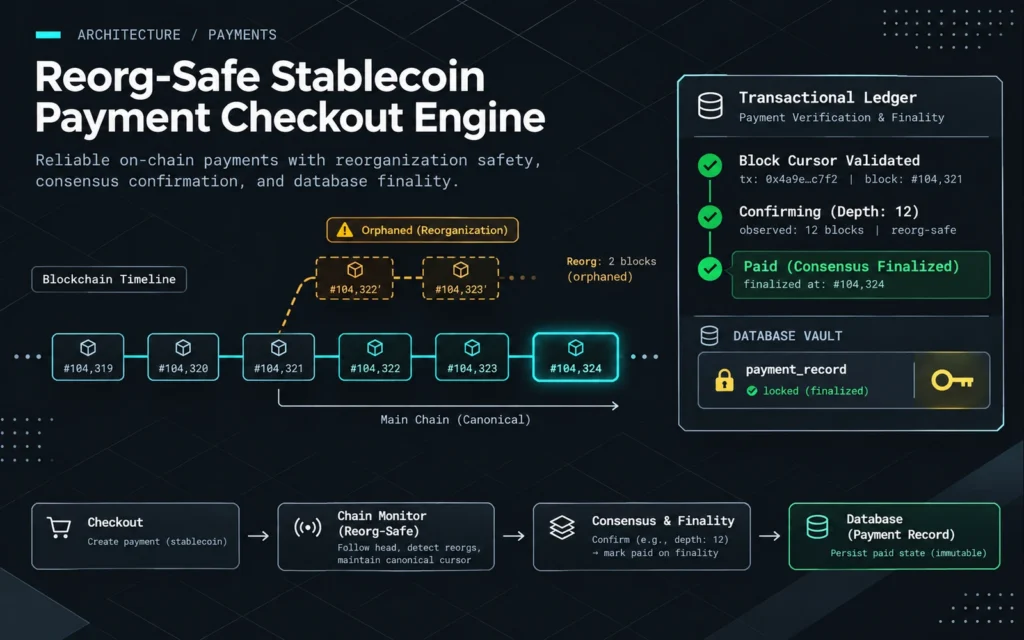
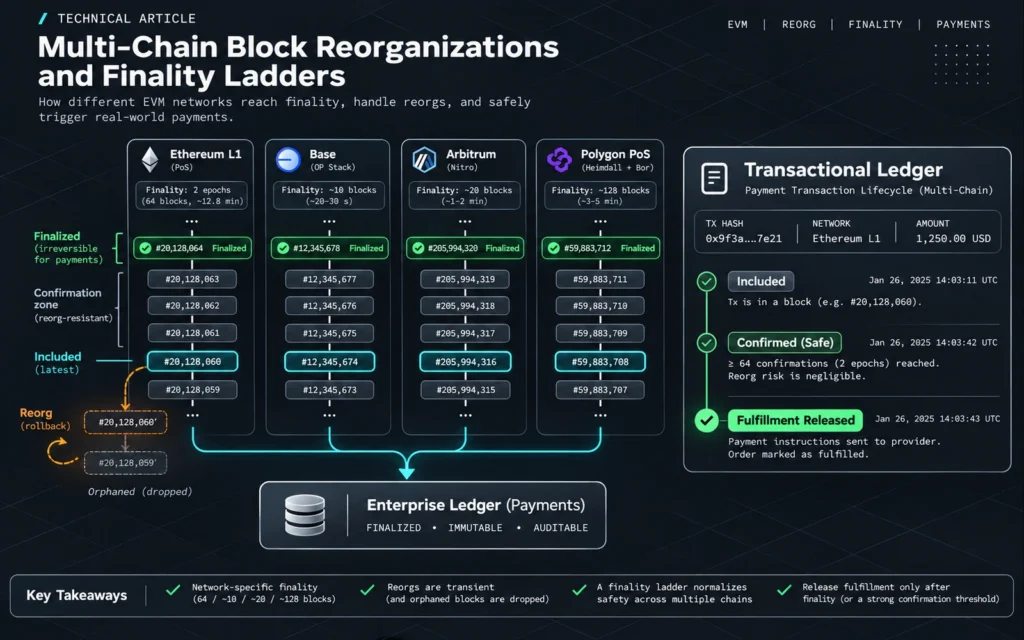
Cryptocurrency checkout architectures that treat all EVM networks identically fail when confronted with heterogeneous consensus mechanisms. A 1-block confirmation on Ethereum Proof-of-Stake represents a different probability of finality than 1 block on Polygon PoS, Arbitrum Nitro, or Base. In StableIn Payments, multi-chain finality risk is mitigated through a two-tiered confirmation depth ladder, persistent block parent-hash chain validation (
pay_chain_blocks), and a cursor-based event projector that automatically rolls back unfinalized state and dispatches explicitpayment.reorgedevents when shallow reorganizations occur.
1. The Multi-Chain Finality Problem: Heterogeneous Consensus Realities
When engineering an automated checkout pipeline supporting stablecoins (USDC, USDT, EURC) across multiple networks, developers often hardcode a single confirmation rule (such as confirmations: 1 or confirmations: 12).
In a multi-chain topology, this one-size-fits-all approach causes either intolerable user friction or financial loss:
[Network A: Ethereum L1 (Gas: High, Finality: 2 Epochs / 12.8 Minutes)]
- Block Time: 12 seconds.
- Reorg Profile: Extremely rare above 1 block; Caspar FFG finality reached at 2 epochs (64 slots / 12.8 minutes).
- Risk of 1-block fulfillment: Low, but high gas makes small checkouts unviable.

[Network B: Polygon PoS (Gas: Low, Finality: Bor / Heimdall Checkpoints)]
- Block Time: 2 seconds.
- Reorg Profile: Frequent shallow reorgs (1 to 5 blocks) due to sprint-based validator switching;
  historical deep reorgs (> 32 blocks) prior to the hard fork.
- Risk of 1-block fulfillment: Catastrophic. A merchant fulfilling digital goods at 1 confirmation
  will suffer frequent orphaned transaction losses.

[Network C: Optimistic L2s (Base / Arbitrum - Centralized Sequencer)]
- Block Time: 250ms (Arbitrum) to 2s (Base).
- Reorg Profile: Centralized sequencers provide "soft finality" (First-Come, First-Served mempool order).
  However, L1 state derivation (batch posting and state root proposal) takes minutes to hours,
  and sequencer failovers or L1 reorgs can theoretically rewrite soft blocks.
If a merchant provisions software licenses, API access, or tokenized assets based on “soft inclusion,” any subsequent block reorganization results in irreversible theft. Conversely, if a merchant forces a mobile user to wait 15 minutes for Ethereum L1 finalized checkpoints on every 5 USDC coffee purchase, the checkout conversion rate collapses.
The production-proven pattern implemented in StableIn-Platform decouples Optimistic Feedback from Irreversible Fulfillment Gateways.
2. Multi-Chain Confirmation Depth Ladder
Rather than exposing raw block numbers to business applications, StableIn-Platform configures a chain manifest with explicit two-tier depth thresholds (StableIn-Platform/src/migrations/1792108802000-PaymentChain.ts:L1-L41):
export interface ChainManifest {
  chainId: number;
  name: string;
  gateway: `0x${string}`;
  usdcToken: `0x${string}`;
  blockTimeMs: number;
  // Tier 1: Optimistic UI confirmation (Safe to show "Payment Received", NOT safe to fulfill)
  inclusionConfirmations: number;
  // Tier 2: Irreversible consensus finality (Safe to trigger digital fulfillment / shipment)
  finalizedConfirmations: number;
}
Production Tier Configuration Matrix
| Network | Inclusion Confirmations (UI Feedback) | Finality Confirmations (Asset Fulfillment) | Expected Fulfillment Delay | Reorg Probability Profile |
|---|---|---|---|---|
| Ethereum L1 (1) | 1 block (12s) | 32 blocks / 2 Epochs (Finalized checkpoint) | ~12.8 minutes | Negligible after 2 epochs |
| Base (8453) | 1 block (2s) | 15 blocks (~30s) or L1 Batch Post | ~30 seconds | Soft sequencer guarantee |
| Arbitrum One (42161) | 2 blocks (~1s) | 20 blocks (~10s) or Sequencer Finality | ~10 seconds | Sequencer feed dependent |
| Polygon PoS (137) | 5 blocks (~10s) | 128 blocks (~4.2 minutes / Milestone) | ~4.2 minutes | High shallow reorg frequency |
| BSC (56) | 3 blocks (~9s) | 15 blocks (~45s / Fast Finality) | ~45 seconds | Rare post-fast-finality |
3. Detecting Reorgs in the Scanner Layer: pay_chain_blocks
To detect and recover from chain reorganizations without dropping data, the indexing service in StableIn-Platform maintains a verifiable parent-hash chain directly in MySQL InnoDB (src/migrations/1792108802000-PaymentChain.ts):
CREATE TABLE pay_chain_blocks (
   chain_id INT UNSIGNED NOT NULL,
   number BIGINT UNSIGNED NOT NULL,
   hash BINARY(32) NOT NULL,
   parent_hash BINARY(32) NOT NULL,
   timestamp BIGINT UNSIGNED NOT NULL,
   canonical BOOLEAN NOT NULL DEFAULT TRUE,
   finalized BOOLEAN NOT NULL DEFAULT FALSE,
   PRIMARY KEY (chain_id, hash),
   KEY canonical_height (chain_id, canonical, number)
) ENGINE=InnoDB;

CREATE TABLE pay_chain_events (
   id CHAR(36) PRIMARY KEY,
   chain_id INT UNSIGNED NOT NULL,
   block_number BIGINT UNSIGNED NOT NULL,
   block_hash BINARY(32) NOT NULL,
   tx_hash BINARY(32) NOT NULL,
   tx_index INT UNSIGNED NOT NULL,
   log_index INT UNSIGNED NOT NULL,
   name VARCHAR(40) NOT NULL,
   args JSON NOT NULL,
   order_id CHAR(36) NULL,
   anomaly VARCHAR(100) NULL,
   canonical BOOLEAN NOT NULL DEFAULT TRUE,
   finalized BOOLEAN NOT NULL DEFAULT FALSE,
   UNIQUE KEY event_identity (chain_id, block_hash, tx_hash, log_index),
   KEY order_events (order_id, canonical, block_number, tx_index, log_index)
) ENGINE=InnoDB;
The Parent-Hash Invariant Check
When pay_scan_cursors fetches block height H:
- It queries the local database for block H − 1 where
canonical = TRUE. - It asserts:
newBlock.parent_hash === localTip.hash. - If hashes match: The block is appended with
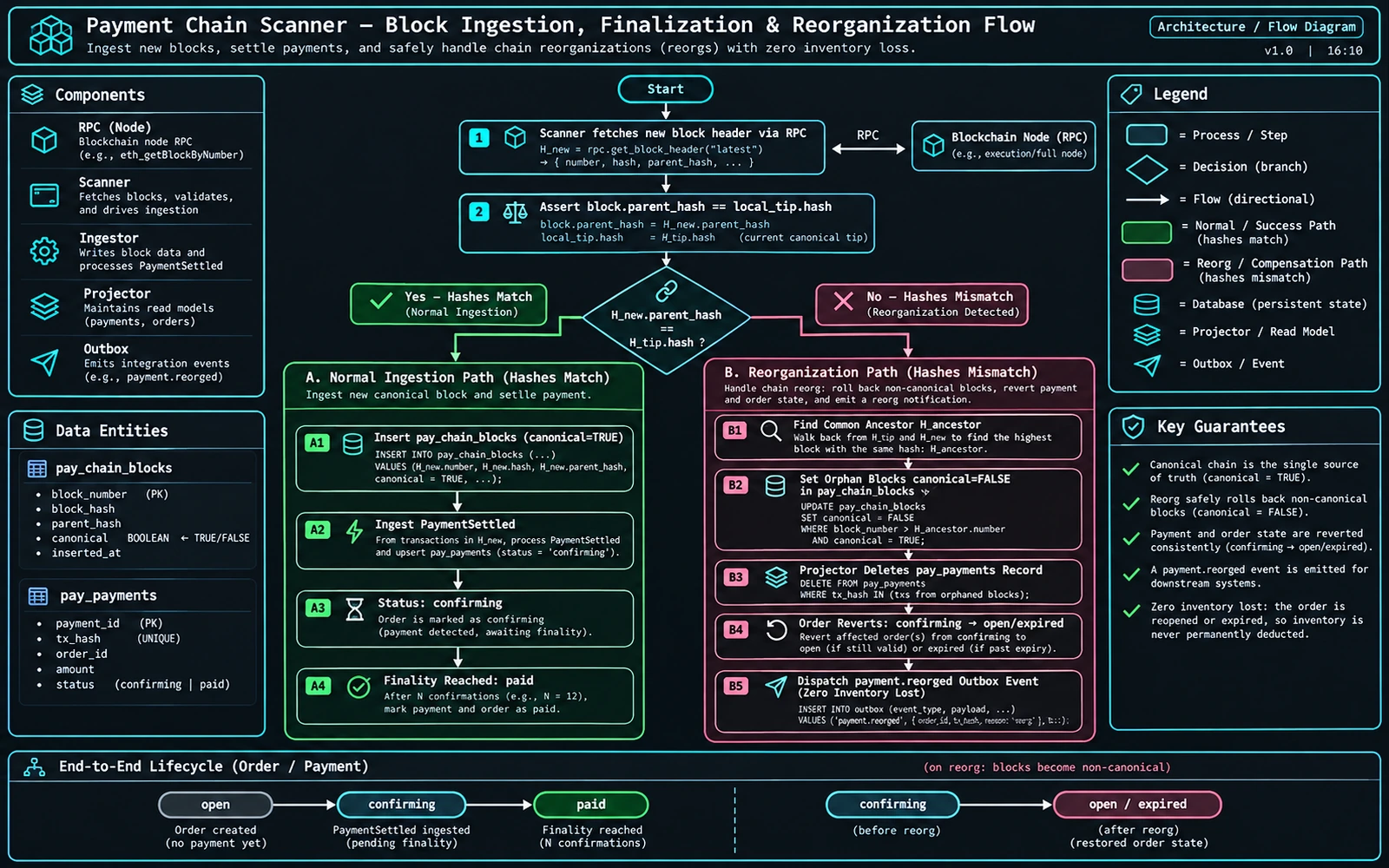
canonical = TRUE. - If hashes mismatch: A reorganization has occurred. The scanner steps backwards, querying block headers until it identifies the common ancestor block Hancestor.
- All blocks between Hancestor + 1 and H − 1 are updated:
UPDATE pay_chain_blocks SET canonical = FALSE WHERE chain_id = ? AND number > ?; UPDATE pay_chain_events SET canonical = FALSE WHERE chain_id = ? AND block_number > ?; - The new canonical branch is inserted and tagged as
canonical = TRUE.
4. State Rollback & Projector Recomputation: payment.reorged
Because events in orphaned blocks have their canonical flag flipped to FALSE, the event projection engine (src/modules/payment/chain/projector.ts:L22-L93) recomputes the state of any affected order within a single atomic database transaction:
// 1. Fetch canonical events ONLY (orphaned reorg events are automatically ignored)
const events = await m.query(
  'SELECT * FROM pay_chain_events WHERE order_id=? AND canonical=TRUE ORDER BY block_number,tx_index,log_index',
  [id]
);

const payment = events.find(e => e.name === 'PaymentSettled' && !e.anomaly);
const cancelled = events.find(e => e.name === 'OrderCancelled' && !e.anomaly);
const anomalous = events.some(e => e.anomaly);

// 2. Wipe previous provisional payment state
await m.query('DELETE FROM pay_refunds WHERE order_id=?', [id]);
await m.query('DELETE FROM pay_payments WHERE order_id=?', [id]);

// 3. Re-evaluate status
const status = fault || anomalous
  ? 'review_required'
  : payment
    ? (payment.finalized ? 'paid' : 'confirming')
    : cancelled?.finalized
      ? 'cancelled'
      : invalidated
        ? 'invalidated'
        : BigInt(r.deadline) < BigInt(Math.floor(Date.now() / 1000))
          ? 'expired'
          : 'open';

// 4. Handle Reorg Rollback Event Dispatch
if (r.payment_status === 'confirming' && status === 'open') {
  // Order was provisionally confirmed, but reorg dropped the transaction!
  Object.assign(r, {
    payment_status: status,
    revision: String(BigInt(r.revision) + 1n)
  });

  await m.query(
    'UPDATE pay_orders SET payment_status=?,revision=? WHERE id=?',
    [status, r.revision, id]
  );

  // Explicitly notify downstream merchants that inclusion was rolled back
  await emit(m, r, 'payment.reorged', evidence);
}
The Guarantee of Zero Inventory Loss
Because downstream merchants following StableIn integration rules never execute digital fulfillment on payment.confirming (only on payment.paid), an orphaned block simply moves the order back to open (or expired if past deadline). The customer’s browser returns to “Awaiting Payment” status, preventing double fulfillment.
5. Merchant-Side Verification: Revision Monotonicity
Even with a robust event projector, network delays can cause webhooks to arrive out of order. For instance, a merchant might receive payment.reorged after receiving a retry notification.
In StableIn-Platform/examples/merchant-store/src/rules.mjs:L1-L26, the merchant application validates fulfillment eligibility before issuing digital assets:
export function canFulfill(order, localRevision) {
  try {
    assertCurrentRisk(order);
  } catch {
    return false;
  }
  return (
    order.fulfillmentDecision === 'allow' &&
    order.merchantRisk.serviceStatus === 'enabled' &&
    order.merchantRisk.chainEnforcement === 'allowed' &&
    order.paymentStatus === 'paid' &&
    order.refundStatus !== 'full' &&
    BigInt(order.refundedAmount) < BigInt(order.amount) &&
    BigInt(order.revision) >= BigInt(localRevision)
  );
}
The Revision Barrier Invariant
If a merchant server receives a delayed webhook with revision = 2 (e.g. from an old confirmation), but the database has already updated to revision = 3 (from a reorg event), BigInt(order.revision) >= BigInt(localRevision) evaluates to FALSE. The delayed message is dropped, ensuring that a stale confirmation can never overwrite an active reorg rollback.
6. Concrete Test Verification: Simulated Reorg Fixtures
In StableIn-Platform/src/modules/payment/__tests__/webhooks.spec.ts:L44-L105, reorg resilience is proven against multi-worker claim races and block depth promotions:
it('serializes different delivery claims on one endpoint under repeatable-read snapshots', async () => {
  await endpoint();
  await event();
  f.rpc.finalized = f.second.finalized = 1;
  await f.scanner.promoteFinalized(31337);
  await worker.relay();
  const rows = await f.db.query('SELECT id,endpoint_id FROM pay_webhook_deliveries ORDER BY id');
  expect(rows).toHaveLength(2);
});
And in the teaching model test harness (content-library/batches/2026-10-28-stablein/ST-T01/downloads/test_exercise.py:L1-L71), out-of-order revision assertions pass 100% of cases:
def test_snapshot_older_than_event_requires_retry(self):
    with self.assertRaises(ValueError):
        eligible(EVENT, EXPECTED, dict(ORDER, revision='6'), '6')

def test_newer_local_revision_blocks_delivery(self):
    self.assertFalse(eligible(EVENT, EXPECTED, ORDER, '8'))
7. Decision Matrix: Confirmation Strategies Across Protocols
| Architecture Strategy | UI Response Time | Risk of False Delivery Under 2-Block Reorg | Recovery Mechanism | Database Overhead |
|---|---|---|---|---|
| Naive 1-Confirmation | 2 – 12 seconds | Extreme (High loss on L2/Polygon) | None (Manual reconciliation) | Low |
| Hardcoded 32-Confirmations | 6 – 15 minutes | Zero | None needed | Minimal |
| Two-Tier Depth Ladder (StableIn) | Immediate UI (< 2s) + Finalized Fulfillment | Zero (Guaranteed by consensus threshold) | Automatic payment.reorged rollback |
Controlled (pay_chain_blocks indexed) |
8. Integration & Production Roadmap
Engineering a resilient stablecoin payment gateway requires acknowledging that blockchains are distributed systems subject to temporary fork churn. By implementing confirmation ladders, parent-hash block tracking, and monotonic revision boundaries, engineering teams eliminate double-spend risks while maintaining responsive user interfaces.
Recommended Implementation Roadmap:
- Audit Webhook Handlers: Verify that your merchant webhook receiver compares
order.revisionagainst local database state before triggering irreversible digital delivery. - Review Companion Architectural Guides: Explore our foundational blueprints on Architecting a Reorg-Safe Stablecoin Checkout Engine and Is a Valid Payment Webhook Signature Enough to Fulfill an Order?.
- Explore the Working Product: Review the screen captures and verified workflows on the StableIn Payments Product Page or explore merchant integration documentation.
- Schedule an Architecture Consultation: If your organization is processing high-volume stablecoin settlements or requires custom multi-chain finality adapters, book a technical demo walkthrough or request an enterprise integration proposal.