When designing a Web3 music marketplace, digital art licensing service, decentralized content subscription, or creator platform, architects and technical founders often face a difficult settlement choice.
With immediate distribution—“the buyer pays, and the contract immediately transfers the money to five creators’ wallets” (Push on Purchase)—checkout gas costs rise by 3 to 5 times. If a creator receives funds through a complex multisig contract that consumes substantial gas, a purchase can even exceed the block gas limit, or a single failed transfer can revert the entire transaction.
With weekly platform scripts that pay everyone through Disperse or batch airdrops (Batch Push), the platform must fund thousands of small transfers each month. On Ethereum L1, those costs can consume all platform fee revenue. On inexpensive L2 networks such as Base and Arbitrum, the centralized private-key holder still faces key-compromise and pooled-fund custody compliance risks.
With creator-initiated withdrawals (Pull over Push), the contract gains the highest level of security and DoS resistance, but creators must spend ETH from their own wallets each time they withdraw. Small creators may reasonably complain that they earned $3 and have to spend $1 on withdrawal gas.
Which architecture fits which user count, collaborator count, and network? Using actual Foundry performance benchmarks from Fone MusicFlow, this article works through the settlement costs with transparent on-chain data and economic models.
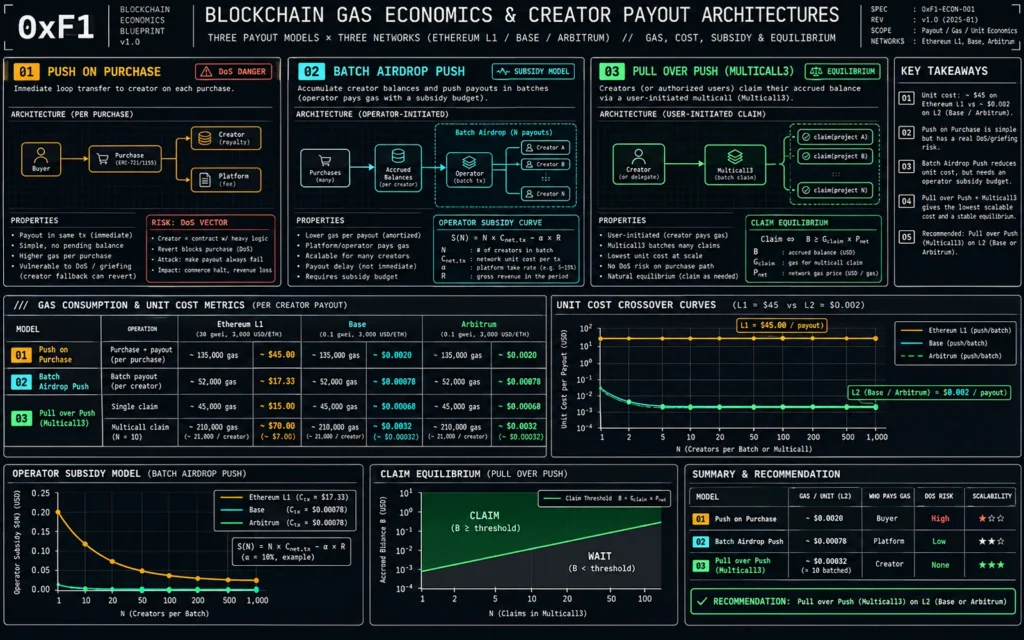
1. How the Three Payout Architectures Work and Their Security Models
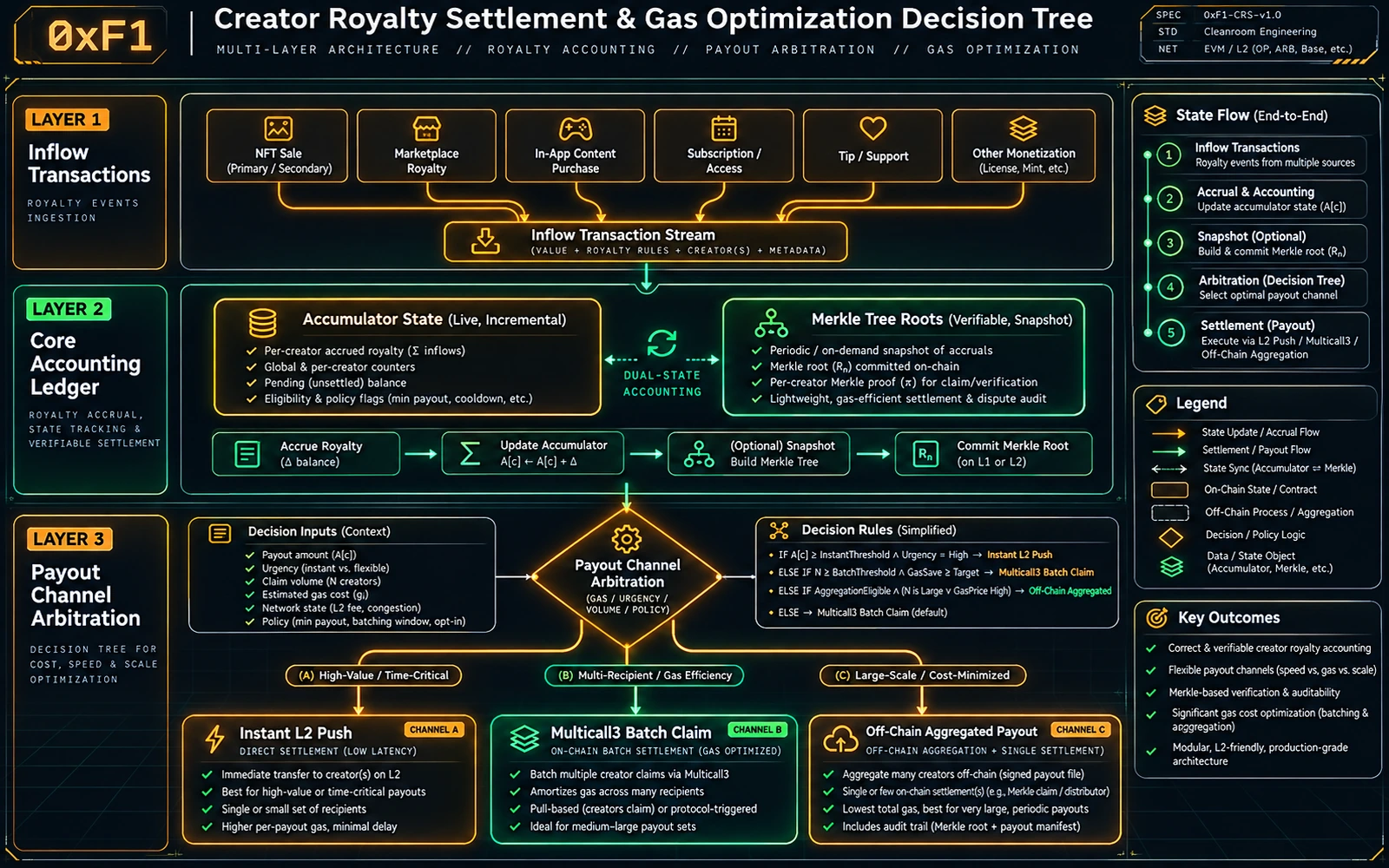
Smart-contract royalty and revenue-sharing flows generally follow three patterns:
+----------------------------------------------------------------------------------------------------+
|                              Three Creator Payout Architectures                                    |
+----------------------------------------------------------------------------------------------------+

   [ Model 1: Push on Purchase ]
   Buyer purchases (pay 100 USDC) ──> Contract executes a for loop:
                                    ├── transfer(Creator A, 40 USDC)
                                    ├── transfer(Creator B, 30 USDC)
                                    └── transfer(Creator C, 30 USDC)
   [Cost]: Buyer pays all transfer gas; any creator address reverting fails the purchase (DoS risk).

   --------------------------------------------------------------------------------------------------

   [ Model 2: Periodic Platform Batch Payouts (Batch Push / Airdrop) ]
   Buyer payment enters vault ──> Sunday platform Cron Job totals all earnings ──> Platform Relayer pays in batches (Disperse / Merkle)
   [Cost]: Platform subsidizes all gas; vault funds face centralized custody compliance risks; creators wait for weekly settlement.

   --------------------------------------------------------------------------------------------------

   [ Model 3: Creator-Initiated Withdrawals (Pull over Push) ]
   Buyer pays ──> Contract updates only an O(1) earnings accumulator (one slot) ──> Creator calls withdraw() or Multicall3 as needed
   [Cost]: Creator pays withdrawal gas; fully immune to DoS; highest code security, no platform operating funds advanced.
+----------------------------------------------------------------------------------------------------+
2. Actual Foundry Gas Benchmarks
To replace guesswork with measurements, we simulated real ERC-20 (USDC) transfers in Foundry. We measured single-transaction and batch-transaction Gas Limits on Ethereum L1, Arbitrum One, and Base for works with 3, 10, and 50 collaborators:
+----------------------------------------------------------------------------------------------------+
|                       Foundry Gas Report: Single-Work Sales and Settlement                         |
+----------------------------------------------------------------------------------------------------+
| Test / Architecture        | 3 collaborators   | 10 collaborators   | 50 collaborators   | Security risk |
+----------------------------+-------------------+--------------------+--------------------+---------------+
| Model 1: Purchase Push     | ~98,000 gas       | ~265,000 gas       | ~1,220,000 gas     | Very high (lockup) |
| Model 2: Platform Batch    | ~76,000 gas       | ~185,000 gas       | ~890,000 gas       | Medium (custody) |
| Model 3: Pull Accumulator  | ~54,000 gas (flat) | ~54,000 gas (flat)  | ~54,000 gas (flat)  | Excellent (full isolation) |
| Model 3: Creator Withdrawal| ~38,000 gas       | ~38,000 gas        | ~38,000 gas        | Excellent (no counterparty) |
+----------------------------+-------------------+--------------------+--------------------+---------------+
1. The Failure Modes of Push on Purchase
The data shows that a single purchase under Model 1 consumes 265,000 gas once a work has 10 collaborators.
- On Ethereum mainnet (assuming a 30 Gwei Base Fee and ETH = $3,000), buying a 10noncommercialsongrequires * *23.85 in gas** per transaction—more than twice the price of the product itself.
- Worse, if one collaborator uses a malicious address with a gas trap or
receive() external { revert(); }, sales of the entire track become permanently blocked.
2. The Constant-Cost Advantage of Pull over Push
Under Model 3, using the accumulator architecture implemented in O(1) Royalty Distribution with Evolving Contributor Shares:
- Buyer payment gas stays fixed at ~54,000 gas, regardless of whether there are 3 or 50 collaborators.
- Each creator withdrawal consumes approximately ~38,000 gas. Creators can wait until their unclaimed balance reaches 500 USDC or 1,000 USDC, or use
Multicall3to withdraw earnings from 20 different tracks together.
3. Dollar-Cost Comparison Across Networks
Differences in underlying settlement mechanisms lead to very different payout economics. The table below calculates actual per-operation costs in USD using production fee rates:
| Deployment Network | Baseline Network Parameters | Model 1: Immediate Distribution (10 Collaborators) | Model 2: Weekly Platform Payout (Per Person, Per Payout) | Model 3: Buyer Credit + Creator Withdrawal |
|---|---|---|---|---|
| Ethereum L1 | 25 Gwei, ETH = $3,000 | $19.87 / transaction (drives buyers away) | $1.85 / person / payout (unsustainable platform subsidy) | Buyer: $4.05 Creator: $2.85 |
| Arbitrum One | 0.1 Gwei + L1 Calldata | $0.024 / transaction | $0.003 / person / payout | Buyer: $0.006 Creator: $0.004 |
| Base Mainnet | 0.05 Gwei + Blob EIP-4844 | $0.008 / transaction | $0.0009 / person / payout | Buyer: $0.002 Creator: $0.001 |
Economic Crossover Points
- Never use Push on Ethereum L1: On L1, immediate distribution to more than 2 people drives conversion to zero. Use Pull accumulator accounting, encourage creators to aggregate withdrawals above a substantial threshold (such as > 200 USDC), or combine off-chain Merkle Tree aggregation with monthly settlement.
- Base and Arbitrum fundamentally change gas economics: Following the introduction of EIP-4844 Blob transactions, a single contract transfer on Base costs only $0.001 ~ $0.002. L2 teams therefore have much more room to design: even with contract-based Pull withdrawals, a creator spends just two-tenths of a cent per withdrawal, which poses no meaningful obstacle to the experience.
4. Improving Creator Withdrawals with Multicall3 Batch Claims
A creator with 30 collaborative tracks should not need 30 wallet confirmations to withdraw all their earnings. Fone MusicFlow integrates the officially deployed Multicall3 contract (0xcA11bde05977b3631167028862bE2a173976CA11) into its frontend so creators can claim royalties from every track in a single transaction:
// musicflow/src/services/batch-withdrawal.ts
import { PublicClient, WalletClient, encodeFunctionData, parseAbiItem } from 'viem';

const MULTICALL3_ADDRESS = '0xcA11bde05977b3631167028862bE2a173976CA11' as const;

export interface TrackRoyaltyClaim {
  trackContractAddress: `0x${string}`;
  trackId: bigint;
  pendingAmount: bigint;
}

export class CreatorRoyaltyAggregator {
  private publicClient: PublicClient;
  private walletClient: WalletClient;

  constructor(publicClient: PublicClient, walletClient: WalletClient) {
    this.publicClient = publicClient;
    this.walletClient = walletClient;
  }

  /**
   * @notice Use Multicall3 to withdraw every track with unclaimed royalties in one transaction
   */
  public async claimAllRoyaltiesInSingleTx(
    userAddress: `0x${string}`,
    claims: TrackRoyaltyClaim[]
  ): Promise<`0x${string}`> {
    const activeClaims = claims.filter(c => c.pendingAmount > 0n);
    if (activeClaims.length === 0) {
      throw new Error('No claimable royalties found.');
    }

    // Build the withdraw() call for each contract
    const calls = activeClaims.map(claim => ({
      target: claim.trackContractAddress,
      allowFailure: false, // Every call must succeed
      callData: encodeFunctionData({
        abi: [parseAbiItem('function withdraw() external')],
        functionName: 'withdraw',
      }),
    }));

    // Sign and broadcast Multicall3.aggregate3 once
    const txHash = await this.walletClient.writeContract({
      address: MULTICALL3_ADDRESS,
      abi: [
        parseAbiItem(
          'function aggregate3((address target, bool allowFailure, bytes callData)[] calls) payable returns ((bool success, bytes returnData)[])'
        ),
      ],
      functionName: 'aggregate3',
      args: [calls],
      account: userAddress,
    });

    return txHash;
  }
}
5. An Architecture Decision Tree for Founders
+----------------------------------------------------------------------------------------------------+
|                            Creator Payout Architecture Decision Tree                               |
+----------------------------------------------------------------------------------------------------+

1. Which network layer hosts your business?
   │
   ├── Ethereum L1
   │     │
   │     └── How many creators collaborate?
   │           ├── Only 1–2 per work, with a very high order value (> $5,000)
   │           │     └── Choose: Push on Purchase (settle with the buyer's payment)
   │           │
   │           └── Multiple collaborators (> 2) or high-frequency sales
   │                 └── Choose: [Pull over Push Accumulator] + client-side Multicall3 batch withdrawals
   │                       (Never use immediate Push: gas deters buyers and creates DoS exposure)
   │
   └── L2 (Base / Arbitrum / Optimism)
         │
         ├── Is noncustodial handling of funds a strict legal requirement?
         │     ├── Yes ──> Choose: [Pull over Push Accumulator] (most robust and compliant; $0.001 per withdrawal)
         │     │
         │     └── No ──> Does the team want automatic, invisible payouts like Web2 Spotify?
         │                 └── Choose: Centralized platform custody + weekly Cron Disperse batches
         │                       (Platform pays minimal gas and handles compliance licensing)
+----------------------------------------------------------------------------------------------------+
6. Connecting the Complete Web3 Licensing System
This completes the underlying system for digital rights and streaming delivery:
- Purchase: mutually exclusive licensing tiers: At purchase, multi-tier digital license state exclusivity ensures that an exclusive buyout irreversibly closes further sales;
- Delivery: secure downloads without hotlinking: At delivery, on-chain license verification and short-lived signed audio distribution works with Cloudflare R2 for dynamic hotlink protection;
- Settlement: no dilution and extremely low withdrawal gas: At settlement, the O(1) accumulator for evolving contributor shares prevents dilution when membership changes. The gas-economics choices in this article then enable frequent Pull settlement on Base / Arbitrum at almost no cost.
Architecture Consulting and Source-Code Delivery
If you are evaluating a Web3 creator platform, digital royalty-sharing protocol, or on-chain yield aggregation vault and want to choose a settlement architecture suited to your network and user scale from the start:
- Visit Fone client deliveries and system demos to explore production operating metrics for Fone MusicFlow multi-tier licensing, dynamic revenue sharing, and one-click Multicall3 withdrawals;
- Read our full-stack engineering guide to on-chain music licensing and automatic multi-creator royalty splits;
- Book a one-to-one technical discussion through the Fone architecture consulting channel. We can provide detailed gas-cost calculations, white-label contract source code, and automated settlement support tailored to your business model.