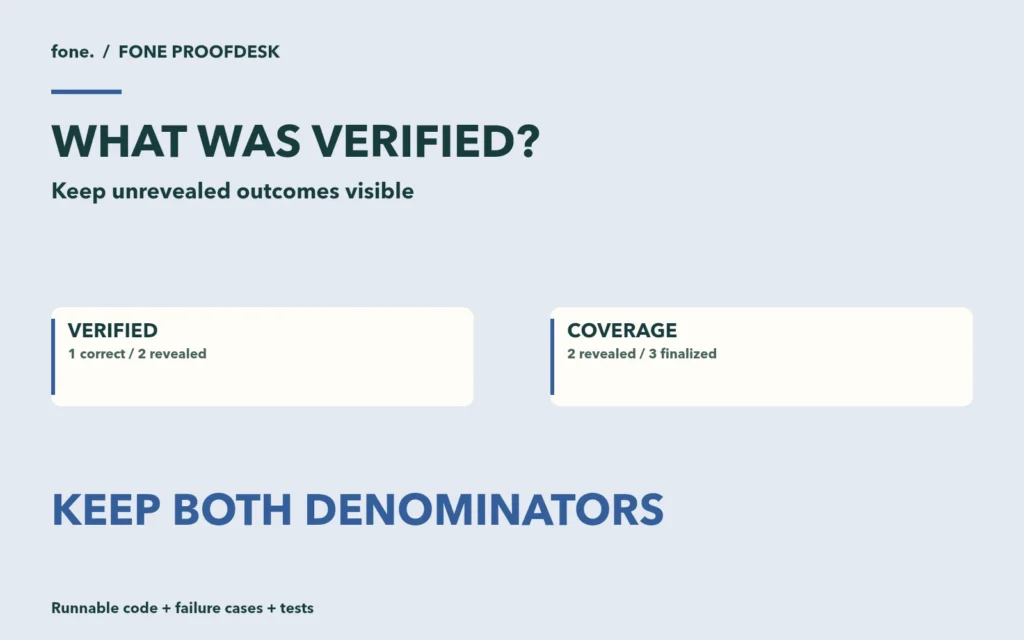
An order can pay a researcher without proving that the submitted prediction was correct. Fone ProofDesk's inspected contract has an expired-window settlement branch that does exactly that. The branch finalizes an answered order using answerCorrect=false and revealed=false. Its reputation counters then include that order in both totalFinalized and incorrect.
A dashboard that labels correct / totalFinalized as verified prediction accuracy would hide a material difference. A revealed answer checked against the designated result source and an unrevealed order settled after the deadline carry different evidence.
The source review for this article followed those branches through the reputation update and score calculation. The downloadable exercise turns the distinction into an offline report with explicit denominators. It uses five synthetic orders and Python's standard library. No Polymarket connection, wallet or production research record is involved.
Define what each row proves
The inspected workflow accepts price and sports questions. A successful reveal compares a committed structured answer against the applicable result. Correct answers settle; incorrect answers refund. An unanswered order can be cancelled after the answer deadline, while an answered order can follow the separate expiry path. Price expiry settlement additionally requires the stored result snapshot.
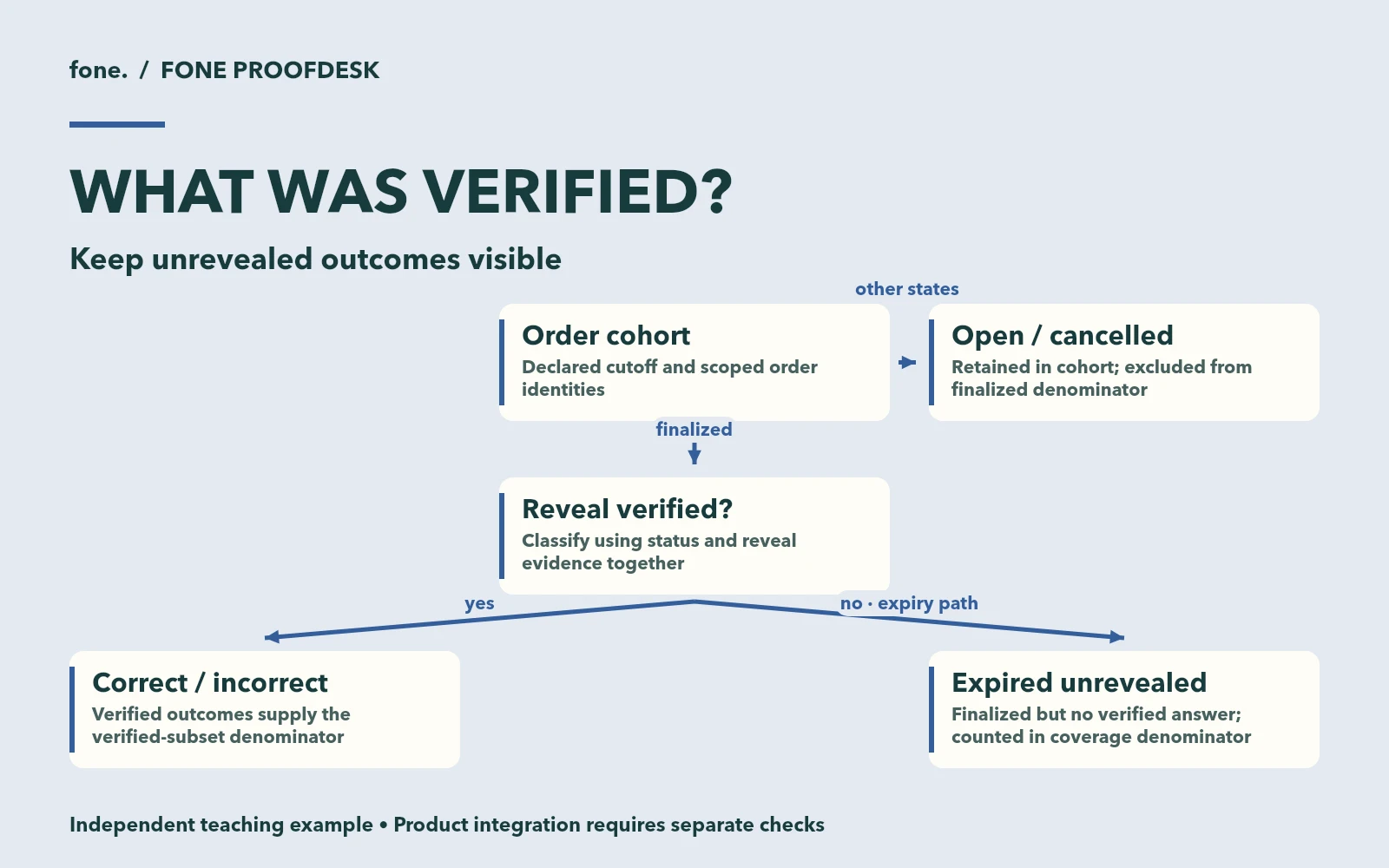
Those behaviors give the report five categories. Verified correct and verified incorrect describe completed reveals. Expired unrevealed describes a finalized order without a revealed answer. Cancelled orders and open orders remain visible in the cohort, but neither enters the finalized denominator.
The exercise receives a normalized order export. Its verified_correct field is null when no verification exists. The contract's stored false value for an unrevealed result must therefore be interpreted together with the reveal flag when building that export. Copying the false value into a verified-outcome column would lose its meaning.
if status == "Settled" and revealed and correct is True:
    return "verified_correct"
if status == "Refunded" and revealed and correct is False:
    return "verified_incorrect"
if status == "Settled" and not revealed and correct is None:
    return "expired_unrevealed"
This excerpt comes from the supplied classify function. Its remaining branches accept open and cancelled orders only without reveal evidence. Conflicting combinations raise an exception. A settled, revealed, incorrect row should send the operator back to the export and source transaction for investigation.
Run the small cohort
Download the status-aware scorecard lab, extract it into an empty directory and run the following commands with Python 3.10 or later. The recorded run used Python 3.13.3; the minimum version was not separately tested.
python3 -m unittest discover -v
python3 scorecard.py fixture.json
The fixture has one order in each of the five categories. All belong to a fictional demonstration researcher. The output includes the cohort description and cutoff alongside the report so a copied result retains its context.
| Measure | Numerator | Denominator | Fixture result |
|---|---|---|---|
| Contract-style correct share | Verified correct | All finalized | 3,333 basis points |
| Verified subset correct share | Verified correct | Verified correct plus verified incorrect | 5,000 basis points |
| Reveal coverage | All verified | All finalized | 6,666 basis points |
The integer values follow floor division. They correspond to approximately 33.33%, 50% and 66.66%. The first ratio explains the current counter semantics. The second describes only the revealed subset. The third tells the reader how much of the finalized cohort that subset covers.
Show the counts beside those rates. One correct result out of two revealed orders offers little evidence for judging future performance. The exercise deliberately uses a small fixture to make every denominator inspectable. It provides no statistical ranking or probability of future success.
Preserve an empty denominator
A cohort containing only expired unrevealed orders has no verified accuracy observation. Displaying zero percent would imply observed failures that do not exist. The helper returns null when the denominator is empty.
def bps(numerator, denominator):
    return None if denominator == 0 else numerator * 10000 // denominator
A frontend can render that null as “No verified outcomes” and retain the count of unrevealed settlements beside it. This is a reporting convention introduced by the lab. The contract's own score helper returns zero for an empty finalized cohort; the article does not propose silently changing that stored or computed behavior.
The distinction also prevents a favorable verified-subset percentage from standing alone. If a researcher reveals only some answers, the subset does not establish results for the remaining orders. The report preserves unrevealed and open counts so an operator can inspect that gap. Detecting selective participation or collusive orders would require more evidence and rules than this exercise supplies.
Make retries visible before aggregation
Each row carries a chain ID, escrow identity and order ID. The combination identifies an order in the fixture. An order numbered 1 on a second chain must remain distinct; importing order 1 twice from the same escrow must fail.
python3 - <<'PY'
import json
from pathlib import Path
export = json.loads(Path("fixture.json").read_text())
export["orders"].append(dict(export["orders"][0]))
Path("duplicated.json").write_text(json.dumps(export))
PY
python3 scorecard.py duplicated.json
The command exits with code 2 and identifies the duplicate. Without that guard, repeating the correct row would change the verified-subset result from one out of two to two out of three. A dashboard could improve its displayed score solely because an import job retried a page.
Rebuild the input with one final row per scoped order identity before running it again. The checker rejects duplicates even if their contents match, because identical repetition and conflicting historical versions should be resolved in the adapter. It does not choose a current version by file position.
Keep token volume in its own columns
The contract's first reputation implementation adds raw payment amounts to totalStake. Raw units from differently denominated tokens cannot be compared as economic volume without further interpretation. Our fixture deliberately includes a six-decimal test token and an eighteen-decimal test token.
The report keeps finalized units grouped by token within each chain and escrow. It never adds those two balances into a single monetary figure. Verified-incorrect refunds still belong to finalized order volume under this definition, so that column also must not be labeled researcher revenue. Revenue would need settlement amounts, fees and refund treatment from the corresponding transactions.
The tests cover those separate token totals, empty denominators and invalid reveal combinations. They also check duplicate imports, distinct chain identities, string values masquerading as booleans and unsupported question types. The original code runs entirely on supplied data.
This report is a proposed companion exercise for Fone ProofDesk, whose current product foundation provides research orders, encrypted delivery, answer commitments and conditional settlement. It is not a shipped analytics integration. A project adopting it would still need a confirmed-block export, canonical address normalization and a completeness check over the chosen cohort. A valid file can omit inconvenient orders; arithmetic alone cannot prove completeness.
For a research service acceptance review, request a sample order list containing both verified outcomes and an expired unrevealed settlement. Agree on the cohort and the labels before discussing a leaderboard. Those decisions determine what a customer can infer from the numbers.
Source review covered ConsultationEscrow.sol settlement and reputation paths on 29 October 2026, together with the ProofDesk product narrative and local audit. Exact paths and SHA-256 hashes are retained in draft metadata. The fixture contains no real consultants, customers or trading results.