A Web3 music platform focused on indie-game soundtracks and short-video background music encountered a serious legal dispute and licensing failure in its first month:
A creator released a popular ambient track, offering a personal non-commercial license for 15 USDC and a commercial sync license for 120 USDC. Its success among indie developers attracted a major publisher willing to pay 8,000 USDC for an exclusive buyout. The publisher clicked the platform’s buyout purchase button.
The contracts, however, treated the three license modes as ordinary ERC-1155 tokens for ongoing minting and sale. There was no mutually exclusive state lock. The day after the publisher paid 8,000 USDC, three more users successfully bought 15 USDC personal licenses through the frontend and router contract.
After collecting on-chain evidence, the publisher’s legal team sent notice of a breach claim: “We signed and purchased an Exclusive Buyout agreement. Why is the chain still issuing licenses to third parties?”
The incident exposes a core problem in on-chain rights infrastructure: real-world licensing is a complex state machine with temporal exclusivity, defined rights boundaries, and grandfathered historical rights, rather than simple fungible-token minting.
Using the production practices in Fone MusicFlow, this article explains how to build a reliable multilevel digital-rights licensing state machine in Solidity.
1. Three Core Business Invariants for Licensing
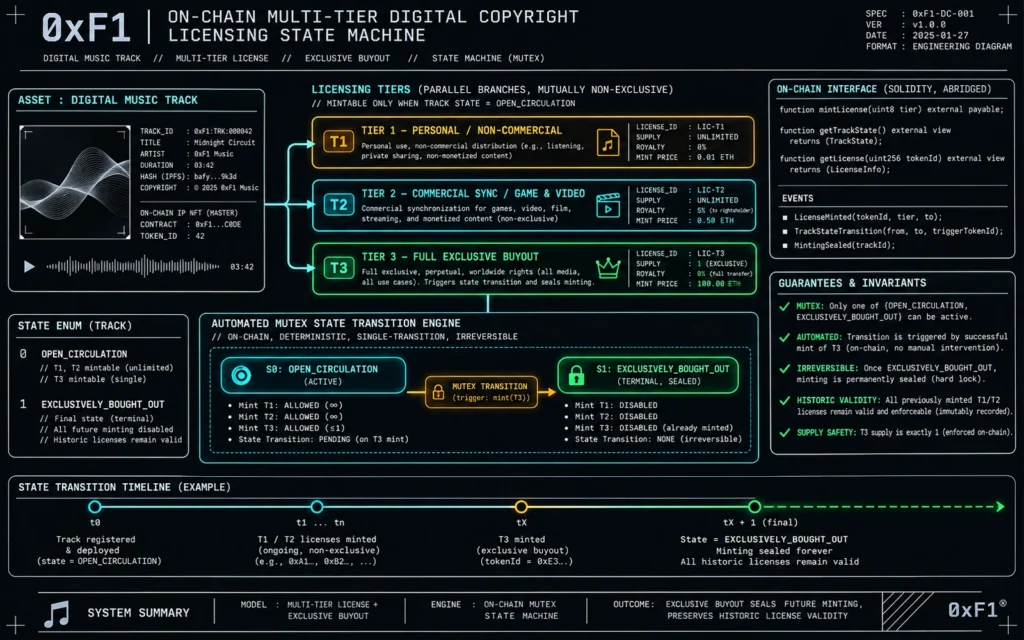
Commercial licensing typically has three tiers:
- Tier 1: Personal Non-Commercial: personal listening, podcast background audio, and nonprofit display; unlimited supply and a low price;
- Tier 2: Commercial Sync: indie games, commercial advertising, and monetized YouTube videos; limited supply or time-bounded rights at a medium price;
- Tier 3: Exclusive Buyout: worldwide exclusive commercial rights or exclusive master-use rights, with the highest price and a strict global inventory of 1.
To give these arrangements legal seriousness on-chain, the contract must enforce three invariants:
+----------------------------------------------------------------------------------------------------+
|                          Mutually Exclusive Multilevel Licensing State Machine                     |
+----------------------------------------------------------------------------------------------------+

                   [ Initial state: OPEN_CIRCULATION ]
                                     │
                   ┌─────────────────┴─────────────────┐
                   │                                   │
                   ▼ (repeatable)                      ▼ (exactly once)
     [ Buy Tier 1 / Tier 2 license ]           [ Buy Tier 3: Exclusive Buyout ]
     - Mint LicenseReceipt NFT                 - Lock pool and inventory
     - Split funds proportionally in real time - Trigger atomic state transition
                   │                                   │
                   │                                   ▼
                   │                  [ Terminal state: EXCLUSIVELY_BOUGHT_OUT ]
                   │                                   │
                   │                 ┌─────────────────┴─────────────────┐
                   │                 │                                   │
                   │                 ▼                                   ▼
                   │        [ Any new license request ]        [ Existing Grandfathered Licenses ]
                   │        Enforce Revert!                     - Pre-buyout Tier 1/2 remain valid
                   │        (Irreversible closure; no double exclusivity) - Third-party verification:
                   │                                             issuedAt <= buyoutTimestamp
                   └─────────────────────────────────────────────────────┘
+----------------------------------------------------------------------------------------------------+- Invariant 1: Irreversible buyout lock: A
BUYOUTpurchase must irreversibly move the track toEXCLUSIVELY_BOUGHT_OUTwithin the same transaction. Every later attempt to buy Tier 1, Tier 2, or Tier 3 must revert. - Invariant 2: Grandfathered rights protection: Existing users who lawfully bought Tier 1 or Tier 2 before the buyout retain their licenses. The on-chain validity criterion is
licenseReceipt.issuedAt <= track.buyoutTimestamp. - Invariant 3: Tamper-proof license ID: Every license must include on-chain evidence containing a usage-scope hash (
scopeHash) for YouTube Content ID appeals or game-distribution platforms to verify within seconds.
2. MusicFlow’s Core Licensing State-Machine Contract
Fone MusicFlow combines structured enums and packed storage with reentrancy protection to implement licensing efficiently:
// musicflow/contracts/src/MusicFlowLicensing.sol
// SPDX-License-Identifier: MIT
pragma solidity ^0.8.20;

import "@openzeppelin/contracts/token/ERC20/IERC20.sol";
import "@openzeppelin/contracts/token/ERC20/utils/SafeERC20.sol";
import "@openzeppelin/contracts/utils/ReentrancyGuard.sol";

error TrackExclusivelyBoughtOut(uint256 trackId);
error InvalidTierSelection(uint8 tier);
error InsufficientPaymentAmount(uint256 expected, uint256 actual);
error LicenseNotFound(bytes32 licenseId);

contract MusicFlowLicensing is ReentrancyGuard {
    using SafeERC20 for IERC20;

    enum LicenseTier {
        PERSONAL,        // 0: Personal non-commercial
        COMMERCIAL_SYNC, // 1: Commercial sync license
        EXCLUSIVE_BUYOUT // 2: Exclusive buyout
    }

    enum TrackState {
        ACTIVE_CIRCULATION,   // Available for normal sales
        EXCLUSIVELY_LOCKED    // Exclusively bought out; sales closed
    }

    struct TrackLicenseConfig {
        address creator;
        IERC20 paymentToken;
        uint256 personalPrice;
        uint256 commercialPrice;
        uint256 buyoutPrice;
        TrackState state;
        address buyoutHolder;       // Exclusive buyer's address
        uint64 buyoutTimestamp;     // Absolute timestamp of buyout
    }

    struct LicenseReceipt {
        bytes32 licenseId;
        uint256 trackId;
        address licensee;           // Licensed party
        LicenseTier tier;
        bytes32 usageScopeHash;     // Keccak256 of the authorized usage-scope text
        uint64 issuedAt;
    }

    // trackId => configuration
    mapping(uint256 => TrackLicenseConfig) public tracks;
    // licenseId => on-chain license evidence
    mapping(bytes32 => LicenseReceipt) public licenses;

    uint256 public nextLicenseNonce;

    event LicensePurchased(
        bytes32 indexed licenseId,
        uint256 indexed trackId,
        address indexed licensee,
        LicenseTier tier,
        uint256 pricePaid
    );
    event TrackBoughtOut(uint256 indexed trackId, address indexed buyoutHolder, uint64 timestamp);

    /**
     * @notice Core purchase entry: enforce mutually exclusive states
     */
    function purchaseLicense(
        uint256 trackId,
        LicenseTier tier,
        bytes32 usageScopeHash
    ) external nonReentrant returns (bytes32 licenseId) {
        TrackLicenseConfig storage track = tracks[trackId];
        require(track.creator != address(0), "TRACK_NOT_REGISTERED");

        // Core invariant: globally block all new licenses for an exclusively bought-out track
        if (track.state == TrackState.EXCLUSIVELY_LOCKED) {
            revert TrackExclusivelyBoughtOut(trackId);
        }

        uint256 requiredPrice;
        if (tier == LicenseTier.PERSONAL) {
            requiredPrice = track.personalPrice;
        } else if (tier == LicenseTier.COMMERCIAL_SYNC) {
            requiredPrice = track.commercialPrice;
        } else if (tier == LicenseTier.EXCLUSIVE_BUYOUT) {
            requiredPrice = track.buyoutPrice;

            // Atomic mutually exclusive transition: block every subsequent purchase path
            track.state = TrackState.EXCLUSIVELY_LOCKED;
            track.buyoutHolder = msg.sender;
            track.buyoutTimestamp = uint64(block.timestamp);

            emit TrackBoughtOut(trackId, msg.sender, track.buyoutTimestamp);
        } else {
            revert InvalidTierSelection(uint8(tier));
        }

        // Settle funds to creator / split contract
        track.paymentToken.safeTransferFrom(msg.sender, track.creator, requiredPrice);

        // Generate a unique deterministic license ID
        licenseId = keccak256(abi.encodePacked(
            block.chainid,
            trackId,
            msg.sender,
            tier,
            nextLicenseNonce++,
            block.timestamp
        ));

        licenses[licenseId] = LicenseReceipt({
            licenseId: licenseId,
            trackId: trackId,
            licensee: msg.sender,
            tier: tier,
            usageScopeHash: usageScopeHash,
            issuedAt: uint64(block.timestamp)
        });

        emit LicensePurchased(licenseId, trackId, msg.sender, tier, requiredPrice);
    }

    /**
     * @notice Third-party verification interface (fast YouTube / game-channel review)
     */
    function verifyLicenseValidity(bytes32 licenseId) external view returns (
        bool isValid,
        string memory reason,
        LicenseReceipt memory receipt
    ) {
        receipt = licenses[licenseId];
        if (receipt.licensee == address(0)) {
            return (false, "LICENSE_NOT_FOUND", receipt);
        }

        TrackLicenseConfig memory track = tracks[receipt.trackId];

        // If bought out, verify that the license predates the buyout (grandfathered rights)
        if (track.state == TrackState.EXCLUSIVELY_LOCKED) {
            if (receipt.tier == LicenseTier.EXCLUSIVE_BUYOUT) {
                return (true, "VALID_EXCLUSIVE_BUYOUT", receipt);
            }
            if (receipt.issuedAt <= track.buyoutTimestamp) {
                return (true, "VALID_GRANDFATHERED_LICENSE", receipt);
            } else {
                return (false, "INVALID_POST_BUYOUT_ISSUANCE", receipt);
            }
        }

        return (true, "VALID_CIRCULATING_LICENSE", receipt);
    }
}
3. Foundry Tests: Buyout Exclusivity and Historical Rights Boundaries
The automated Foundry tests verify that buyouts block new purchases while preserving earlier lawful rights:
// musicflow/contracts/test/MusicFlowLicensing.t.sol
// SPDX-License-Identifier: MIT
pragma solidity ^0.8.20;

import "forge-std/Test.sol";
import "../src/MusicFlowLicensing.sol";

contract MusicFlowLicensingTest is Test {
    MusicFlowLicensing public licensing;
    // Mock test tokens and addresses...

    function test_ExclusiveBuyoutSealsFuturePurchases() public {
        uint256 trackId = 1;

        // 1. User A buys a Commercial Sync license
        vm.prank(userA);
        bytes32 licenseA = licensing.purchaseLicense(trackId, MusicFlowLicensing.LicenseTier.COMMERCIAL_SYNC, bytes32(0));

        // 2. Major game studio buys exclusive rights (Exclusive Buyout)
        vm.prank(studioX);
        bytes32 buyoutLicense = licensing.purchaseLicense(trackId, MusicFlowLicensing.LicenseTier.EXCLUSIVE_BUYOUT, bytes32(0));

        // 3. User C attempts a personal license; must revert with the exact error
        vm.prank(userC);
        vm.expectRevert(abi.encodeWithSelector(TrackExclusivelyBoughtOut.selector, trackId));
        licensing.purchaseLicense(trackId, MusicFlowLicensing.LicenseTier.PERSONAL, bytes32(0));

        // 4. Verify User A's prior commercial license remains valid (Grandfathered)
        (bool isValidA, string memory reasonA,) = licensing.verifyLicenseValidity(licenseA);
        assertTrue(isValidA);
        assertEq(reasonA, "VALID_GRANDFATHERED_LICENSE");
    }
}
4. Comparing Ordinary NFT Issuance with a Mutually Exclusive Rights State Machine
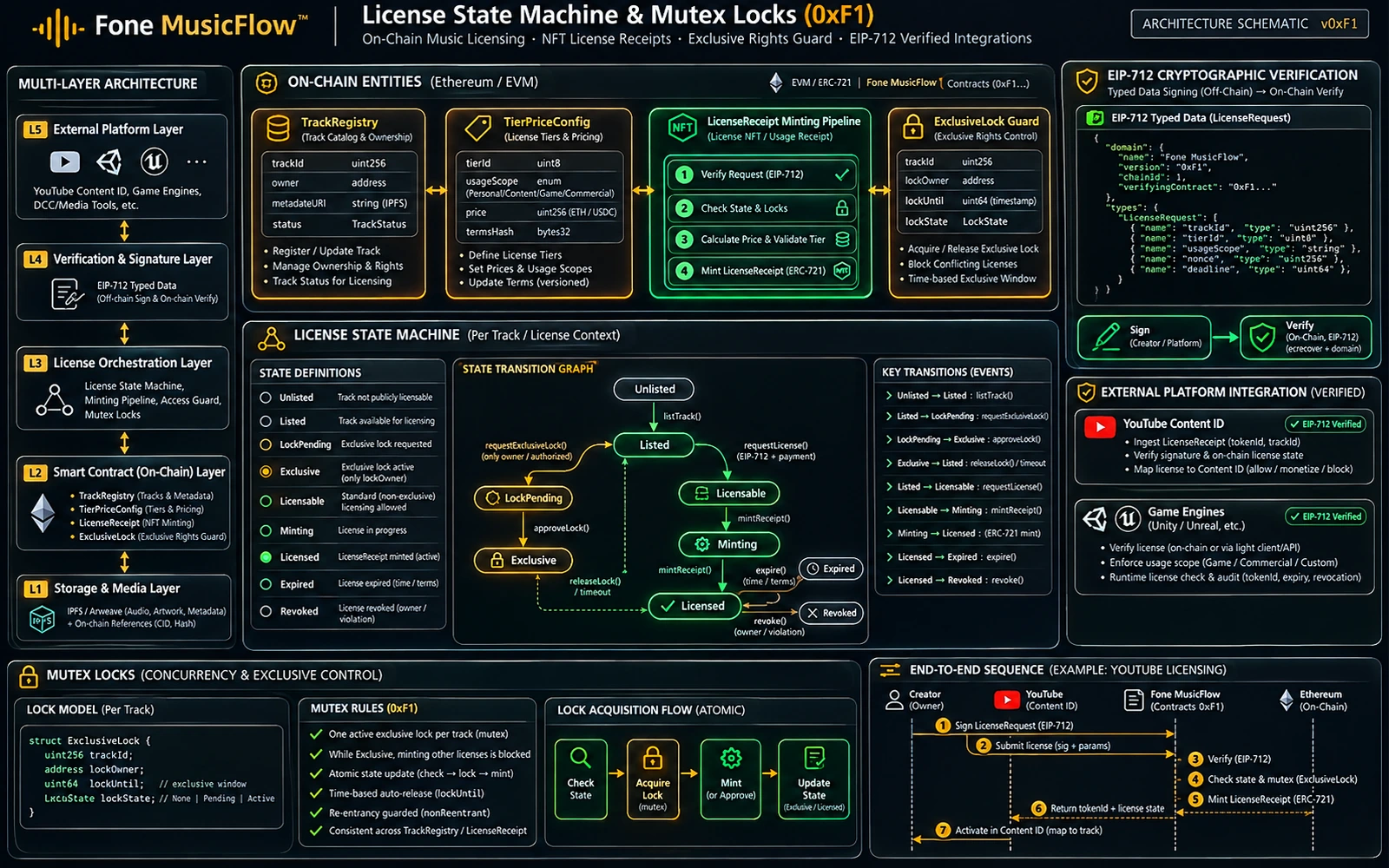
The following table compares traditional NFT models with a dedicated rights state machine for complex digital licensing:
| Licensing dimension | Traditional: mint ERC-1155 collectible NFTs | This approach: MusicFlow mutually exclusive state-machine contract |
|---|---|---|
| Exclusive buyout representation | Cannot express it (buyer owns an NFT, but minting can continue) | Strict mutual exclusion, with an irreversible transition to EXCLUSIVELY_LOCKED |
| Existing customer rights | Exclusive buyer can challenge earlier rights; no on-chain criterion | Code-level grandfathering proof based on issuedAt <= buyoutTimestamp |
| Automated third-party verification | Platforms such as YouTube cannot infer usage rights from an NFT | Fast O(1) read-only verification including scopeHash |
| Distribution and revenue sharing | Basic sales fees only; cannot handle dynamic multiparty royalties | Direct integration with on-chain royalty accumulators and creator pull-withdrawal vaults |
| Legal evidence of rights | On-chain ownership represents an image, often without copyright effect | On-chain evidence structure aligned with internationally recognized commercial-license models |
5. Integrating Royalty Sharing and Encrypted Audio Delivery
Multilevel licensing is the entry point to digital-asset monetization. The full delivery flow connects it with two other core components:
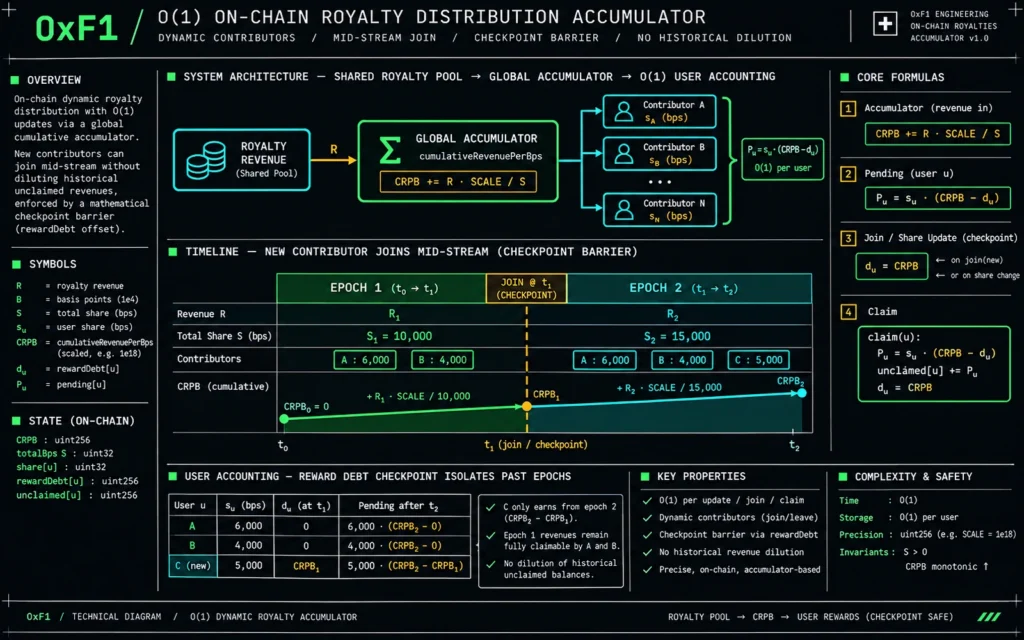
- Integrate the creator O(1) royalty accumulator: Whether payment is 15 USDC for personal use or 8,000 USDC for a full buyout, incoming funds invoke the Dynamic Contributor O(1) Royalty Accumulator, accruing earnings without error across lyricists, composers, arrangers, and singers.
- Combine with short-lived signed audio download URLs: To download a high-fidelity lossless master after purchase, the system verifies
hasValidLicensethrough On-Chain License Verification and Signed Audio Delivery, then issues a private download URL valid for 60 seconds at the edge gateway.
Consulting and Source-Code Delivery
If you are building a Web3 rights marketplace for independent creators, AI-generated music, game sound effects, or commercial design assets, and need a robust multilevel licensing and exclusive-buyout engine:
- Visit Fone’s Client Deliveries and System Demos to explore Fone MusicFlow previews, license selection, exclusive buyouts, and license-verification dashboards;
- Read our Full-Stack Architecture for On-Chain Music Licensing and Multi-Creator Revenue Splits;
- Book a one-to-one discussion through Fone Architecture Consulting for deployable licensing state-machine contracts and a Next.js frontend package.