
Before giving an AI Agent wallet access, define the purchase it may make, the account and network it will use, and the limits on that authority. Decide who can stop it and how your team will recover when the chain and your application show different states. Those decisions give an integration team something concrete to build and test.
Agent Wallet Guard provides a local prototype for part of that workflow. An Owner reviews an existing policy and authorizes an Agent public address. A separate Node process signs a payment, and the Owner can later revoke the Session. The recorded demonstration uses MockUSDC on a local Anvil chain. It does not include an LLM deciding what to buy or a purchase from a real provider.
Start with the purchase your Agent needs to make
Suppose you are building a research assistant that occasionally buys a dataset. Before adding wallet execution, write down the provider, what a successful purchase returns and what should happen if the data never arrives. This is a proposed use case for integration, not a customer deployment demonstrated by Agent Wallet Guard.
The payment and the useful result need separate checks. A transfer receipt can show that money moved. Your application still needs to retrieve the dataset and connect it to the original task. The same distinction appears on the merchant side in our article about a confirmed payment with an undelivered order.
For a first integration, I would choose one payment task with a known recipient and a clear completion condition. That gives the team a smaller set of failures to investigate before adding more tools or providers.
Define the authority the Owner is granting
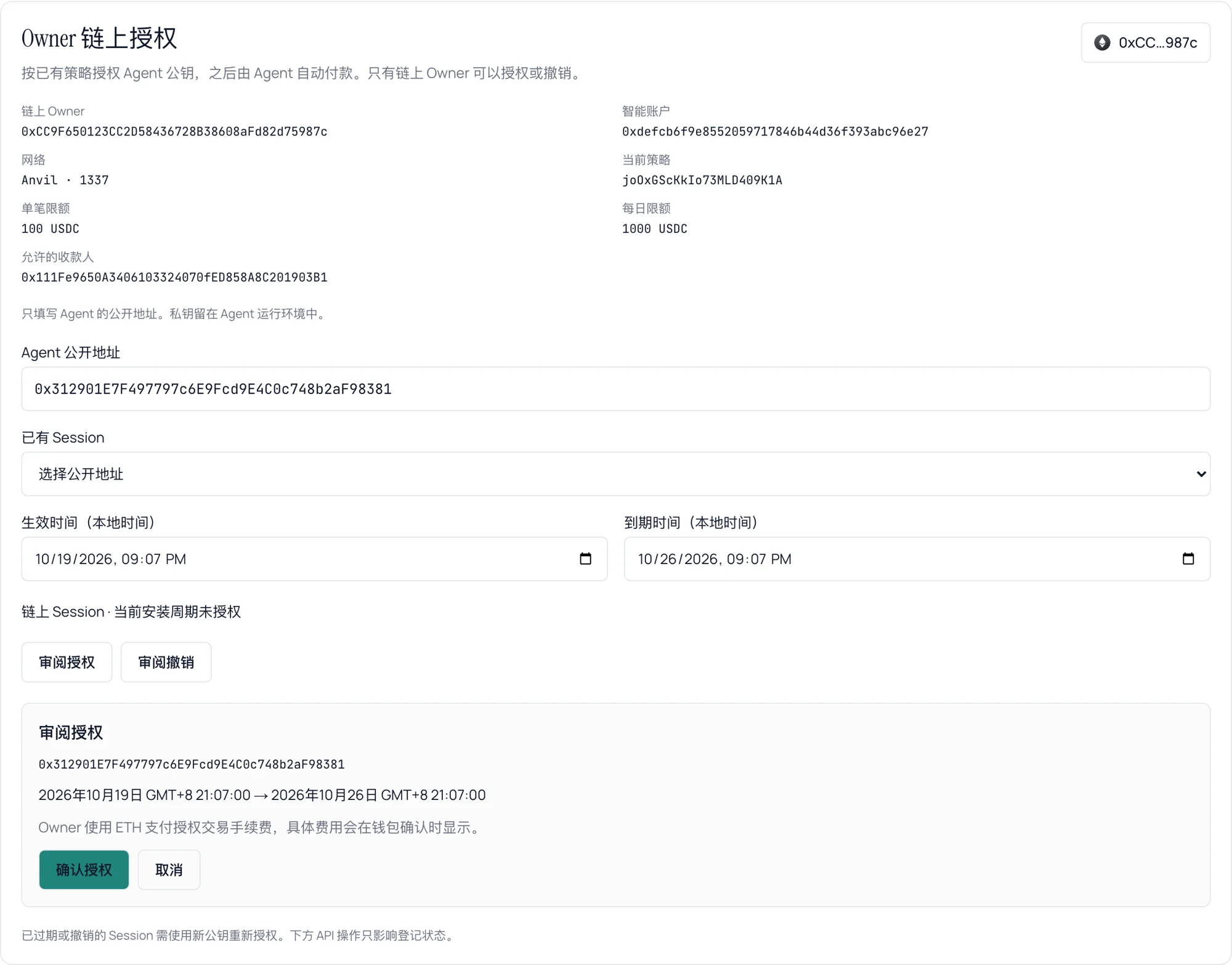
In the prototype, the Owner reviews the smart account, existing policy and Agent public address before granting a time-bounded Session. A Session associates that address with an authorization the Guard can check. The Agent private key stays in its own execution environment. The Owner does not import it or sign every subsequent Agent payment.
Your integration brief should settle the following choices before implementation.
| Decision | What your team needs to specify |
|---|---|
| Account and network | The smart-account implementation, target chain and payment asset. Compatibility must be checked for that combination. |
| Spending policy | The maximum per payment, the cumulative budget period and allowed recipients. Identify who may change these rules. |
| Authorization lifetime | When the task starts, when authority expires and who can revoke it early. |
| Agent runtime | Where the signer runs, how its key is stored and who handles rotation or a compromised runtime. |
| Service ownership | Who monitors pending operations and failed synchronization, and who can respond when the Owner is unavailable. |
The current demonstration authorizes against an already configured local policy. A policy-creation workflow, production organization permissions and your preferred key-management setup need their own scope. A spending policy also cannot decide whether a dataset was worth buying. That belongs to the task logic and review process you build around payment.
Ask where a rejected payment was stopped
The October 19, 2026 demonstration records a successful payment of 1 MockUSDC. The recipient balance increased by that amount, the smart-account balance decreased, and Guard spending and the operation nonce changed consistently. The API recorded one corresponding success.
The same exercise submitted a request for 101 MockUSDC against a single-payment limit of 100. It was rejected during API preparation, with no change to balances, Guard spending or nonce. That result demonstrates the API check in this exercise. It should not be presented as a separate proof that this over-limit request reached and was rejected by on-chain validation.
When evaluating an implementation, ask for the operation and the layer that rejected it. An API response, a bundler validation result and a completed transaction answer different questions. Ethereum's account abstraction overview explains the broader use of programmable account rules; the results here refer specifically to Agent Wallet Guard's recorded local workflow.
Include revocation in the acceptance criteria
An Owner needs a way to end the Agent's authority when a task finishes. Acceptance should include an operation prepared before revocation and submitted afterward, as well as a new request made after revocation.
The local demonstration covers both. After the Owner's revoke transaction, the API refused to prepare another payment for that Session. A correctly signed operation prepared earlier was also submitted directly to the Alto bundler and rejected during Guard validation. Balances, spending and nonce remained unchanged across those rejection checks.
In the same Guard installation cycle, a revoked public key cannot simply be enabled again. A new authorization requires a new public key. Plan that rotation alongside the Agent runtime. Revocation does not undo payments already completed, so support and reconciliation still need the earlier payment records.
Treat chain confirmation and API registration separately
Authorization can succeed on-chain while the application fails to register it. Sending another authorization transaction immediately would make the state harder to understand.
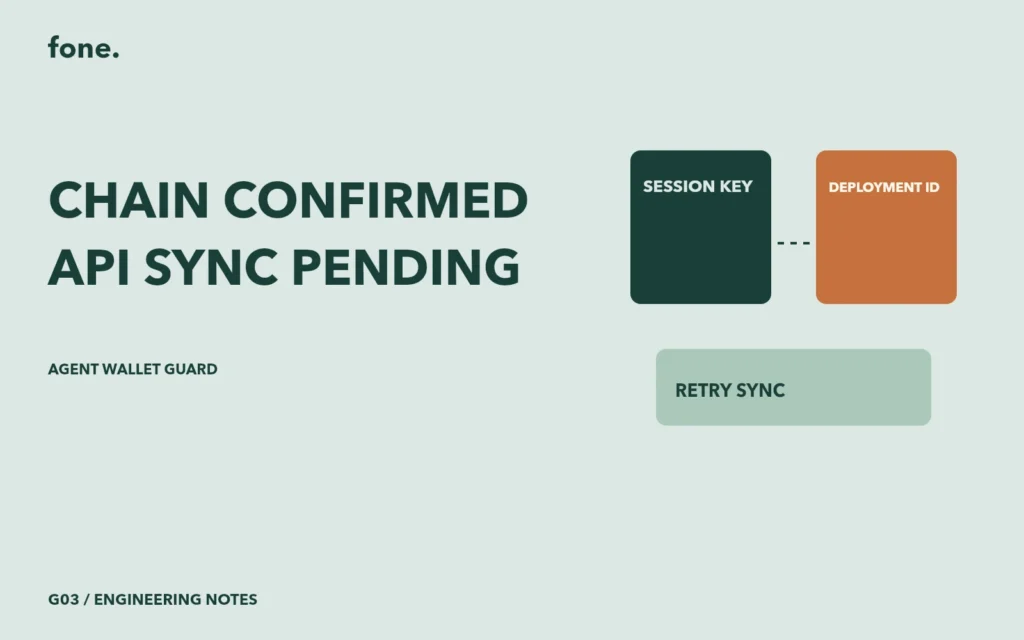
In a recorded fault-injection exercise, a registration request returned HTTP 503 after the authorization transaction succeeded. The interface retained the distinction between chain confirmation and pending API synchronization. Reloading recovered the operation summary; retrying completed registration without sending another authorization transaction. The evidence records one Session and one Owner grant transaction.
This is a useful behavior to include in your own acceptance plan. Agree on what the interface should say, which transaction reference support can inspect and which step a retry actually repeats. The prototype's recovery record is bound to its local deployment and account context; a new network integration needs its own verification.
What is ready to demonstrate, and what needs integration work?
The existing demonstration connects Owner authorization, an independent Node signer and smart-account execution through the API, Alto and EntryPoint. It includes payment records, revocation and recovery after a synchronization failure. The evidence comes from a local chain and an isolated transaction wallet bridge, not a real browser-wallet extension test or a production security audit.
Connecting an LLM, buying from a real provider and operating a hosted Agent service are additional work. Production deployment also needs decisions about account compatibility, key custody and monitoring. Gas sponsorship and a human approval workflow were not validated in this demonstration and should not be assumed to be included.
If you are planning an integration, explore Agent Wallet Guard and its integration scope. For a useful first conversation, send the task your Agent should perform, the target network and your permission requirements. Those details let us identify which parts of the prototype apply and what your project still needs.