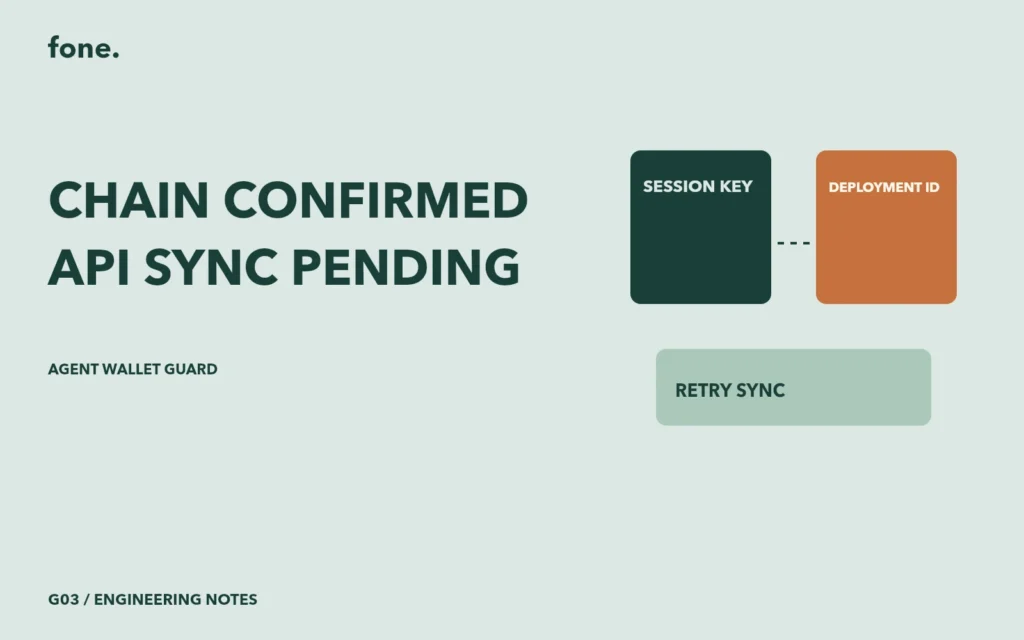
An authorization can succeed onchain while its API registration fails. The recovery action should preserve the authorization already granted and reconcile the missing server record against current chain state. Asking the Owner to authorize again creates another operation without resolving what happened to the first one.
Agent Wallet Guard's historical local demonstration deliberately returned HTTP 503 for one registration request after an authorization transaction succeeded. The interface showed chain confirmation and pending API synchronization separately. After a refresh, retrying synchronization registered one Session while the Owner authorization transaction remained a single transaction. This was a local fault-injection demonstration, not a customer outage.
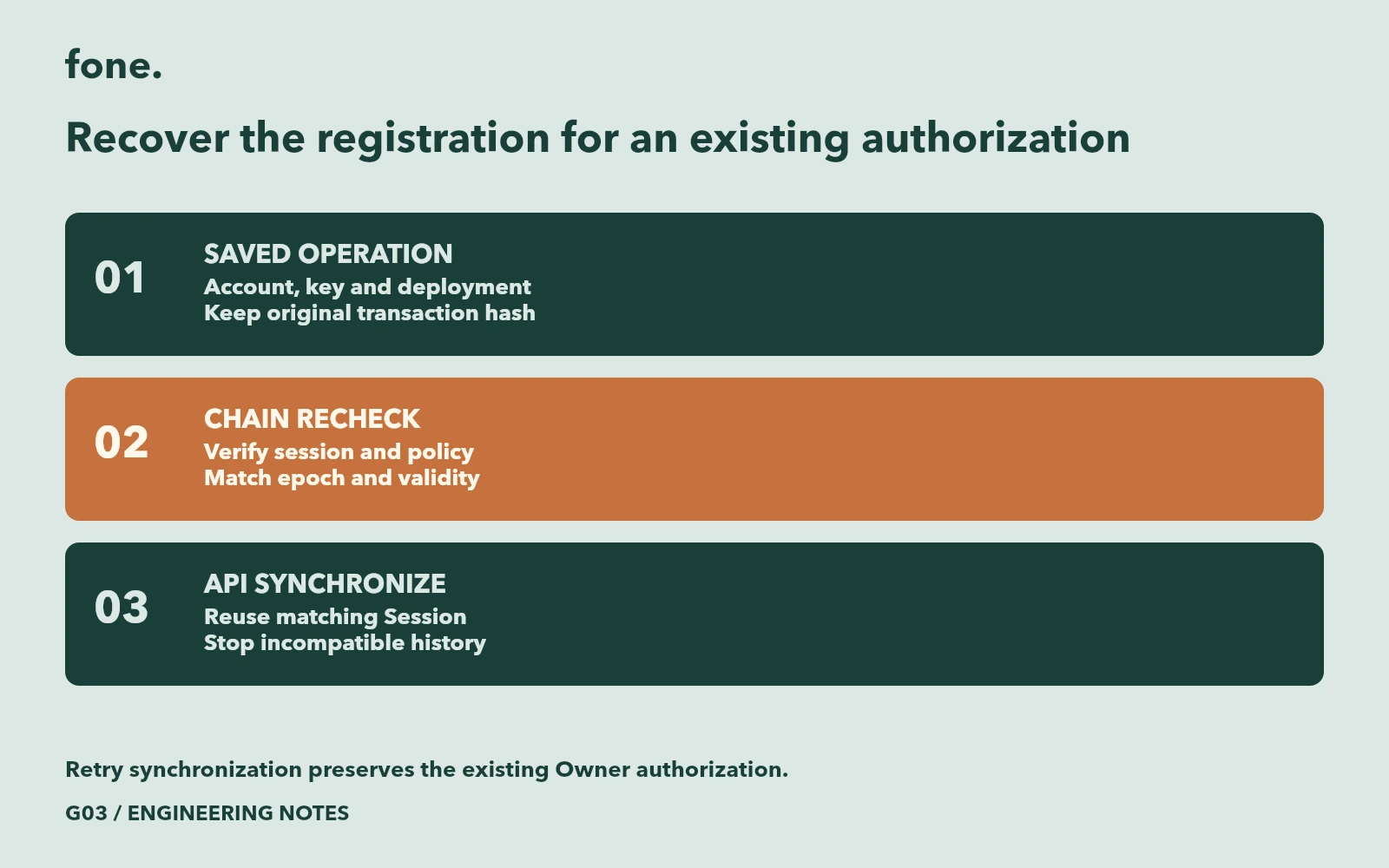
Save the operation before losing the page
The current frontend recovery record contains the chain ID, deployment identity and account, along with the Guard, Agent and session-key address. It also keeps the grant or revoke action, policy details, validity window and transaction hash. Replacement metadata can retain an original hash and nonce when relevant.
Those fields give recovery enough context to reject an unrelated environment. The local schema is specifically scoped to chain 1337. Matching a chain ID alone would be insufficient after restarting a local chain with a new deployment, so the recovery comparison also checks deployment identity and contract addresses.
A durable browser record is still only a recovery hint. It can identify the operation to inspect, but it cannot establish that the authorization currently exists. The page needs a fresh chain read before presenting an active grant or a completed revocation.
Reconcile the state the API will register
The synchronization endpoint loads the Agent's current authorization context. It reads the session from the Guard and checks that the Guard is installed, the session belongs to the current installation epoch, and the Agent identity and expected status match.
For a grant, the API also compares the policy and validity window with the intended operation. It refuses synchronization if the active policy or resource state no longer fits. That makes a changed authorization an explicit conflict instead of quietly recording whichever values a retried browser request supplies.
Transaction evidence remains useful for explaining how the state arose. Ethereum's JSON-RPC API exposes transaction receipts with status and block information, while an unavailable receipt must be interpreted with other state. A saved hash by itself does not establish success or finality. This article's recovery flow relies on the product's current authorization checks, alongside its local transaction evidence.
| Chain observation | Server observation | Recovery action |
|---|---|---|
| Matching active session | Registration absent | Synchronize that session |
| Matching active session | Same session present | Return the existing registration |
| Different policy or validity | Older browser recovery record | Stop and show a conflict |
| Matching revoked session | Server still active | Synchronize revocation |
| Deployment identity changed | Old local operation retained | Keep it separate from the new deployment |
Serialize competing registrations
Two open tabs may retry the same synchronization. The repository uses a transaction-scoped lock based on organization, account and key address. It looks for matching Session history and rejects multiple or incompatible records. A compatible existing record can be reused.
The repository also locks related resource and binding rows while rechecking the authorization. The endpoint reads the chain state again inside this process and rejects a change between checks. Audit entries are written when registration or revocation actually changes stored state. These source-level choices explain how repeated synchronization is intended to converge on one record.
They also expose an acceptance question worth keeping. A chain read and a database commit belong to different systems, so a deployment must decide how later chain changes are detected and displayed. The inspected synchronization endpoint does not justify a claim of universal transaction atomicity across both systems.
Make the recovery button describe its action
The page should offer Retry synchronization when the chain fact is established and the API record is missing. A new grant action belongs to a different decision. Show the account and session key next to the recovery action so an Owner can tell which authorization is being reconciled.
For review, deliberately interrupt registration after the chain transaction, refresh the page, and retry from two tabs. Confirm that there is one matching server Session and that synchronization sends no new authorization transaction. Repeat with a changed policy and a different local deployment identity to check that the old recovery record cannot silently attach to new state.
The downloadable steps are proposed review cases and remain Not run. They are separate from the recorded historical 503 demonstration and should be executed against the actual environment under review.
Download the authorization recovery steps and state matrix.
Agent Wallet Guard demonstrates the flow on a local chain with MockUSDC and an independent Node runner. Production login permissions and operational ownership should be specified before extending it beyond that scope.