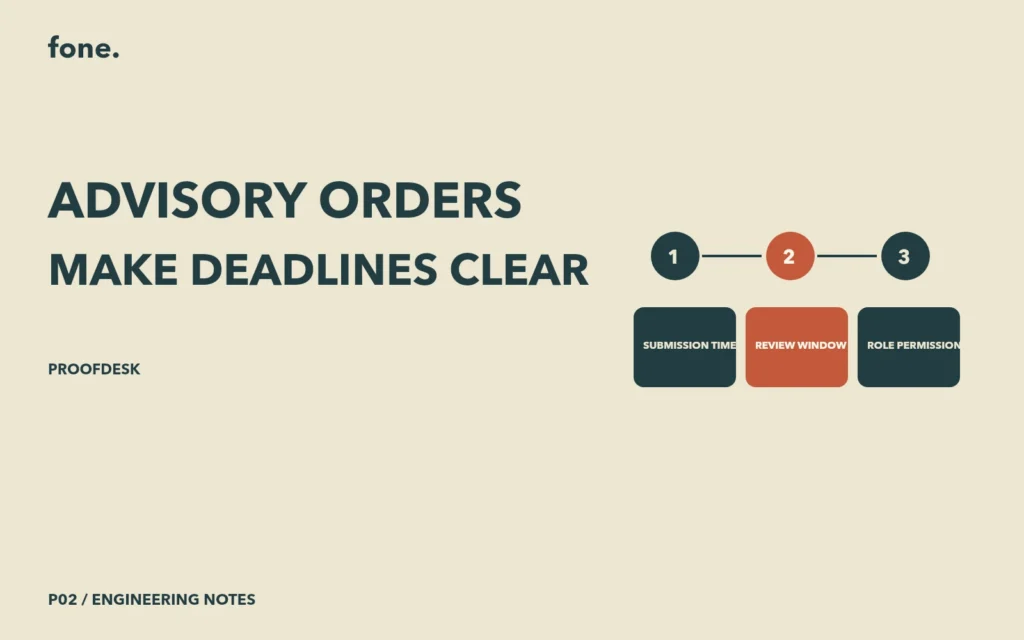
A paid advisory order should show the customer when the consultant must submit the document and when the order can reach a final state. Those timestamps serve different purposes. Combining them into one countdown makes it difficult to explain why submission is closed while another action is still unavailable.
Fone ProofDesk's local prototype stores an answer deadline, a resolution time and a dispute window. The inspected contract checks their relationship when an order is created and checks the current state again for later actions. The following review concerns software delivery rules with simulated consultants and test assets. It does not establish a production escrow service or unconditional refund policy.
Put each time on the order
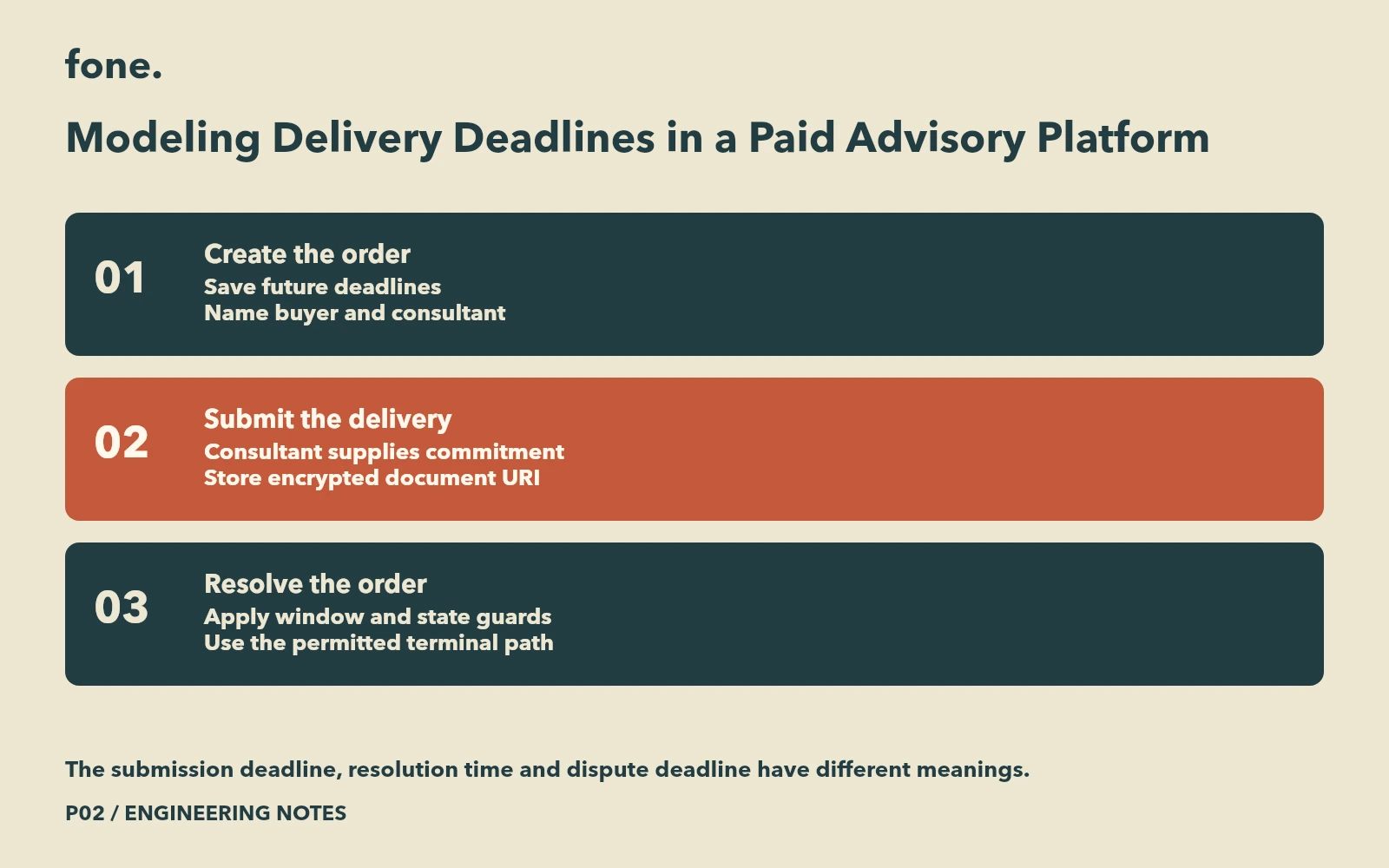
Creation requires the answer deadline and resolution time to be in the future, with the answer deadline no later than resolution. The consultant's submission must happen by the answer deadline and strictly before resolution. That second condition matters if the two timestamps were configured to be equal.
A submission records a nonzero answer commitment and a nonempty encrypted delivery URI. Only the named consultant may submit, and the order must still be in its created state. The code then changes the state to answered and calculates the dispute deadline from resolution time plus the dispute window.
The URI identifies where the encrypted answer is represented. Acceptance of a nonempty URI alone does not establish that the customer has successfully downloaded and decrypted a readable document. A delivery interface should show those as separate facts. Any added requirement for customer acknowledgment would need a separately designed state transition.
| Boundary | Observed condition | Interface consequence |
|---|---|---|
| Answer deadline | Submission rejects times later than it | Show an exact date and timezone |
| Resolution time | Submission must precede it | Do not imply delivery remains open at equality |
| Unanswered cancellation | Buyer acts after answer deadline in created state | Explain why an answered order uses another path |
| Dispute deadline | Derived after submission | Show the applicable review window |
| Final settlement | Answered state and expired dispute window | Recheck additional result requirements |
Give each role its own actions
The buyer can cancel an unanswered order after its answer deadline. The contract requires the buyer's address and created state before returning the order amount. A consultant who already submitted a document changes which path is available. A late customer complaint cannot be described as the same operation as cancellation for non-delivery.
The protocol also has structured reveal paths associated with the order's external condition. Those paths use commitments and result checks. A general advisory product may need other acceptance or dispute rules, particularly where the quality of a written explanation requires human judgment. That would be additional scope rather than a capability established by the current result comparison.
The settlement function operates on answered orders after the dispute deadline. For the source's price-result branch, it also requires a stored result snapshot. These checks show why a button should be derived from current state and applicable conditions instead of being enabled solely because a countdown reaches zero.
Check equality and delayed transactions
Deadline reviews should include the instant before a boundary, the boundary itself and the instant after it. The inspected submission and cancellation checks use different inequalities. At the answer deadline, a submission can still satisfy its deadline check if it also precedes resolution, while unanswered cancellation requires a later timestamp.
A browser estimate is useful for explanation but cannot decide the final outcome of a transaction. The contract evaluates its timestamp and state when execution occurs. Displaying an estimated remaining time should therefore be accompanied by the exact configured timestamp and a refreshed state after confirmation or rejection.
Pause controls add another operational dependency. The inspected delivery, cancellation and settlement functions are guarded by the contract's pause mechanism. An operator procedure needs to explain who responds during a pause and how customers receive updates. The code does not, by itself, establish an automatic extension of the saved order deadlines.
For procurement, ask for sample delivery forms and a role-by-role action table before selecting screen labels. Decide whether the service requires a customer acknowledgment, an external result or a human dispute review. Each choice changes the information that must be retained with an order.
The advisory order state worksheet includes boundary cases with their status left as Not run. Fone ProofDesk provides the corresponding local workflow. Bring the delivery format, reading-key recovery requirements and proposed deadline rules to discuss the implementation scope.