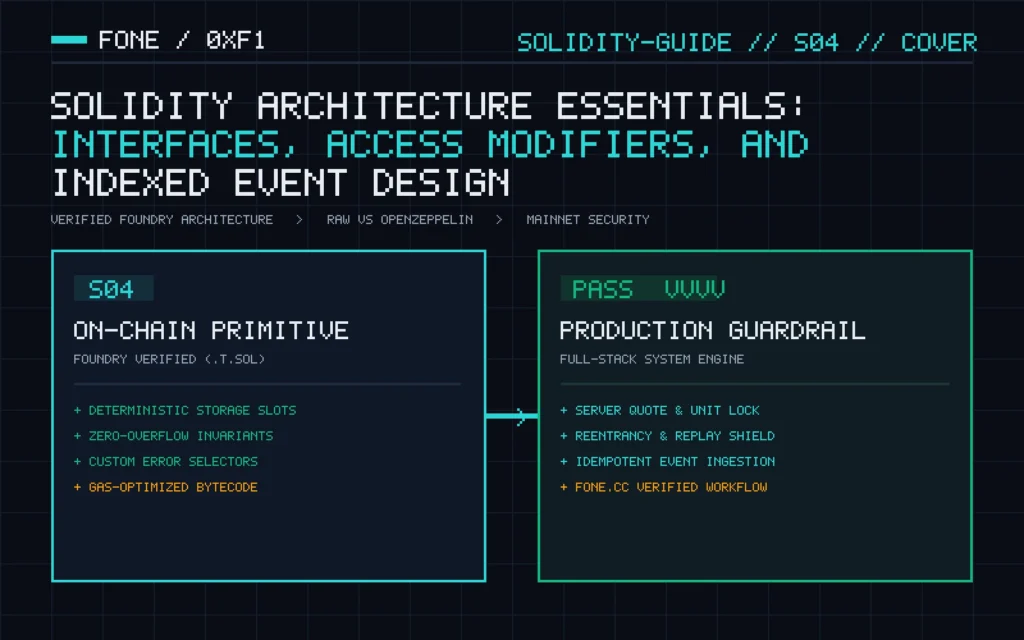
Summary: Monolithic contracts create maintenance debt and security review risks. Modular Solidity development relies on three structural patterns: Interfaces decouple external protocol calls without copying bytecode. Modifiers centralize access control and emergency circuit breakers around state-mutating functions. Events emit cryptographic logs stored in transaction receipts and indexed in block headers, giving off-chain systems a reliable stream of state changes at a fraction of the cost of persistent storage. This guide covers interface decoupling, modifier execution order, and indexed event design using Foundry tests.
1. Modular Architecture: Interfaces, Libraries, and Inheritance
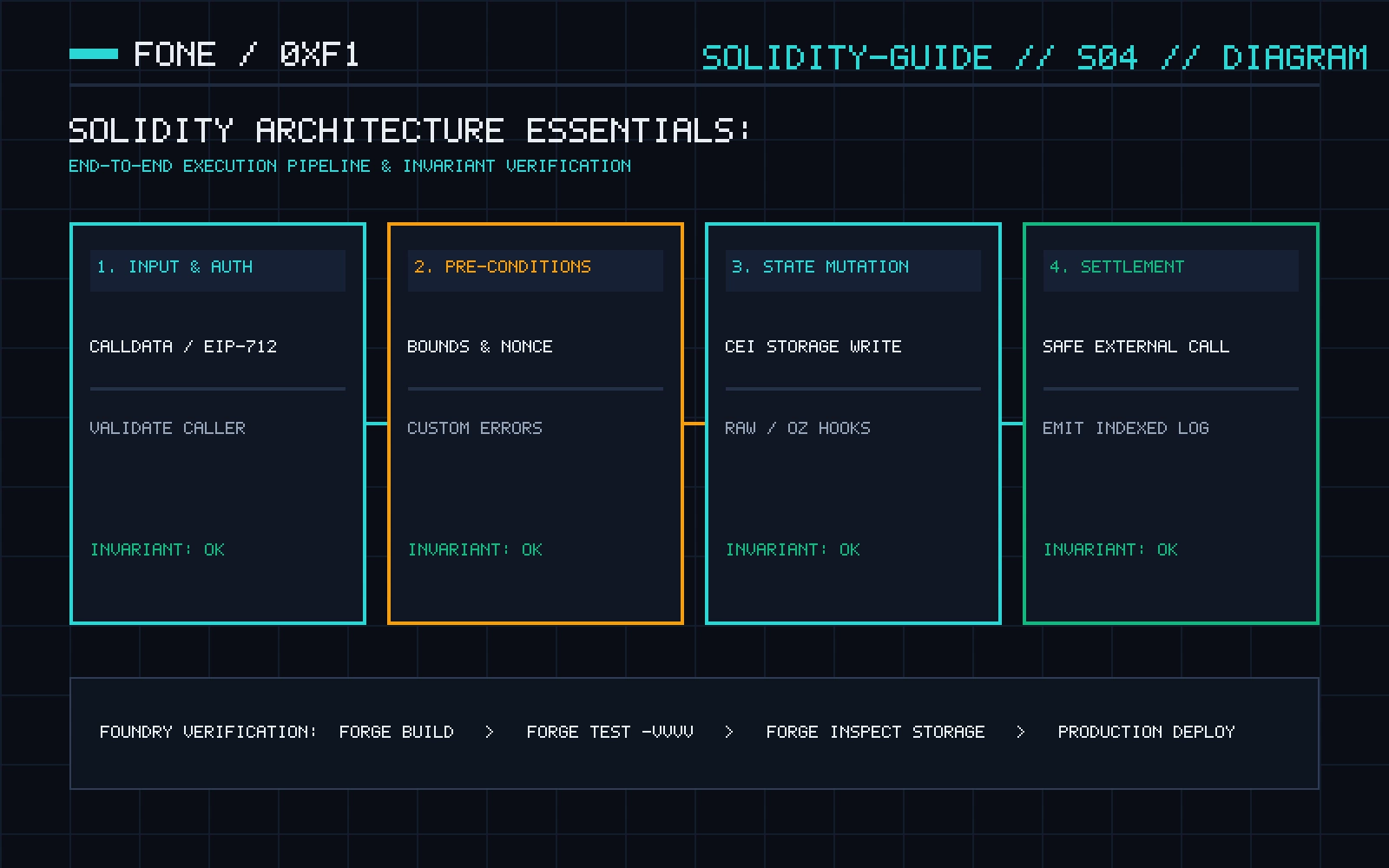 Execution lifecycle: validating pre-conditions before code execution and emitting gas-efficient bloom filter logs upon state changes.
When contracts interact on-chain, importing full contract bytecode introduces bloat and rigid coupling. Solidity provides three distinct mechanisms:
+----------------------------------------------------------------------------------------------------+
|                                      MODULAR ARCHITECTURE TIERS                                    |
|                                                                                                    |
|  [ INTERFACES (interface IERC20) ]                                                                 |
|  * Function signatures and events only; no state variables, no implementations.                    |
|  * Used for: Protocol composability and cross-contract interactions.                               |
|                                                                                                    |
|  [ LIBRARIES (library SafeERC20) ]                                                                 |
|  * Stateless helper functions; cannot hold ETH or storage state.                                   |
|  * Used for: Reusable algorithms and safe wrapper functions.                                       |
|                                                                                                    |
|  [ INHERITANCE (contract Token is Ownable, Pausable) ]                                             |
|  * Shared storage layout and internal function reuse via virtual/override.                         |
|  * Used for: Base primitives and framework extensions.                                             |
+----------------------------------------------------------------------------------------------------+
1.1 Interface Rules:
- Always
external: Functions in aninterfacemust be declaredexternal. - Compile-Time Type Safety: Calling
IERC20(tokenAddress).transfer(recipient, amount)provides compiler checks on argument names and types. - ERC-165 Support: Protocols frequently implement
supportsInterface(bytes4)to verify contract capabilities before calling.
2. Guardrails with Modifiers
A modifier wraps pre- and post-execution checks around a function, centralizing recurring validations like onlyOwner or whenNotPaused.
This example adapts the SecureContract in Solidity-Guide. The example adds an owner-only unpause() function so you can see how the same modifier protects both state changes.
// SPDX-License-Identifier: MIT
pragma solidity ^0.8.35;

error NotOwner();
error NotAdmin();

contract SecureContract {
    address public owner;
    mapping(address => bool) public admins;
    uint256 public storedValue;
    bool public paused;

    // Checks caller before entering function body
    modifier onlyOwner() {
        if (msg.sender != owner) revert NotOwner();
        _; // Function body runs here
    }

    modifier onlyAdmin() {
        if (!admins[msg.sender]) revert NotAdmin();
        _;
    }

    // Emergency circuit breaker
    modifier whenNotPaused() {
        if (paused) revert("Paused");
        _;
    }

    constructor() {
        owner = msg.sender;
        admins[msg.sender] = true;
    }

    function addAdmin(address _addr) external onlyOwner {
        admins[_addr] = true;
    }

    function removeAdmin(address _addr) external onlyOwner {
        admins[_addr] = false;
    }

    function pause() external onlyOwner {
        paused = true;
    }

    function unpause() external onlyOwner {
        paused = false;
    }

    // Stacking modifiers: onlyAdmin executes first, then whenNotPaused, then body
    function setValue(uint256 _value) external onlyAdmin whenNotPaused {
        storedValue = _value;
    }

    function getValue() external view returns (uint256) {
        return storedValue;
    }

    function withdrawAll() external onlyOwner {
        payable(owner).transfer(address(this).balance);
    }
}
2.1 The _; Placeholder and Execution Order
- Statements before
_;run as pre-conditions. - The
_;marks the exact point where the decorated function body executes. - Statements after
_;execute as post-conditions (such as releasing a reentrancy lock).
When multiple modifiers are declared on a function:
function setValue(uint256 _value) external onlyAdmin whenNotPaused { ... }Execution runs from left to right: 1. onlyAdmin pre-checks. If invalid, the call reverts. 2. whenNotPaused pre-checks. 3. The function body runs (storedValue = _value). 4. Any post-conditions in whenNotPaused run. 5. Any post-conditions in onlyAdmin run.
3. Emitting Event Logs
Contracts cannot issue external HTTP requests or write to off-chain storage. Instead, they emit Events.
Events are written to transaction receipts and incorporated into block headers via the log bloom filter. Off-chain indexers listen for these logs to update application state.
3.1 Indexed Topics vs. Data Payloads
Solidity allows up to three parameters to be marked indexed:
event Transfer(address indexed from, address indexed to, uint256 value);In the EVM log entry: – Topic 0: Hash of the event signature: keccak256("Transfer(address,address,uint256)"). – Topic 1: The from address. – Topic 2: The to address. – Data Payload: The unindexed value amount.
Indexed topics allow external indexers to query logs by topic filter (e.g., all transfers where to == userAddress) without scanning entire transaction bodies.
3.2 Gas Profile: Events vs Storage
A log gives an indexer something to read from the transaction receipt. A storage write leaves a value that the contract can read in a later call. Use a log for an off-chain record and storage for state the contract needs later. Log cost depends on the number of topics and the size of the data. Storage cost depends on the slot’s values and whether the transaction has already accessed that slot.
EIP-2200 · EIP-2929 · Solidity ABI event specification
4. Testing Modifiers and Events in Foundry
Foundry provides two essential cheatcodes for access control and event testing: vm.prank() and vm.expectEmit().
From foundry_projects/03_core/12_Modifier/test/12_Modifier.t.sol:
// SPDX-License-Identifier: MIT
pragma solidity ^0.8.35;

import {Test} from "forge-std/Test.sol";
import {SecureContract, NotAdmin, NotOwner} from "../src/12_Modifier.sol";

contract SecureContractTest is Test {
    SecureContract public target;
    address public owner = address(this);
    address public admin = address(0x1);
    address public stranger = address(0x2);

    function setUp() public {
        target = new SecureContract();
        target.addAdmin(admin);
    }

    function testAdminCanSetValue() public {
        vm.prank(admin); // Mocks msg.sender = admin for the immediate next call
        target.setValue(200);
        assertEq(target.storedValue(), 200);
    }

    function testStrangerCannotSetValue() public {
        vm.prank(stranger);
        vm.expectRevert(NotAdmin.selector); // Verifies custom error revert
        target.setValue(300);
    }

    function testPausedBlocksAdmin() public {
        target.pause();

        vm.prank(admin);
        vm.expectRevert("Paused");
        target.setValue(400);
    }
}
4.1 Checking Event Logs with vm.expectEmit
vm.expectEmit(checkTopic1, checkTopic2, checkTopic3, checkData) tells Forge which event fields to assert.
This fragment assumes the test already declares the Transfer event and has a token instance, a funded caller and a recipient named alice. For a standard ERC-20 Transfer, the first two indexed fields are the sender and recipient. The amount is checked as event data. Foundry checks the event signature separately.
function testTransferEventEmission() public {
    // Check the sender, recipient, and amount.
    vm.expectEmit(true, true, false, true);

    // Emit the expected event signature and values:
    emit Transfer(address(this), alice, 100 ether);

    // Call the function that emits the event:
    token.transfer(alice, 100 ether);
}
5. Implementation Gotchas
- Omitting
_;in Modifiers: Forgetting_;causes the function body to never execute, while the transaction appears to succeed. - Post-Condition Ordering: Placing logic after
_;in a modifier means external calls made in the body run before post-conditions, risking reentrancy if invariants are not restored first. - Over-Indexing: Marking more than 3 parameters as
indexedcauses a compilation error.
6. Production Systems Context
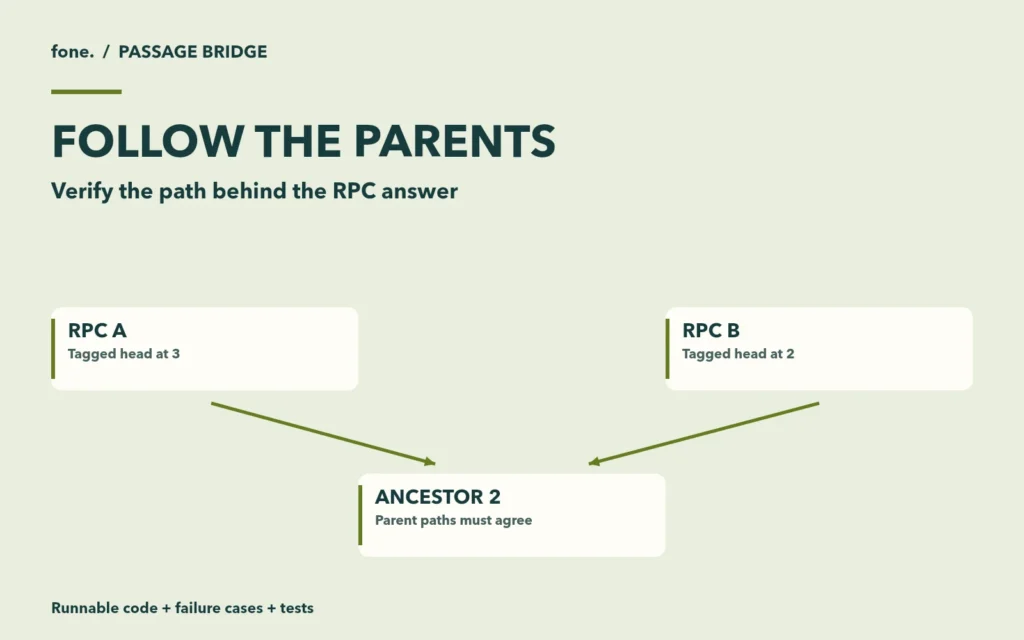
In production software built at Fone (0xF1): – Agent Wallet Guard (中文版): Expands modifier checks into dynamic, revocable session keys that enforce daily spending caps and allowlist filters on AI agents (see Testing Agent Wallet Revocation with Signed Operations). – Passage Bridge (中文版): Uses indexed event logs (SourceChain, DestChain, MessageNonce) to drive the off-chain review and relayer pipeline (see Binding Cross-Chain Messages to Their Execution Context). – NOVA Membership (中文版): Replaces static modifiers with a staged rule simulation engine before changes go live on-chain.
Explore working products on the Fone Products Center (中文版) or review engineering case studies on Fone Insights.
Verify It Locally with Foundry
Run the modifier tests in the Solidity-Guide repository. The tests cover owner and admin permissions, rejection of a caller without access, and blocked updates while the contract is paused. The transfer-event example above is separate from this module.
# 1. Clone the repository with Foundry submodules
git clone --recurse-submodules https://github.com/fonecc/Solidity-Guide.git
cd Solidity-Guide

# 2. Run the verified Foundry test suite for this module
cd foundry_projects/03_core/12_Modifier && forge test -vvv
Expected local verification output:
[PASS] testAdminCanSetValue()
[PASS] testOwnerCanAddAdmin()
[PASS] testOwnerCanSetValue()
[PASS] testPausedBlocksAdmin()
[PASS] testStrangerCannotSetValue()
Suite result: ok. 5 passed; 0 failed; 0 skipped
Frequently Asked Questions (Technical FAQ)
How many parameters can be marked indexed in a Solidity event?
A standard Solidity event supports up to 3 indexed parameters. In the EVM log structure, topic[0] holds the keccak256 hash of the event signature, leaving topic[1], topic[2], and topic[3] for indexed filter fields.
What happens if an indexed event parameter is a string or bytes array?
Because each EVM log topic is strictly 32 bytes wide, dynamic types (string, bytes, arrays, structs) marked indexed are not stored verbatim in the topic—instead, the EVM stores their keccak256 hash, meaning off-chain indexers cannot recover the original string from the topic alone.
Does placing code before and after _; in a modifier increase bytecode size?
Yes. The Solidity compiler inlines the modifier body directly around every function that uses it. If a complex modifier is attached to 20 functions, wrapping its pre/post validation logic inside an internal helper function avoids duplicating bytecode 20 times.
Series & Related Engineering Guides
- Previous Lesson (S03): Mastering EVM Data Locations: Storage, Memory, Calldata, and Mapping Layouts in Solidity
- Next Lesson (S05): Low-Level EVM Calls in Solidity: ETH Transfers, Call vs. Delegatecall, and ABI Selectors
- Companion Security & Architecture Deep-Dive (T08): The Practical Foundry Testing Cheat Sheet: Mastering vm.prank, expectRevert, vm.sign, and Time Manipulation
- Production Engineering Case Study: Versioning Business Rules in a Membership Platform
- Open-Source Codebase: fonecc/Solidity-Guide (
foundry_projects/03_core/12_Modifier) - Commercial Platforms & Advisory: Fone Products Center (中文版) | Fone Services | Contact Engineering